


While the main cause of these vitamin deficiencies may be inadequate dietary intake or malabsorption, various other factors such as gender, age, genetics, ethnicity, and sociocultural background may also affect their status
Release date – 06:20 AM, Monday – July 10

Hyderabad: Researchers from various national research organizations, including the National Institute of Nutrition (NIN) in Hyderabad, conducted an all-India study to bridge the prevalence of vitamin B12 and (folate) FA deficiency among Indian children and adolescents A key information gap study showed that about one third (33%) of adolescent boys in India may be deficient in B12 and FA.
Published June 21 in MDPI’s open-access peer-reviewed journal Nutrients, the study involved 1,05,243 children and adolescents (ages 10 to 19), including 31,058 preschoolers, 38,355 school-age children and 35,830 adolescents. .
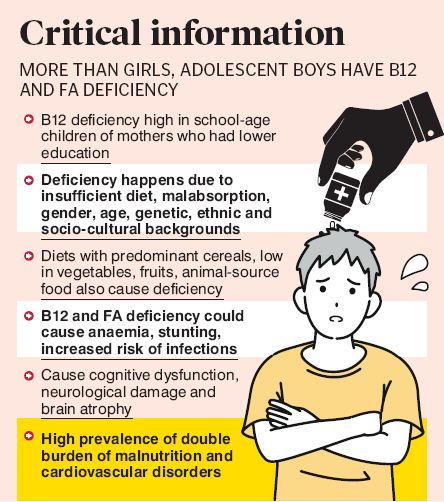
“Vitamin B12 and FA deficiencies were more prevalent in adolescents (31%) than in school-age children (17.3%), followed by preschool children (13.8%). Prevalence was significantly higher in adolescent boys compared to girls, respectively 8% and 5%. Our study bridges a key information gap on the prevalence of vitamin B12 and FA deficiency among Indian children and adolescents. However, the prevalence is lower among younger cohorts. These findings are important for nutrition policy in India ,” said the research team, which included Dr. G Bhanuprakash Reddy, a senior scientist from NIN.
Folate deficiency occurs when the blood lacks vitamin B9 (folic acid) needed to function properly, while vitamin B12 deficiency in the body can lead to a reduction in healthy red blood cells (anemia).
While the main cause of these vitamin deficiencies may be insufficient dietary intake or malabsorption, various other factors such as gender, age, genetics, ethnicity, and sociocultural background may also affect their status.
The prevalence of FA was higher among participants with unimproved drinking water, the researchers said.
