

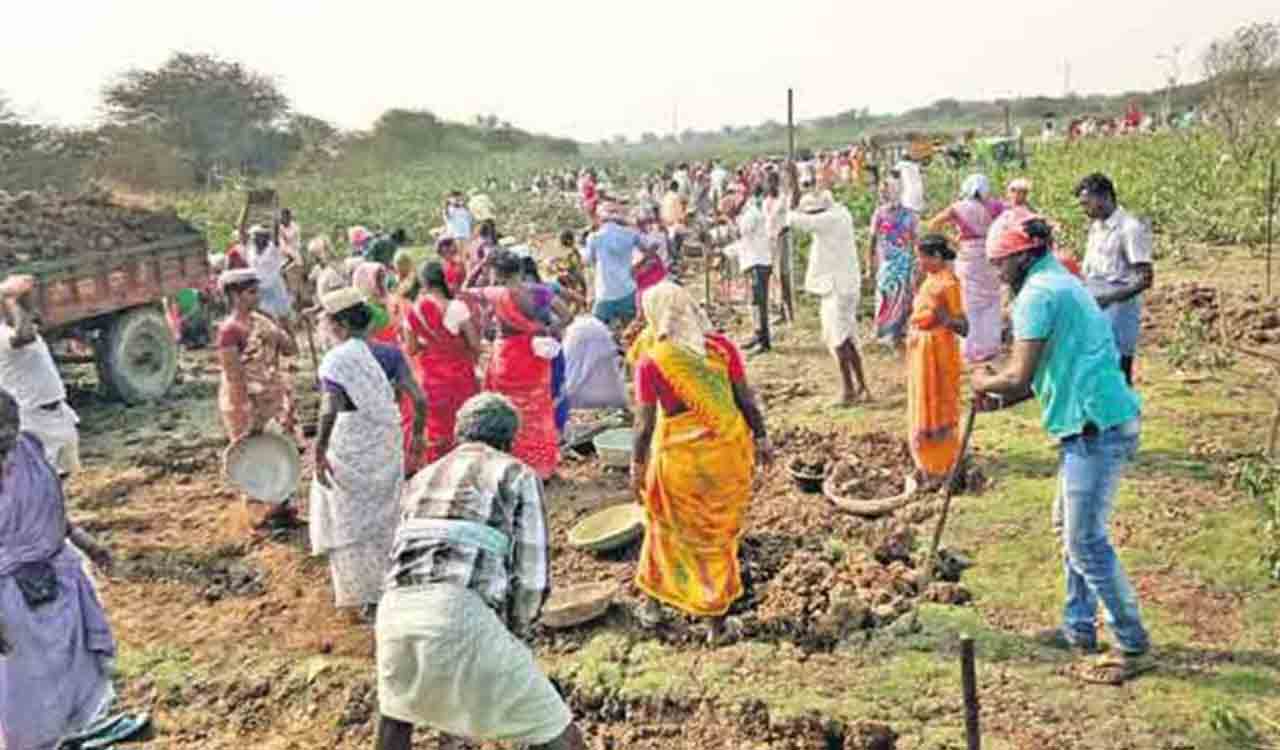
A new order from the federal government now threatens to affect the implementation of works under the state’s scheme.
Post Date – 11:30 PM, Wednesday – 1/4/23

Hyderabad: A new order from the coalition government now threatens To influence work to be done in the State under the program.
The new directive, issued by the Ministry of Rural Development Unions late last month and enforced from January 1, mandates the digital capture of attendance of workers employed under MGNREGS. The center touts the move as an attempt to curb corruption and irregularities, but appears to have many deficiencies, including on-site supervisors not equipped with smartphones, and a lack of technical or logistical support and internet connectivity.
Except for “individual beneficiary schemes/projects”, all workplaces must register attendance on the mobile application National Mobile Monitoring System (NMMS), regardless of the number of workers employed, the center’s directive said. This entails uploading time-stamped and geotagged photos of workers twice a day.
The center launched a pilot program for this purpose on May 16 last year, citing problems with corruption, accountability and duplication of rosters. Although several issues, including technical glitches, were brought to its attention, the center decided to continue expanding the NMMS to a nationwide implementation rather than addressing these issues.
Telangana tops the list of states with the highest number of working days per capita since the state’s inception. In terms of man-days generated from April to September this year, Telangana generated 9.92 crore man-days during the six-month period this year. Officials are concerned that the center’s latest directive could affect overall staff days.
“We have flagged several technical and sociological issues related to the use of the app. We are concerned that this will deter workers from participating in the MGNREGS project, which will affect its implementation in the state,” a Rural Development Department official told Telangana Today.
Geographically tagged and time-stamped photos of workers are taken on site twice a day to check for fake attendance, according to officials. However, this requires workers to remain on site before being photographed. During the pilot program, poor internet connectivity and technical errors repeatedly affected obtaining attendance numbers online.
In addition, the system has become more complex, with officials needing to match hundreds of photos of workers taken on site each day with those on their job cards, which is considered nearly impossible. Workers were also forced to work a specified number of hours, contrary to the original goal of the MGNREG Act, which enabled workers to be paid on a piece-rate rather than hourly basis.
Several organizations, including the People’s Action for Employment Security (PAEG), which has been advocating MGNREGA since 2004, have been disputing the centre’s decision, saying it will not eradicate corruption and will only discourage workers from taking jobs.
To add insult to injury, the app was designed entirely in English and offered no technical assistance to resolve several issues faced by users. In the event of a technical failure, workers have no choice but to go home as attendance cannot be registered.
Telangana’s MGNREGS has been in the news lately, late last year when the coalition government sent a notice to the state government to return Rs 1.519 crore of MGNREGS funds that were used to build dry platforms under the scheme, saying they were not allowed under the central planning guidelines. The state called the center’s move more retaliatory because it allowed states with coastlines to build fish-drying platforms under the same program.
