


A good economic order must combine elements of classic capitalism with classic socialism, making it economically diverse.
Post Date – 12:40 AM, Friday – 1/6/23

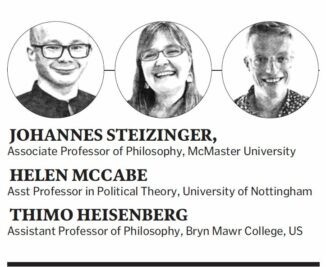
Johannes Steizinger, Helen McCabe, Thimo Heisenberg
Hyderabad: The economy keeps hitting the headlines for all the wrong reasons — stories about rising prices, supply shortages and a looming recession have been making the front pages quite often lately.
The current economic crisis is deepening long-standing social inequalities and widening the gap between rich and poor—a problem already exacerbated by the 2008 Great Recession and the economic shock of the Covid-19 pandemic.
The United States, the richest country in the world, is one of the most extreme examples of this trend. Today, US CEOs earn 940% more than their counterparts in 1978. On the other hand, the average worker goes home earning only 12 percent more than the worker did in 1978.
As a report by the Economic Policy Institute shows, rising CEO pay does not reflect changes in the value of skills—it represents a shift in power. For decades, American politics has weakened workers’ bargaining power by preventing and hindering self-organizing efforts such as unionization.
Increased wealth by the few at the expense of the many means that power is concentrated in the hands of the few, mainly men. Not surprisingly, figures such as Donald Trump, Mark Zuckerberg, and Elon Musk have had a disproportionate impact on our communities—sometimes with devastating consequences that threaten our democratic institutions.
find alternatives
Now more than ever, it is necessary to re-examine the foundations of our economic order. However, traditional mindsets make finding alternative economic models difficult.
Many people believe that we are facing a stark choice between a capitalist market economy on the one hand and a socialist planned economy on the other.
Although we live in a world where economic models are defined in absolutist terms, it doesn’t have to be. We believe that the perspectives on economic psychology and sociology developed by 19th-century philosophers such as Georg Wilhelm Friedrich Hegel, Johann Stuart Mill, and Georg Simmel can help us reimagine economics. human face.
These thinkers firmly believed that a good economic order must combine elements of classical capitalism, such as free markets for goods and services, with elements of classical socialism, such as collective ownership of the means of production. This is what we call economic diversification.
affluence problem
Hegel is a good example of an economic pluralist thinker. In his “Philosophy of Law” of 1820, he reflected extensively on modern economics. He discusses markets and how they work, social inequalities, and even desires shaped through advertising and consumer culture.
Among the many topics he studies is the issue of affluence. Hegel worried not only about the poverty caused by the modern market economy, but also about the concentration of extreme wealth in the hands of a few.
Hundreds of years before the appearance of the modern billionaire, Hegel had already pointed out that “both aspects of poverty and affluence represent the scourge (Verderben) of civil society”.
Hegel’s analysis was even more prescient: He argued that affluence creates counter-intuitive tendencies among the wealthy, making them feel victimized and socially disenfranchised.
As a result, the rich see all social needs, such as taxes, as unwarranted violations of their personal liberty.
Hegel argues that this sense of victimization can lead to an unexpected connection between those at the top of the economic pyramid and those at the bottom of the economic pyramid—a connection that overcomes lifestyle differences and mutual aversions to form Coalition to attack civil society. Trump’s MAGA alliance phenomenon is an interesting modern example.
reimagine the economy
Unlike some later socialists, Hegel did not believe that the problem of affluence was best solved by introducing a planned economy that enforced equality of wealth. Instead, his approach is pluralistic.
He makes a case for combining free market transactions with a model of cooperative production that is in some ways similar to modern worker cooperatives.
Hegel argues that if most economic production in a society is organized cooperatively, wealthier subjects will participate with others in economic decision-making, replacing the harmful “pernicious” relationship between rich and poor with a collective identity based on shared economic institutions. Victim Bond”.
In reimagining our current economic order, we can draw on Hegel’s playbook, focusing on workers’ cooperatives: economic enterprises jointly owned by workers who often — though not always — work together democratically. productive decisions.
Under what conditions is this co-production model successful? How does the state incentivize these forms of production in existing market economies? Are these worker cooperatives really a way to achieve economic justice? These questions, inspired by the past, may help us imagine a new, pluralistic, more egalitarian and people-centred economic future.
www.theconversation.com
