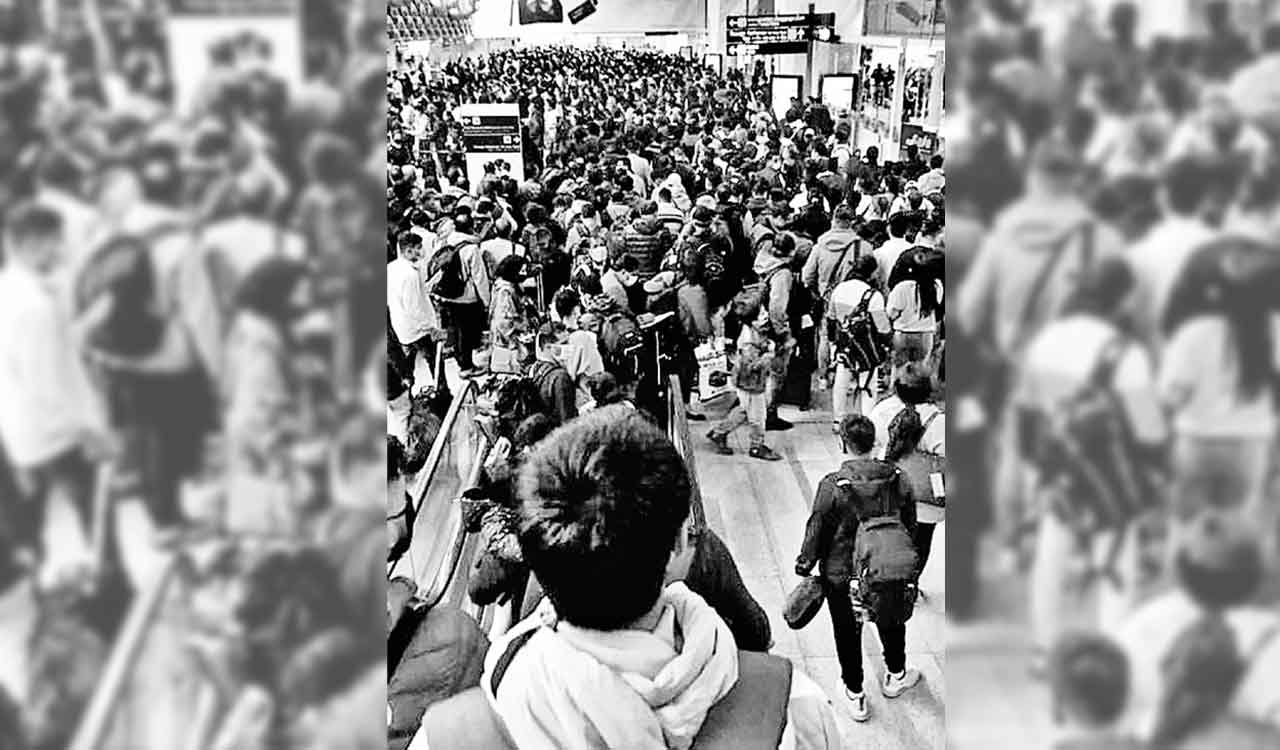
If it doesn’t work, what good is winning the “Best Airport” or “Busiest Airport” trophy?
Post Date – 12:40 AM, Sat – 1/7/23
SOME VENKATA SOUNDS
Hyderabad: From a passenger perspective, Indian aviation is now reduced to a daily spectacle. The recent chaos at Delhi International Airport (DIAL) due to overcrowding and passenger complaints, along with frequent and unreported incidents at other airports, has created a problem. What exactly do passengers get from these airports in exchange for paying passenger terminal fees? Why isn’t anything being done to make travel less stressful?
What’s the use of winning trophies for “Best Airport” or “Busiest Airport” if they’re ineffective and dysfunctional? While some airports may be proud of receiving these awards, in reality, customers are screaming and voting with their feet.
revolution, reverse
Our flashy airports seem to herald a revolution, albeit to the contrary. When airports consume almost as much time as short- and moderate-distance road trips, flying becomes an avoidable annoyance. The country’s airport revolution is making ordinary people think: Is the 3 hours before departure worth the trouble of flying the domestic sector? Then there’s the usual flight delays; landing at your destination and battling city traffic, etc.?
These questions, which have become commonplace for air travelers, have many questioning the value of flying. In India, expect to spend more than half a day in the air. This is an unfortunate standard. By taking passengers’ time for granted and disrupting their schedules, airports are killing business and personal travel. All stakeholders must address this issue.
Depressed dream
Airport operators have turned a well-meaning aviation revolution into a dashed dream that’s worse for crowd control than an interstate bus terminal. It’s distressing and can easily catch someone’s flu or any other airborne illness if swirling groups of people gather in the same square foot space without adequate air circulation. What are India’s major airport operators doing despite mandatory Covid-19 distancing rules? Airport operators don’t seem to care much about it.
The irony of this situation is obvious: it’s fascinating how technology has advanced to the point where it can detect whether a person’s heart valve needs repair, while airport X-ray machines still require us to go through the rather old-fashioned process of removing items from out of carry-on luggage, not to mention our jackets, belts, etc. This blind check is an insult to any civilized procedure. Unfortunately, this is a form of public shaming that we all feel is necessary. The pallet handler has no knowledge of objects or electronics that must be properly handled.
Are we saying the deployed man and machine are so suspicious of each other’s capabilities that they want to double-check the passengers to see if they’re criminals on a mission? It questions the capabilities of humans and machines.
Snaking lines and tight spaces can give you a headache, but poor air circulation can make things worse. In the cold winter, it is easy to sweat in a jacket while queuing at Delhi airport. How does this benefit travelers flying out of the world’s best airport domestically? Furthermore, it’s not even good business sense to delay passengers, as it would throw into chaos the carriers’ valuable non-aeronautical revenue from retail shopping.
some solutions
Practical solutions, such as airline or destination prioritization and customs clearance in real time, will reduce stress for passengers. Passengers now seem to be responsible for making sure their flights are safe. Security personnel often don’t mimic the body language of people who need to move items quickly and on time.
Airlines should be able to own their own routes. Why make a passenger suffer because s/he is on a particular airline and is packed like sardines on other airlines’ flights that have peak capacity at that time? Essentially, why is there only one rabbit hole for every airline passenger to go down? These are systems designed for different eras with the sole purpose of cost savings and optimization.
It’s time to review the procedures that create unnecessary bottlenecks, friction, and stress, and eliminate them. In the end, we don’t want quiet airports; we want optimistic airports, airports that understand customer needs, are pragmatic and service-oriented.
Alas, if there are no noticeable changes on the ground soon, the airport sector will face more customer backlash! That doesn’t match the billboards we see touting their services with words like convenience, comfort, and time-saving. There’s no point in watching the bright future of aviation on a backlit panel on a baggage carousel while waiting endlessly for bags to show up. Discrepancies between promises and reality can lead to serious dissatisfaction among customers, which will seriously damage the industry.