

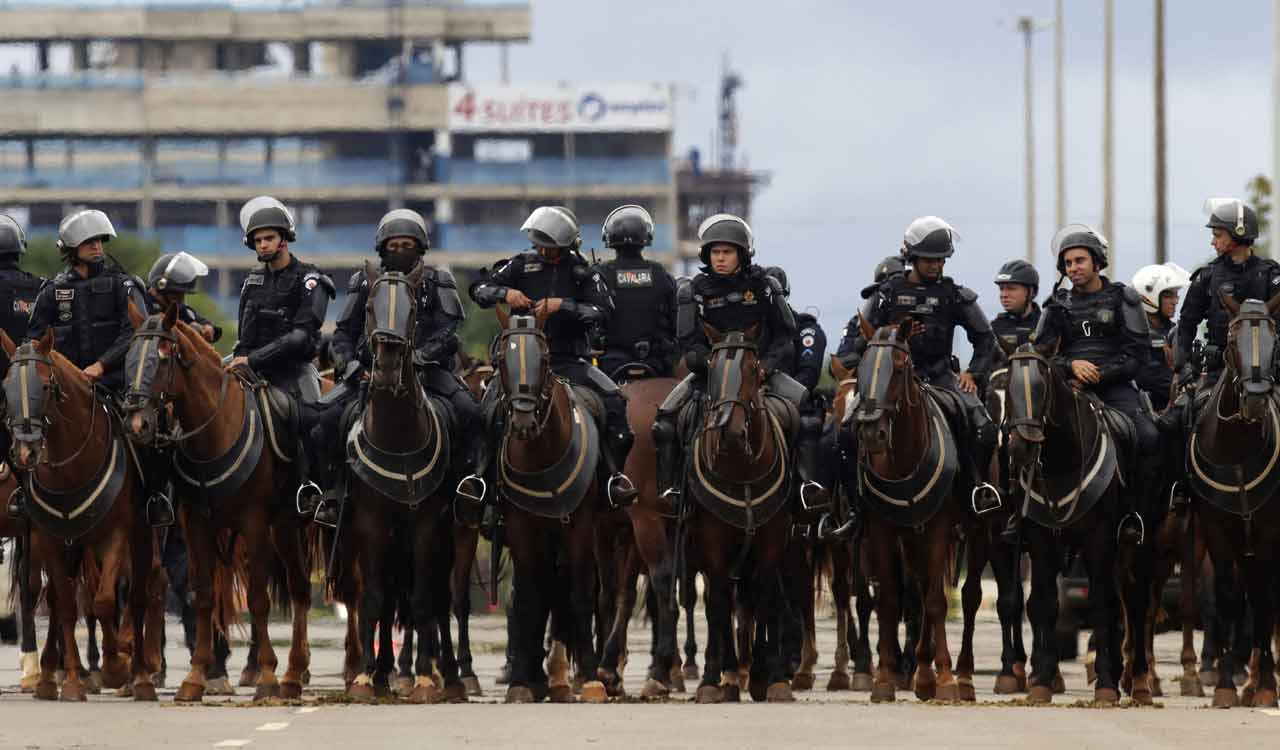
Protesters flooded Congress, Supreme Court and presidential palace on Sunday
Posted Date – 11:20 PM, Mon – 1/9/23

Mounted police watch as supporters of former Brazilian President Jair Bolsonaro leave their home in Brazil, the day after Bolsonaro supporters stormed government buildings in the capital, Monday, Jan. 9, 2023. A camp outside the army headquarters in Brasilia. Photo: AP/PTI
Rio de Janeiro: Brazilian authorities vowed on Monday to protect democracy and punish thousands of former President Jair Bolsonaro’s supporters who stormed and smashed the country’s top authority amid chaos ahead of a Jan. 6, 2021, meeting in the U.S. Capitol The riots that took place in the mansion have a striking similarity.
On Sunday, protesters poured into Congress, the Supreme Court and the presidential palace. Many said they wanted Brazil’s military to bring far-right Bolsonaro back to power and depose new leftist Luiz Inácio Lula da Silva.
Police were dismantling a pro-Bolsonaro camp outside a military building on Monday and had detained about 1,200 people there, the Justice Ministry press office told The Associated Press.
Lula and the heads of the Supreme Court, Senate and Lower House also signed a letter on Monday condemning terrorism and vandalism and said they were taking legal steps.
Justice Minister Flávio Dino told reporters that police had started tracking people who paid for the buses that transported protesters to the capital. At a news conference late Sunday, Brazil’s institutional relations minister said the buildings would be inspected for evidence, including fingerprints and images, to hold people accountable as the rioters apparently intended to spread the word across the country Similar disturbances were triggered across the range.
“They will not succeed in destroying democracy in Brazil. We need to say that fully with firmness and conviction,” Dino said. “We will not accept the criminal path of political struggle in Brazil. Criminals are treated like criminals.”
Rioters wearing green and yellow flags broke windows, toppled furniture and threw computers and printers on the ground on Sunday. They punctured a huge Emiliano Di Cavalcanti painting in seven places in the presidential palace and completely destroyed other works of art.
They toppled the U-shaped table where Supreme Court justices convene, tore out the door to one justice’s office and vandalized iconic statues outside the courthouse. The interior of the monumental building is in a state of ruin.
Another 300 people were arrested on Monday, in addition to the 300 arrested on Sunday.
But the conspicuous slowness of the police response — even after more than 100 buses arrived — left many wondering whether authorities were simply ignoring the flood of warnings, underestimating the strength of the protesters, or somehow complicit.
Prosecutors in the capital said local security forces were at least negligent. A Supreme Court judge temporarily suspended the district governor. Another judge accused the authorities of not being quick to crack down on Brazil’s budding neo-fascism.
After his Oct. 30 election defeat, Bolsonaro, who is headed to Florida, has been fanning the belief among his diehard supporters that electronic voting systems are prone to fraud — though he has never provided any evidence. His lawmaker son Eduardo Bolsonaro has held numerous meetings with former US President Donald Trump, longtime Trump ally Steve Bannon and his top campaign adviser Jason Miller .
The results of Brazil’s election – the closest in more than three decades – were quickly endorsed by politicians across the spectrum, including some of Bolsonaro’s allies, as well as dozens of governments. Bolsonaro’s swift disappearance from view has surprised almost everyone. He neither conceded defeat nor called out fraud, and despite his and his party’s plea to cancel millions of votes, the plea was quickly dismissed.
Brazilians have used electronic voting since 1996, which security experts consider less secure than handwritten ballots because they leave no auditable paper trail. However, Brazil’s system has come under scrutiny, and domestic authorities and international observers have never found evidence it was being used to commit fraud.
Still, Bolsonaro supporters refused to accept the result. They blocked roads and camped outside military buildings, urging the armed forces to intervene. Justice Minister Dino called the camps hotbeds of terrorism. The protests were overwhelmingly peaceful, but isolated threats – including a bomb found in a fuel truck en route to Brasília’s airport – have raised security concerns.
Two days before Lula’s Jan. 1 inauguration, Bolsonaro flew to the United States and took a temporary residence in Orlando. Many Brazilians expressed relief that while he refused to participate in the transition, his absence allowed the transition to proceed smoothly.
