

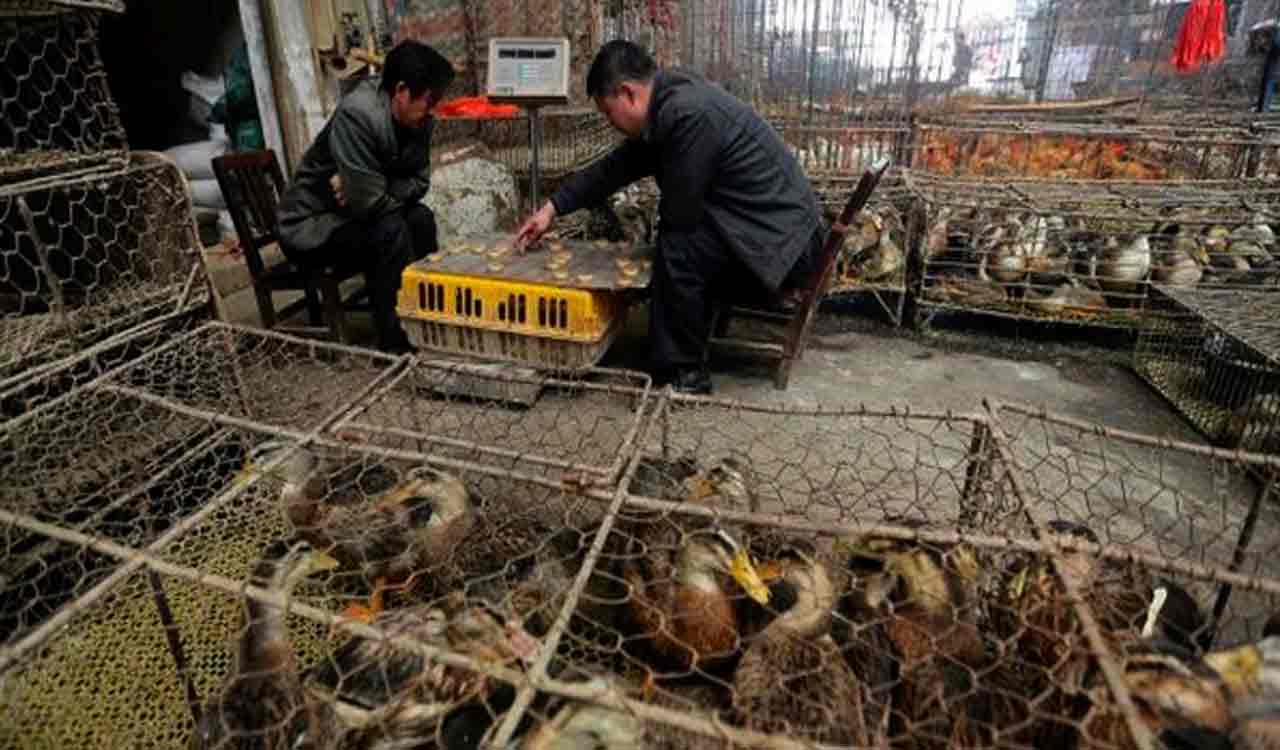
A team of Chinese investigators found that cages commonly used to transport animals tested positive for the coronavirus
Published Date – 06:30 AM, Fri – 24 March 23
Photo: Arnie
Wuhan: Chinese investigators recently released a report detailing the illegal trade in wild animals that sparked the coronavirus pandemic, according to The New York Times.
On January 12, 2020, a team of Chinese investigators combed through markets for clues about a strange new disease in the city of Wuhan. The team found that cages typically used to transport animals tested positive for the coronavirus.
The swab’s genetic material was secretly uploaded to a global database, only made public this year, and examined three years later by a team of international experts. Scientists said in a study published late Monday that swab evidence supports their contention that the coronavirus pandemic was sparked by illegally traded wild animals.
After being approached by the international team, the Chinese researcher who uploaded the raw data requested that it be removed from the database. In response to their alleged breaches, database administrators are now denying access to international researchers, raising concerns about the database’s role in the fight to obtain information that could provide insight into a killed species. The origin of the virus that killed 7 million people.
According to a report published by The New York Times, in addition to the coronavirus genetic signature, the swabs on the trolley contained more than 4,500 long fragments of raccoon genetic material. nobody.
Some Covid-positive swabs from other items and market surfaces also contained more animal genetic material than humans, according to the study.
The animal itself is not necessarily infected just because the genetic material from the virus is found in the same location as the animal’s genetic traces. However, some scientists who read the report noted that the ubiquity of genetic material in animals, especially raccoons, suggested that species known to transmit the coronavirus were actually carrying the virus on the market in late 2019.
They claim that the situation is similar to what led to the first SARS epidemic in China 20 years ago, consistent with the virus jumping from market animals to humans and causing a pandemic.
“You look at them and you say they’re probably infected animals,” said Theodora Hatziioannou, a virologist at The Rockefeller University in New York, who was not involved in the study, adding that “if humans transmit the virus, one hope Human DNA was found there, too.” More information about the origin of the virus in the samples can still be found in the swabs. For example, according to The New York Times, the report noted that there was evidence of a specific gene that could indicate that the substance originated in the upper airways of raccoons.
However, even if an animal has the disease, it may not be an obvious indication that it has exposed humans to the infection. Animals at the market could become sick from people infected with the virus. And because the animals in the market were removed shortly after the outbreak, scientists were unable to determine whether an animal was infected by swabbing the animal directly.
The report has been the focus of intense, speculative discussions since international experts presented their findings to the World Health Organization last week and hastily compiled their analysis. The discoveries have also sparked a fight over the genetic code behind them.
After publishing a paper describing them last year, Chinese researchers first uploaded the raw sequences to global databases. However, the material was taken offline after international experts discovered it and informed Chinese researchers in early March.
The World Health Organization last week condemned China for keeping such important information from the rest of the world for three years, according to a report published by The New York Times. GISAID, the Munich-based nonprofit that manages the database, is currently under fire for its involvement in regulating data access.
According to the new report, the international team of scientists claims that by allowing Chinese researchers to retain the data for so long, GISAID “diverted from its stated mission.”
In response to Tuesday’s report, database administrators banned team members from accessing their online accounts and claimed they broke the rules by releasing their own analysis before Chinese scientists had completed it.
The researchers claim that they complied with the terms of the GISAID database access agreement when downloading and analyzing the sequences. They also mentioned that they have issued several invitations to collaborate with Chinese researchers.
Michael Worobey, an evolutionary biologist at the University of Arizona and co-author of the new report, noted that GISAID also jeopardizes team members’ work related to coronavirus variants and flu preparedness, adding that “cutting ties with the group The aftermath of the authors is huge.” “They accuse you of being wrong.” With so much animal genetic material found in cart key swabs and the fact that they are known to transmit viruses, the international team focused on raccoons , which are furry mammals related to foxes that are sold for their meat and fur.
They claim their research supports the theory that the virus, which originated in bats, is being carried by animals and spread to people in markets.
“It’s not an infected animal,” Joel Wertheim, an evolutionary biologist at the University of California, San Diego and a co-author of the study, said of the new genetic information. But according to The New York Times Reports, if you don’t have the animal in front of you, this is the closest you can find it.
However, the report also provides the most convincing evidence yet that other animals susceptible to the virus are being caught in markets sold to this point.
In addition, swabs that tested positive for the coronavirus contained genetic material from these animals, including the civet cat, a small Asian mammal linked to the SARS epidemic 20 years ago.
Of the variety of animals listed in the report, Joseph Driesi, a professor of biochemistry at the University of California, San Francisco and director of the Chan Zuckerberg Biocenter, said, “This is literally Disneyland for zoonotic transfer.” Large amounts of human genetic material were found in several other swabs on the Internet, which the study said proved that some samples of the virus may have been transmitted by infected individuals. Many of the earliest known Covid patients either worked or shopped in the market.
According to the study, genetic material from animals considered insensitive to the virus dominated the otherwise positive swabs. For example, samples taken from the surface of fish packaging revealed large amounts of fish genetic material. The scientists concluded that the virus was likely deposited by humans, suggesting that the presence of large amounts of animal genetic material does not mean that the virus was created by animals in the area.
Some scientists have cited these results, claiming that the types of swabs examined in the study simply did not provide concrete evidence of infected animals.
“The report does contain useful information,” says Sergey Pound, a virologist at Temple University in Philadelphia. But does it reveal anything about which mammals were infected, he continued? Really, that’s not the case.
Dr. David Reelman, a microbiologist at Stanford University, said the results could not be assessed without more information about the methods the Chinese researchers used to collect and analyze the swabs. He pointed to a Chinese paper from the previous year detailing the use of kits to remove human genetic material and increase the test’s sensitivity to the virus.
However, some of the swabs from the Chinese researchers mentioned in the international team’s report contained large amounts of human genetic material, suggesting that these filtering techniques did not remove all human genetic material from the samples. Dr. DeRisi, an expert in the kind of analysis detailed in the report, said such kits are often not effective at eliminating people’s genetic signatures.
Frederic Bushman, a microbiologist at the University of Pennsylvania who also specializes in sequencing methods, thinks the report’s methodology is sound.
“I think the easiest answer is that it was an infected raccoon,” he said. “I don’t think that’s absolute proof,” the New York Times reported.
