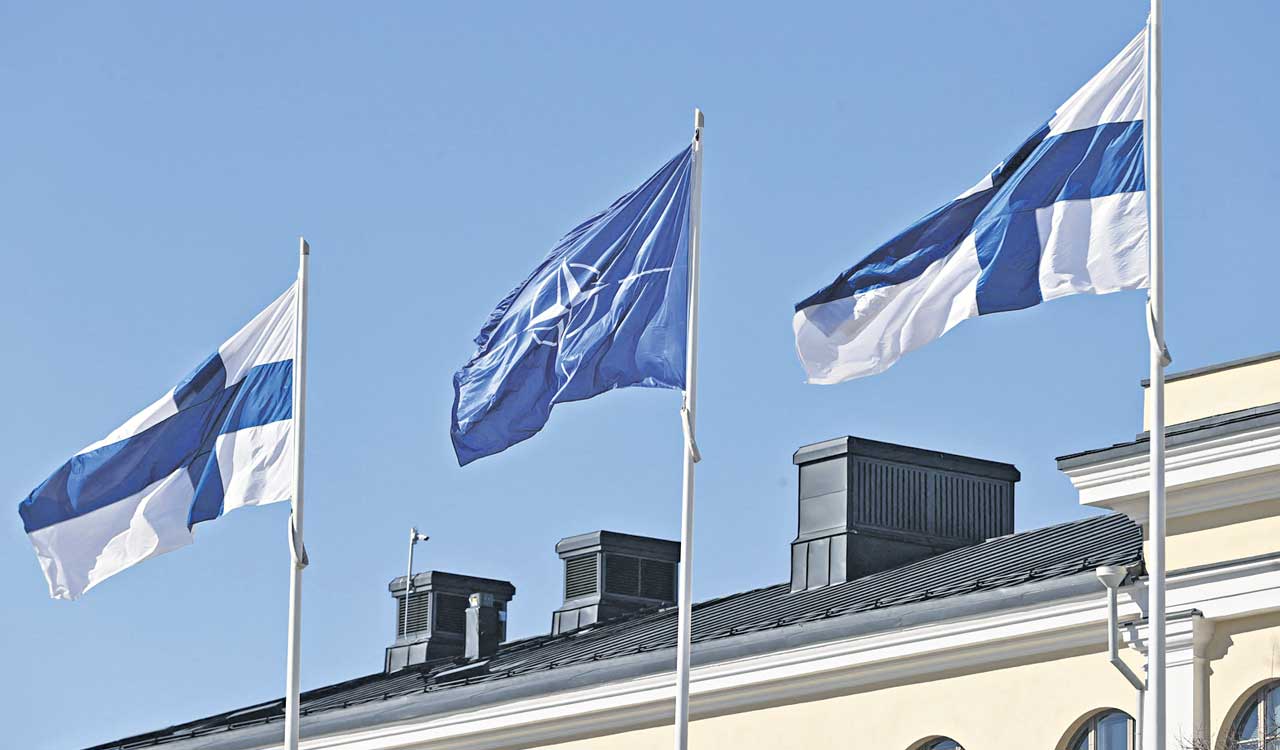
Finland’s accession to NATO marks the possible end of Finnization – a neutral and accommodating model
Posted Date – 12:45 AM, Fri – 7 April 23
Ronald Sonny
Hyderabad: In the geopolitical world, great powers make, break and play by their own rules. Smaller nations have largely had to adapt to a world determined by other nations.
That’s why Finland — a country of just 5.5 million people and known for decades as neutral in Europe –‘s decision to join NATO is so important. It underscores how Russia’s invasion of Ukraine has disrupted global realities long thought to be settled, at least by Western powers.
The vaunted “rules-based order” that the United States and its NATO allies tout as the best way to run the world is changing — appealing to some, but looking more suspicious to those not in the club. At the same time, Russia and China are vying for the supremacy of the United States and the West in global affairs and seeking a system in which power is distributed within regions, with Moscow and Beijing controlling what they consider to be parts of the world.
Smaller nations across the globe are rethinking how to adapt to this new division of the world.
Finland is one such country and has made a dramatic choice. Over the centuries, it has had to align its interests with — and juggle — those of its vast neighbours: Tsarist Russia, then the Soviet Union, and today Vladimir Putin leading Russia. During the years of the Cold War, Finland adopted a mode of neutrality and compromise in order to coexist with Russia. This way of dealing with nearby neighbors is called “Finnishization”.
With Russia’s invasion of Ukraine a year ago, policymakers in Helsinki appear to have put the final nail in the coffin of Finlandization. What Putin — and perhaps the West — fears is that this model is not just being killed in Finland; it is also dead as a potential solution to the Ukrainian conflict.
stay independent
Finland gained independence in 1917 after more than a century of tsarist rule. For the next two decades or so, it became an anti-Soviet outpost teetering adjacent to the Soviet Union. Soviet dictator Joseph Stalin saw Finland as a gateway to the communist state’s enemies. In his view, Finland is an existential threat — similar to how Putin views Ukraine today.
After annexing eastern Poland and the Baltic states – Estonia, Latvia and Lithuania – after signing the German-Soviet Pact in 1939, Stalin demanded major territorial concessions from Finland. The resulting war cost the Finns most of their eastern provinces, but they managed to keep their independence – but at some cost. The cost of maintaining its democratic state and capitalist economy in domestic affairs during the Cold War was Finlandization.
Through its adjusted neutral model, Finland was able to convince Moscow for more than half a century that it was not a threat but a loyal trading partner. With the collapse of the Soviet Union in 1991, Finnish misgivings about Finnishization increased. They debate whether they should consider joining the Western Union.
But it was Putin’s invasion of Ukraine in 2022 that turned the tables and finally convinced Helsinki that its security would be enhanced by NATO membership.
neutral dilemma
The invasion also killed any idea of Finland becoming a post-Soviet Ukrainian model. For the past 30 years, an independent Ukraine has been seen as a problem by Putin, who fears it will be drawn to the West. Likewise, Russia was a problem for Ukraine even before last year’s invasion, with authorities in Kiev fearing dominance from the east.
Before the war, Finland’s model of independence and neutrality was touted as a viable alternative to Ukraine’s membership in NATO or a closer Russia-led strategic alliance, the Collective Security Treaty Organization.
Some observers believe that Finland’s experience of asserting its sovereignty by sacrificing its right to act completely independently in foreign policy may be a viable model for the former Soviet states, especially with regard to Ukraine. In this way of thinking, Finnization may also offer a solution to Ukraine’s internal divisions, whether in favor of the West or in favor of Russia.
Throughout the 1990s and 2000s, Ukraine oscillated between a favored pro-Russian orientation in eastern Ukraine and a pronounced Ukrainian nationalist identity in western Ukraine. The Finnishization of Ukraine, combined with the federalization of Ukrainian provinces, could reduce political polarization with Ukraine and assuage the fears of Russians, especially Putin.
Of course, history cannot be rewound; such alternative possibilities cannot be tested. Federalism, which involves delegating some decision-making to local governments, is seen by many in Ukraine and Russia as a viable form of statehood. After all, a similar process of federalization was blamed for the collapse of the Soviet Union.
In addition, events forced Ukraine’s hand. As Russia leans toward authoritarianism and uses its oil and gas as a weapon against Ukraine, the appeal of the West — democracy, prosperity, and shiny modernity — seems all the more appealing.
Under the initiative of the United States, the West has vaguely agreed to Ukraine’s joining NATO, which is completely unacceptable to Russia. The EU has offered Ukraine closer economic and political ties, which has sparked concern in Moscow as a first step towards NATO. After Russia’s occupation of Crimea in 2014, Ukrainians turned more toward the West and were more receptive to Western commitments to join NATO.
Small country
In hindsight, hopes that Ukraine would be “Finnishized” or federalized were all casualties of Putin’s increasingly hardline line on Ukraine. Finland’s accession to NATO marks the possible end of the Finnish model. Even Finland has abandoned it; neutral Sweden is now eager to join the Western Union; and other countries, even Switzerland, are questioning the efficacy of non-alignment in a polarized world.
Instead, there was the “NATOization” of Eastern Europe – a process that Putin inadvertently accelerated, making Russia’s neighbors less friendly under Putin. Meanwhile, countries like Finland and Sweden have fewer options. “A small country can disappear,” the Czech writer Milan Kundera reminds us, “and know it.
www.theconversation.com