

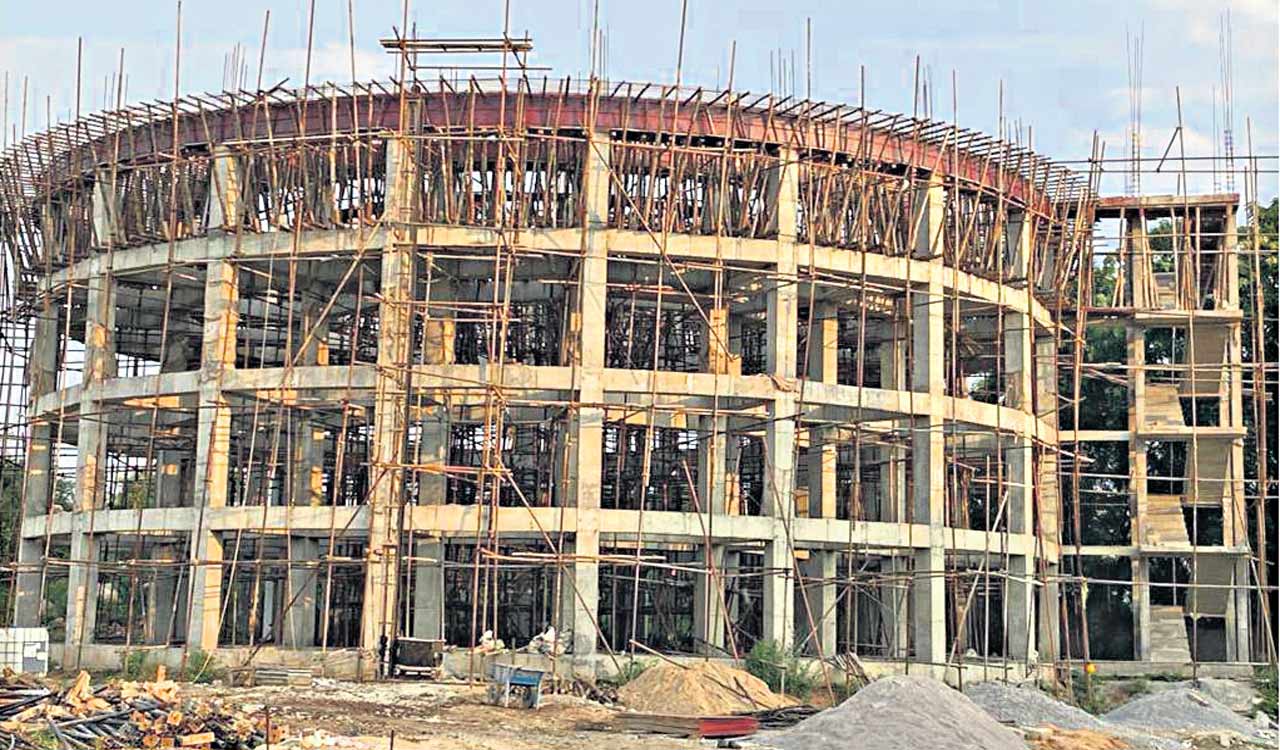
Under Phase II of the ORR project, HMWS&SB is developing a 2,093 km network of water supply pipelines for people located outside GHMC and within ORR
Published Date – Mon, 10 Apr 23 at 09:00 AM

Tanks constructed in phase II of the ORR project outside the GHMC and within the ORR limits.
Hyderabad: In June this year, the Telangana state government is poised to achieve another milestone by providing potable water to over 200,000 households located outside the boundaries of the Hyderabad Municipal Corporation (GHMC) and within the Outer Ring Road (ORR).
The shortage of drinking water has been one of the main problems in these places for decades, and the people who live here have made repeated requests to the earlier state government, but to no avail.
Unlike the previous authorities, the Telangana government formulated ORR project phase 2 and approved Rs 1200 crore earmarked for providing new drinking water connections and augmenting existing supplies, thereby ending the water crisis.
Under this project, HMWS&SB is developing a 2,093 km water distribution network and constructing 75 capacity 1.37 million liters (ML) of the reservoir. Other major works on the project include the construction of a chlorination chamber and a pumping station.
Talking about the current status of the project, which will make water scarcity in these regions a thing of the past, an HMWS&SB official said that ORR Project Phase II has provided drinking water to more than 100 colonies. “By June, the whole project will be complete and we are supplying water to households as the work progresses,” he said.
He further said that camps have been set up where water supply has recently started to ensure that all houses have access to water. “If camps are not yet established in a particular area, people can avail of the new water supply connections by visiting the Water Authority website https://www.hyderabadwater.gov.in/en/,” he said.
Meanwhile, in several colonies where water supply is proposed in Phase II of the ORR project, work related to the development of water supply networks and the construction of reservoirs has been completed, but consumer account numbers (CANs) have not yet been assigned.
