

Insurance, incentives and investment must form key aspects of policy
Posted Date – 12:45 AM, Fri – 21 April 23

representative image.
Dr Sonar Mobal Roy
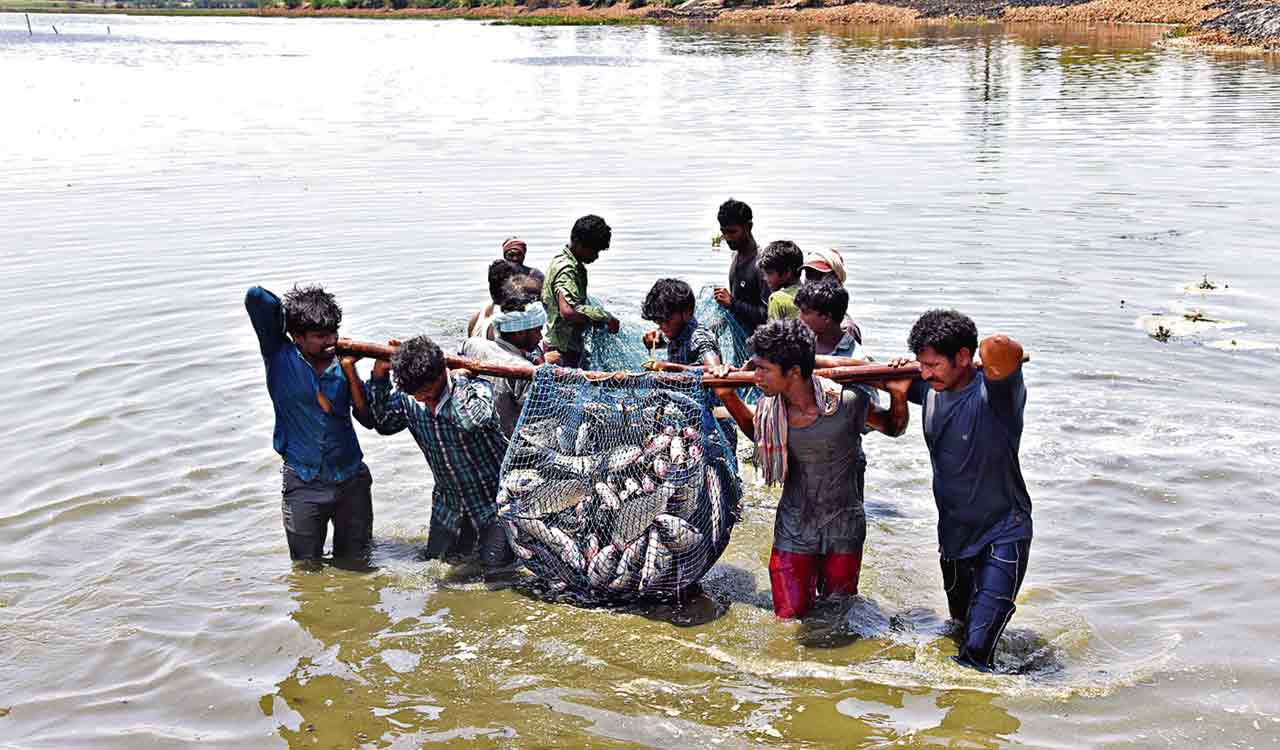
Hyderabad: Recently, Parvathagiri in Warangal district of Telangana state has been in the spotlight for a bumper fish farming harvest. Fish farmers there commonly rear catfish, dace and tilapia, which are popular in the region. The local Ula ponds are suddenly filled with oversized fish that are difficult to catch with ordinary fishing nets. Over the past three years, the fish has grown very large. Cranes are used to bring the fish to shore, where they are transported on large tractor trolleys. With over 20 tons of fish caught, it was an otherworldly sight!
What is commonly referred to as fish farming or fish farming is actually fish farming or aquaculture. The former is simply farming fish (pisciculture) to obtain fish and fish products for food, the latter is the process of breeding, rearing and harvesting commercially valuable aquatic plants and animals in brackish or fresh water, as the case may be. Over the past few years, fish farming has become an essential source of livelihood, especially for the most vulnerable and marginalized populations.
curb malnutrition
In order to solve the problem of iron deficiency anemia in Cambodia, an iron fish experiment was conducted. The same experiment was also replicated in some parts of India. However, in India, cast iron fish is custom made in iron balls or cold shapes because many vegetarians do not want to cook iron fish. Iron deficiency anemia is a common problem, especially among tribal women in India. According to NFHS-5 data, approximately 57.6% of tribal women suffer from anemia and related problems. This can further affect their menstrual cycles and fertility, leading to severe weakness and fatigue. The experiment did raise hemoglobin levels in the participants. It is considered an effective and sustainable solution to iron deficiency anemia in tribal communities.
Under the Poshan Abhiyaan programme, women and adolescent girls also take iron and folic acid (IFA) tablets to curb anemia. Eating fish can help curb malnutrition as it is a good source of protein, vitamins and minerals. It’s especially a good source of heart- and brain-healthy omega-3 fatty acids. While fish alone won’t curb malnutrition, adding it to your diet may be beneficial.
cultural heritage
Oudh or Awadh is a region in northern India, now known as Uttar Pradesh, with a rich cultural history. The fish, as a symbol, holds a special place in various contexts of Audrian culture and tradition. Almost all historic buildings, arches and gates display a pair of fish, beautifully carved and detailed. The fish motif is believed to symbolize Nawab’s love of fishing in the Gomti River and his status as a patron of the arts. The famous Chikankari pieces show fish motifs and continue this tradition.
Fish also plays an important role in Bengali weddings and is an integral part of their cultural traditions. It is considered a symbol of good luck, prosperity and fertility. Newlywed “Bou” entered the family with a live fish in his arms. Rituals are often adjusted for the vegetarian “Bou”, who may enter with a fish made of sweet meat. A few years ago, an indigenous tribe in Andaman shared that he started cooking fish in mustard oil, salt and turmeric instead of the ancient practice of eating it raw. It must have been the effect of the influx of tourists and the urge to be considered “civilized”.
fish culture
India is the second largest fish producer in the world, accounting for 7.56% of global production, with an annual output of about 13.7 million tons. Aquaculture accounts for 65% of India’s total fish production. In recent years, the central government has launched several initiatives to promote and support fish farming, such as the National Fisheries Development Board (NFDB), the Blue Revolution Program and Prime Minister Matsya Sampada Yojana.
Fish farming is an important economic activity in India, providing employment and income to millions, especially in rural and coastal areas. Many farmers follow a rich tradition of sustainable fish farming practices. Rice-fish farming is mainly practiced by the Apatani tribe of Ziro Valley, a progressive farming community in Arunachal Pradesh, using only nature-friendly and sustainable methods. The landscaping design of the terraces is slightly sloped, so that water flows into each field from a higher level and out from a lower level. Bamboo net traps were placed on the embankment between the two plots to restrict the movement of fish and species. Cage fish culture is being widely promoted because it is easily adopted by tribal groups.
3 “I” models
Insurance, incentives and investments are important aspects that can be included in policies to support Indian fishers. Since fishing is an occupation with a high risk factor, insurance policies can be designed to cover losses, market fluctuations and accidents, especially to the fishing community itself.
Incentives can be provided through subsidies and financial assistance for the adoption of environmentally friendly methods. Investment is crucial to the development of the fishery, and the government and corporate sector can invest in infrastructure such as ports, landing centers and cold storage facilities.
Investing in research and development of new technologies and processes will improve the efficiency and sustainability of fisheries. Appropriate training programs and capacity building workshops for fish farmers are needed. Providing fish and fish food in small ponds will contribute to better livelihoods for marginalized groups living in small villages and thandas.
Local fish farming knowledge should be documented and disseminated. Seek government nuances on farming systems, disease management, and scientific fish farming techniques. According to the Ministry of Fisheries, Livestock and Dairy, the fisheries sector is recognized as a “sunrise sector” with an annual growth rate of 10.87% since 2014-15. For the 2021-22 (tentative) period, fish production will reach a record high of 16.187 million tonnes. In addition to achieving the SDGs through targeted interventions, fish and fish products can also help generate more income and employment for those associated with the sector.

(Opinions are personal and derived from author’s ethnographic research)
