

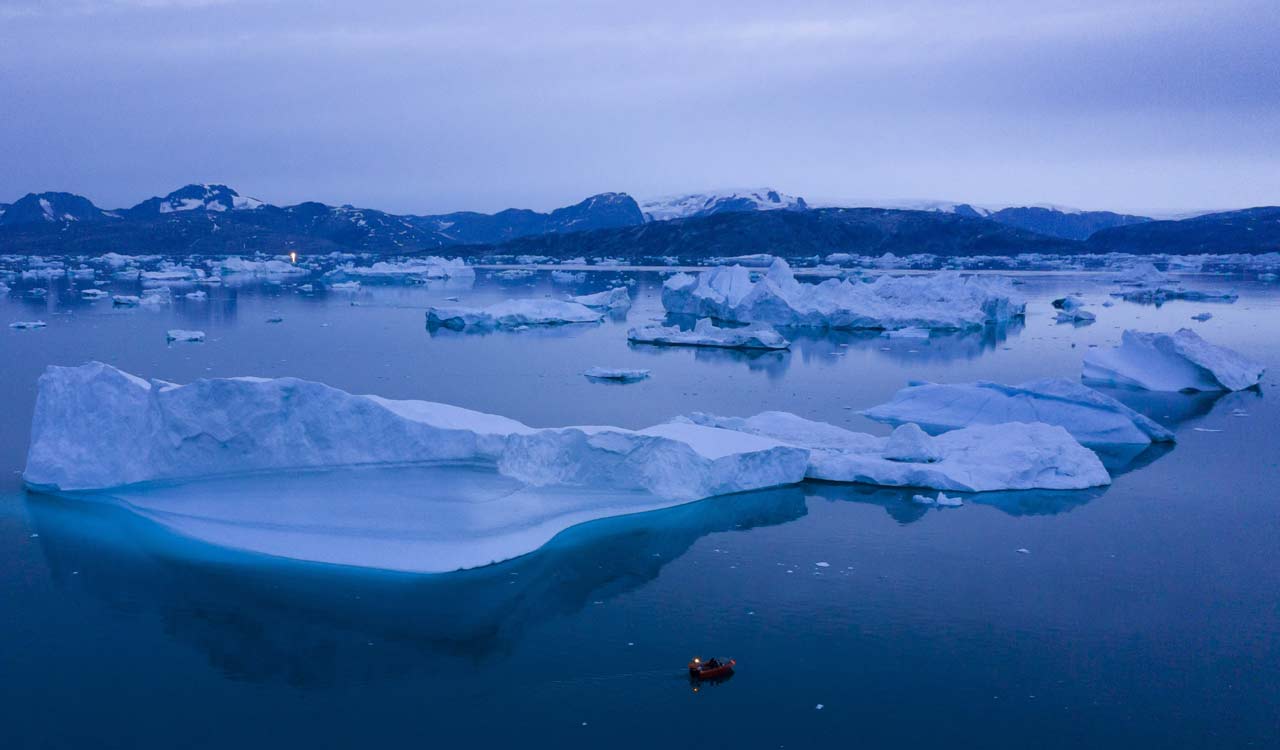
Greenland and Antarctic ice sheets are now losing more than three times as much ice each year as they did 30 years ago
Posted on – Thu, 4/20/23 at 11:59pm

AP Photo
Washington: The Greenland and Antarctic ice sheets are now losing more than three times as much ice each year than they did 30 years ago, according to a new comprehensive international study.
Using 50 different satellite estimates, the researchers found that Greenland’s melting has entered the hyperdrive over the past few years.
Average annual melt in Greenland from 2017 to 2020 has increased by 20% since the beginning of the decade, more than seven times higher than the average annual contraction in the early 1990s.
The new data are “really catastrophic,” said study co-author Ruth Mottram, a climate scientist at the Danish Meteorological Institute.
“We’re losing more and more ice from Greenland.” The study’s lead author, Ines Otosaka, a glaciologist at the University of Leeds in the United Kingdom, said the accelerated loss of the ice sheet is clearly caused by human-caused climate change.
From 1992 to 1996, the two ice sheets – which hold 99 percent of the world’s freshwater ice – shrank by 116 billion tons (105 billion metric tons) per year, two-thirds of which came from Antarctica.
But total melting soared to 410 billion tons (372 billion metric tons) a year from 2017 to 2020, the most recent data available, with more than a third of that, according to research published Thursday in the journal Earth System Science Data. The second is from Greenland.
“It’s a devastating trajectory,” said Twila Moon, deputy chief scientist at the National Snow and Ice Center, who was not involved in the study.
“The rate of these ice losses is unprecedented in modern civilization.” Since 1992, the Earth has lost 8.3 trillion tons (7.6 trillion metric tons) of ice from the two ice sheets, the study found.
That’s enough to flood the entire United States with 33.6 inches (nearly 0.9 meters) of water or 49 feet (nearly 15 meters) of France.
But because the world’s oceans are so large, the average sea level rise since 1992 from melting ice sheets alone is still less than an inch (21 millimeters).
Global sea-level rise is accelerating, with ice sheet melting increasing from accounting for 5 percent of sea-level rise to now accounting for more than a quarter, the study said.
The rest of the sea level rise comes from the expansion of warm sea water and the melting of glaciers.
A team of more than 65 scientists regularly calculates ice sheet loss in research funded by NASA and the European Space Agency, and Thursday’s study added three years of data.
Otosaka said they used 17 different satellite missions and examined ice sheet melting with three different techniques, and all the satellites, radar, ground-based observations, and computer simulations were basically saying the same thing — ice sheet melting was accelerating.
Greenland melted an average of about 283 billion tons (257 billion metric tons) per year between 2017 and 2020, compared with just 235 billion tons (213 billion metric tons) per year between 2012 and 2016.
The latest data also show that the rate of melting appears to be slowing in parts of Antarctica, where there is much more ice than Greenland.
This is largely due to smaller and short-lived weather changes, and the overall long-term trend still shows Antarctica is melting at an accelerated pace, Mottram said.
Antarctica still lost about 127 billion tons (115 billion metric tons) of ice per year from 2017 to 2020, 23 percent less than a decade earlier, but an overall increase of 64 percent since the early 1990s.
“While Greenland is losing mass faster than Antarctica, there are some troublesome wild cards in the south, particularly the behavior of Thwaites Glacier,” which has been nicknamed the doomsday glacier, said Mark Serez, director of the U.S. Snow and Ice Center. , he is not part of the study.
Using changes in gravity and ice height, the study authors measured how much snow fell, how much snow melted, how much ice was lost during calving, and how much ice was eroded away from beneath it by warm water.
“This is important because rising sea levels will displace and/or economically impact hundreds of millions, if not billions, of people and could cost trillions of dollars,” said University of Colorado ice researcher and former U.S. Nasa chief scientist Walid Abdulati said he wasn’t part of the research at the time.
The study “is less disturbing than surprising,” Abdulati said in an email. Using satellite observations, in situ observations and modeling techniques, we have learned that ice responds rapidly to our changing climate.”
