

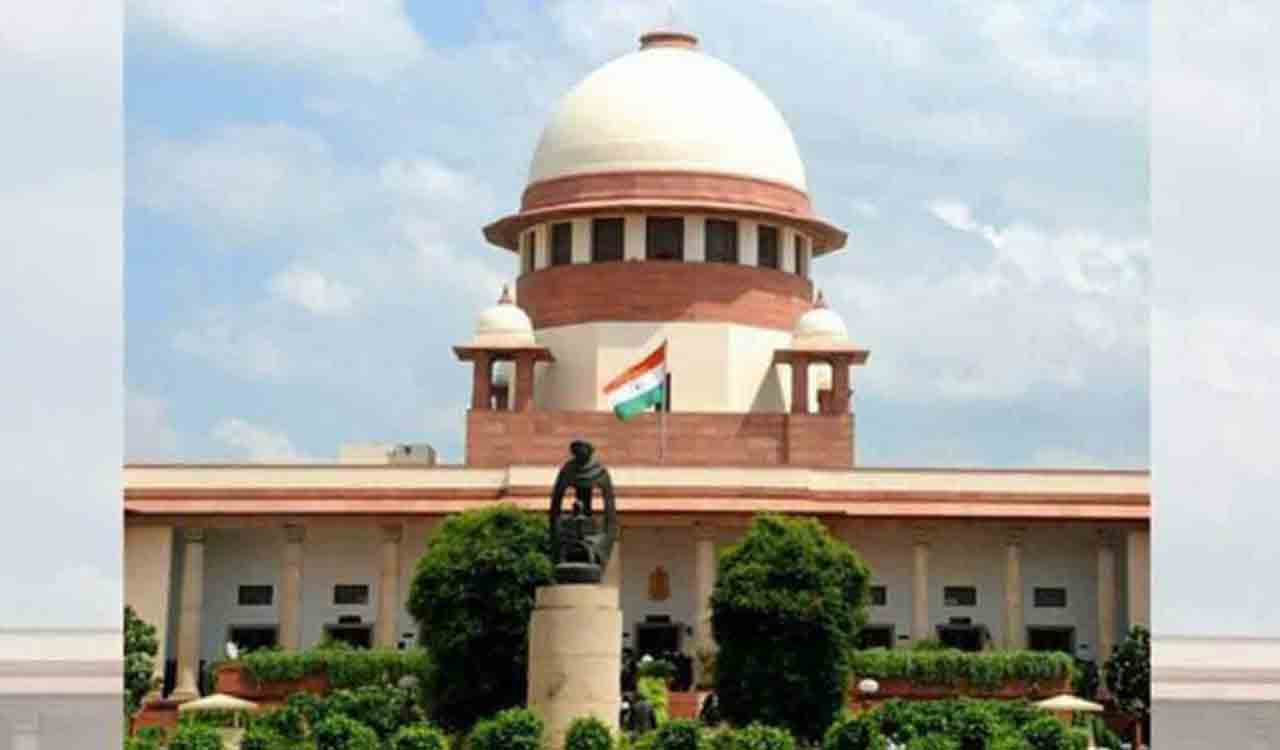
The court noted that Parliament has specific jurisdiction to legislate on issues related to marriage and divorce
Posted Date – Tue, 4/25/23 at 11:59pm

New Delhi: The Supreme Court asked Tuesday how it could intervene in petitions related to marriage equality, and to what extent it could address the issue.
The Constitutional Court comprising Chief Justice of India DY Chandrachud, Justices Sanjay Kishan Kaul, Justices S Ravindra Bhat, Justices Hima Kohli and Justices PS Narasimha is processing a number of petitions related to ‘Marriage Equality Rights for LGBTQAI+ Community’ .
Senior defense lawyer Menaka Guruswamy, who represented one of the petitioners, told the court that unlike Britain, India has a limited parliamentary system.
Guruswami, who has urged courts to grant same-sex couples marriage rights, said they had come to the judiciary because their rights had been violated.
The court noted that Parliament has specific jurisdiction to legislate on issues related to marriage and divorce. “The real question is which gaps this Court may intervene,” the court said, adding further that it might be incorrect to draw comparisons with the UK Parliament. The court wondered how far the court could go on this issue and asked the petitioner’s attorney to address this aspect.
Senior defense lawyer Menaka Guruswamy argued that Parliament is a product of the Constitution and does not enjoy unfettered sovereignty, whose supremacy is protected by the Supreme Court as interpreter of the Constitution. She submits that the Supreme Court’s power of judicial review of legislative acts under Article 32 is part of the basic structure of the Constitution.
The Constitutional Court has the power to review statutory laws to ensure that they conform to constitutional values. As a result, courts do not need to wait for the legislature to enact or amend laws to recognize same-sex marriage, she said.
Guruswamy argues that the provisions of the Special Marriage Act (SMA) are unconstitutional to the extent that it does not recognize same-sex marriages, and that in order for it to be unconstitutional, the SMA must be read to recognize same-sex marriages.
In discussing the special marriage law provisions, the court also raised the issue that there may be some unheard voices who may wish to preserve their way of life and not want to break with their traditions.
Guruswamy replied that those who wish to participate in this new definition of relationship can come, while those who do not want to do not need to.
Geeta Luthra, a senior lawyer representing the petitioners, said 12 of the G20 countries, including the European Union, allow same-sex marriage. Hence, India should not be left behind now, she argued while presenting her arguments in relation to the provisions of the Foreign Marriage Act. She said same-sex couples who married abroad found that such marriages were not recognized in India.
She further states that marriage is the oldest social institution and it gives you valuable social rights. Furthermore, she believes that marriage is not a static concept, but one that is constantly evolving.
Responding to the Center’s comments that the concept of same-sex marriage was an “urban elite view,” senior advocate Anand Grover, representing one of the petitioners, said they were not elitist and that the elitist concept was incorrect.
Grover submitted a gender glossary to help courts understand the transgender community.
Senior Advocate Jayna Kothari, representing the transgender community, said gender identity was recognized in the NALSA case. She argues that family is at the heart of our being and therefore everyone, including trans and intersex people, should have the right to marriage and family.
Senior counsel Saurabh Kirpal, who represented the petitioners, said that in the past, marriage was considered sacrosanct and indivisible. However, provisions for divorce were incorporated and allowed. Furthermore, the counter falsely suggested that same-sex marriage would dilute the institution of marriage.
He proposed that, in fact, by allowing same-sex marriage, the institution of marriage would be expanded and strengthened. He further stated that not allowing same-sex marriage has the effect of promoting lavender marriages that create misery around them.
He further stated that by not recognizing same-sex marriage, they risk pushing able homosexuals into countries that recognize such rights.
Meanwhile, Supreme Court constitutional justices are holding hearings in a hybrid format to hear various petitions seeking marriage equality, with two of the judges participating virtually in the proceedings. Chief Justice of India DY Chandrachud and Justices Hima Kohli and Justices PS Narasimha participated physically, while Justices Sanjay Kishan Kaul and Justices SR Bhat participated virtually.
The Supreme Court is dealing with various petitions seeking legal recognition of same-sex marriage. An earlier petition cited the lack of a legal framework that would allow members of the LGBTQIA+ community to marry whomever they choose.
According to one of the petitions, the couple seeks to exercise the fundamental rights of LGBTQ+ individuals to marry whomever they choose, saying that “the exercise of these rights should be held without the contempt of legislation and the popular majority.” Additionally, the petition People assert their fundamental right to marry one another and pray that this Court will give appropriate directions to permit and enable them to do so.
