

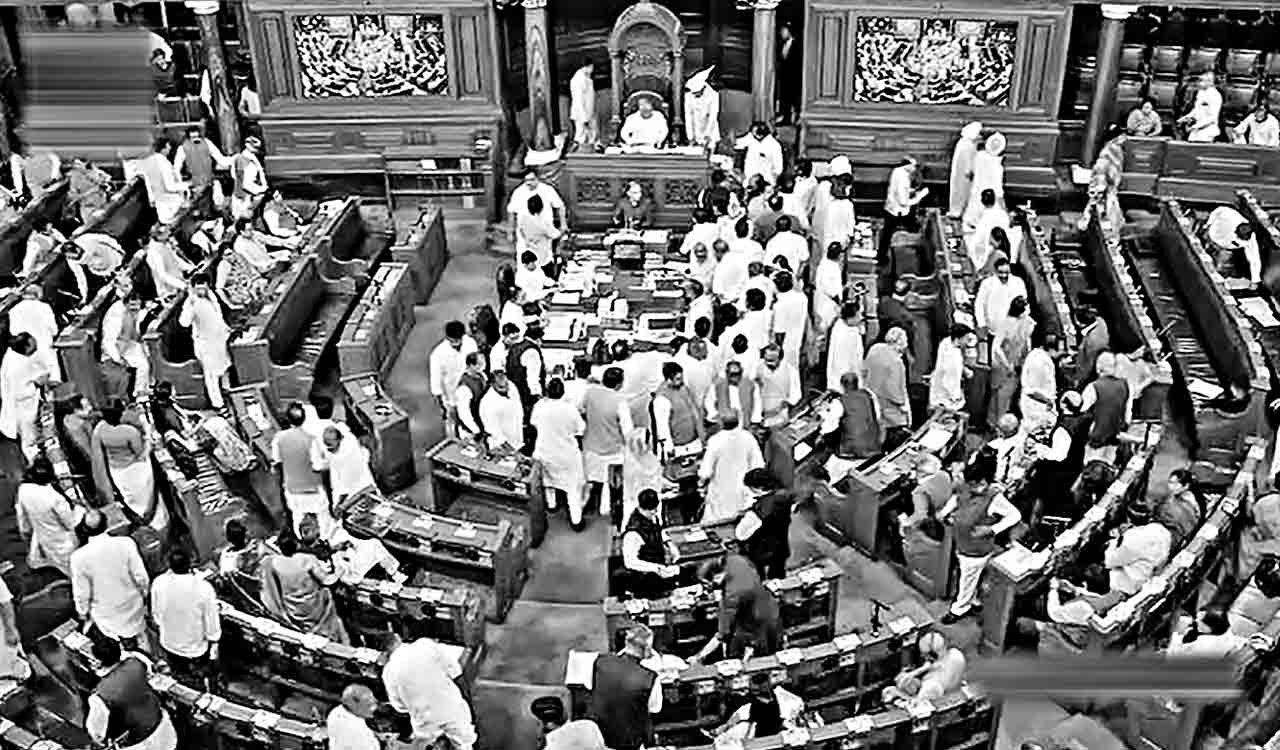
Lok Sabha does not actively monitor decisions taken by the executive from time to time
Posted Date – Tue, 02 May 23 at 12:15pm

By Vanam Jwala Narasimha Rao
Rahul Gandhi hastily revoked his membership in the Lok Sabha after being convicted by a Surat court on March 23 in a criminal defamation case and sentenced to two years in prison, before directing He moved out of his residence in Delhi and was criticized by several national and state political leaders.
They called the action “the pinnacle of Narendra Modi’s arrogance and dictatorship” and said that “the Modi government is abusing constitutional institutions such as parliament and taking reprehensible actions” among others. Rahul Gandhi moved out of his residence on 12 April. The Surat court also granted bail, suspended for 30 days.
Rahul challenged the conviction and the two-year suspended sentence, as well as “bail”, to the Sessions Court, which on April 4 granted him bail and suspended sentence until his appeal was dealt with. Rahul Gandhi’s appeal was dismissed on April 20, with the court rejecting his argument that he would face “irreversible and irreversible recoverable damage”. The case is now before the High Court.
Disqualification
Rahul’s grandmother, former prime minister Indira Gandhi, was also disqualified from the Senate. His mother, Sonia Gandhi, also faced the prospect. Indira Gandhi lost the post-emergency election to the House of Commons, but made a comeback in the 1978 Chikmagra by-election. On November 18, 1978, then-Prime Minister Morarji Desai filed a motion accusing her of insulting government officials and abuse of power while in office. After seven days of debate, a privileged committee was formed to investigate all allegations against Indira Gandhi.
The committee concluded that the allegations were substantiated. On 19 December 1978, she was expelled from Parliament, arrested and sent to Tihar. The Janata government collapsed within two and a half years. Indira Gandhi became prime minister for a second time in 1980 after a landslide victory in the first Congress. Soon after, in May 1981, the Lok Sabha revoked the resolution of December 19, 1978 and the House of Representatives passed a motion setting aside the findings of the 1978 Privileges Committee and the resolution of the House of Representatives. The House said that by repealing the 1978 resolution, the Lok Sabha was atoning for the crimes committed.
In 2006, while UPA was in power, Sonia Gandhi was accused by the opposition of serving as an MP and chairperson of the National Advisory Council, a cabinet ministerial-level position, for gain. Sonia Gandhi resigned from her position on March 23, 2006 Lok Sabha membership. She competed again and won from Raebareli.
Thus, both Indira Gandhi and Sonia Gandhi have come back with astonishing speed after facing political turmoil. Rahul Gandhi is the third member of the Nehru-Gandhi family to be disqualified. However, it remains to be seen whether Rahul will also make a comeback as determinedly as his mother and grandmother.
many questions
The question many are now asking is: Why has the effectiveness of the Indian Parliament as an accountability and oversight body declined over the years? Why give the executive more power to influence the legislature? Parliament does not actively monitor decisions made by the executive from time to time. Why is Parliament increasingly ineffective at providing scrutiny of the executive branch? Why did Parliament itself abdicate many functions? It is also widely believed that the procedural norms that underlie parliamentary practice began to erode, especially after the mid-1970s. Parliaments face major institutional challenges.
The number of sittings of Parliament has declined over the years. The House adjourned sharply amid chaotic scenes and interruptions.
A notable indicator of its declining reputation is that it now often operates without a quorum. For example, the 17th Lok Sabha, which is entering its final year, has only been in session for 230 days so far.
dismal record
Earlier, the 16th Lok Sabha had the least number of sitting days at 331 days. Another year, and as of now the average number of days in session per year is only 58, with the 17th Lok Sabha sitting for a maximum of 288 days at best. This could make it the shortest Lok Sabha since 1952. These figures are limited to the Lok Sabha who have completed a full five-year term. Of the tenures that last at least five years, the 17th Lok Sabha may end up being the shortest. Also, recently, Lok Sabha and Rajya Sabha have spent more time than others on non-legislative activities.
Unfortunately, the functionality of question time is greatly reduced.
According to Chakshu Roy, an expert on parliamentary rules and procedures and how it works, India’s parliament rests for most of the year and seldom sits compared to other countries. “The mistakes of India’s federalism will be evident in its debates,” Roy said, assessing the Indian parliament’s budget session.
Against this backdrop, the million dollar question now is whether the Lok Sabha will annul its verdict, including restoration of domicile, if the lower court judgment in the Rahul Gandhi case is overturned by the Court of Appeal, either the High Court or the Supreme Court. decision? So why such a hasty decision to disqualify Rahul Gandhi? After all, as the proverb goes, patience is a virtue. Patience is the path to wisdom. So a little patience should be exercised until Rahul Gandhi is immediately disqualified by the Lok Sabha Secretariat.
