

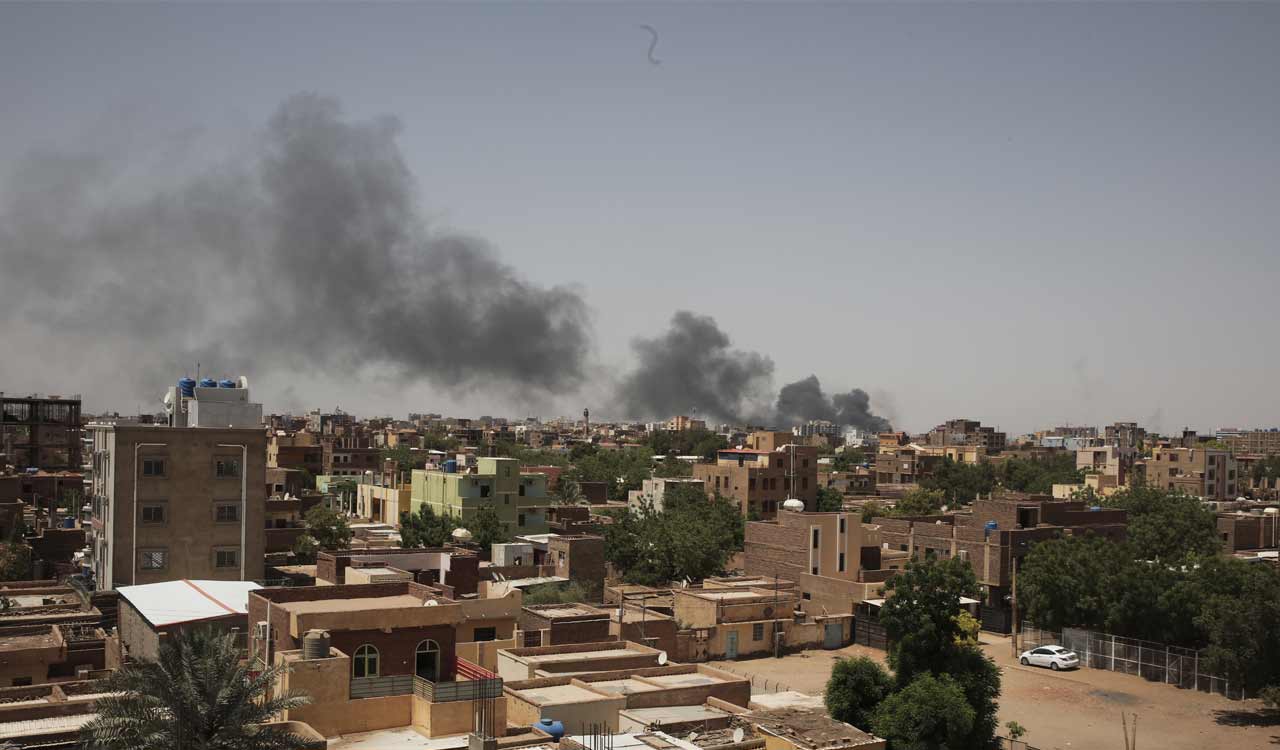
Heavy shelling in Sudan’s capital Khartoum on Thursday disrupted efforts to deliver much-needed aid
Release Date – 06:00 AM, Fri – 5 May 23

AP Photo
Cairo: Heavy shelling on the Sudanese capital Khartoum on Thursday disrupted efforts to deliver much-needed aid to stranded civilians, residents said, as yet another fragile and oft-violated ceasefire expires.
Sudan has been thrown into chaos since fighting broke out in mid-April between two of the country’s top generals.
There is growing concern about those trapped and displaced by the fighting, with aid workers and civilians saying there is a severe lack of basic services, healthcare, food and water.
In the heart of the capital Khartoum, sporadic explosions could be heard Thursday, a day after the United Nations warned the country’s people “face a humanitarian catastrophe” and the latest in a series of ceasefires began earlier in the day maturity.
“The situation is very bad,” said Atiya Abdalla Atiya, secretary of the country’s doctors’ union. “Bombardments of all kinds, whether airstrikes or shelling, can still be heard in Khartoum.” At midday, black smoke rising from downtown neighborhoods dotted Khartoum’s skyline.
The battle has also raised questions about the viability of an internationally-backed initiative aimed at ending the fighting that has undermined the African nation’s democratic transition.
The clashes began on April 15, after the military led by General Abdul Fattah al-Burhan and a hostile force called the Rapid Support Forces (RSF) commanded by General Mohammad Hamdan Dagalo Tensions between the paramilitary groups have raged for months.
The fighting turned urban areas into battlefields as foreign governments scrambled to evacuate their diplomats and thousands of foreigners from Sudan.
Both sides have accused the ceasefire of violating the agreement over the past few weeks. On Thursday, both sides claimed their forces were the target of the attack.
The military said late on Wednesday that it clashed with RSF forces around key government institutions in Khartoum, including the Palace of the Republic in the center of the capital.
Ceasefire initiatives by the United States, Saudi Arabia and the East African bloc known as the IGAD have all paved the way for an extension of the talks.
But neither side has shown a commitment, even in the short term, to stopping the fighting.
Doctors’ groups have warned in recent days that at least 60 percent of hospitals located near areas of heavy fighting have been out of service, either because of shelling or because of shortages of medical staff and supplies.
Some 12,000 patients with kidney failure do not have access to dialysis facilities in critical, life-threatening situations.
“People with chronic diseases are dying at home because hospitals that are functioning only care for the wounded,” said Atiyah of the Doctors Association.
The Kuwaiti government announced on Thursday that it would send flights carrying medical and humanitarian supplies to the city of Port Sudan on Sudan’s Red Sea coast.
KUNA, the Gulf Arab state’s state-run news agency, said there was one flight every day until Sunday
explain.
The flights were intended to deliver at least 75 tons of humanitarian aid to Sudanese health authorities and the Sudanese Red Crescent Society.
Port Sudan, the country’s main seaport, has experienced relative calm amid the chaos elsewhere in the country and has become a hub for tens of thousands of people looking to flee the fighting.
It is now the entry point for international efforts to bring aid into the country.
So far, the conflict has killed at least 550 people, including civilians, and injured more than 4,900.
According to UN agencies, at least 334,000 people have been displaced inside Sudan, with tens of thousands more to neighboring countries – Egypt, Chad, South Sudan, Central African Republic and Ethiopia.
Thousands of people have poured into the crowded desert crossing between Egypt and Sudan in recent days, with many calling on aid groups to do more to provide essential aid to waiting crowds.
On Thursday, the World Health Organization said its staff were on the ground at Alchin, the Egypt-Sudan border crossing, for the first time since the influx of people, to help meet urgent medical needs.
As of Wednesday, more than 50,000 people had entered Egypt alone, including 47,000 Sudanese and 3,500 third-country nationals, the UN refugee agency said.
