

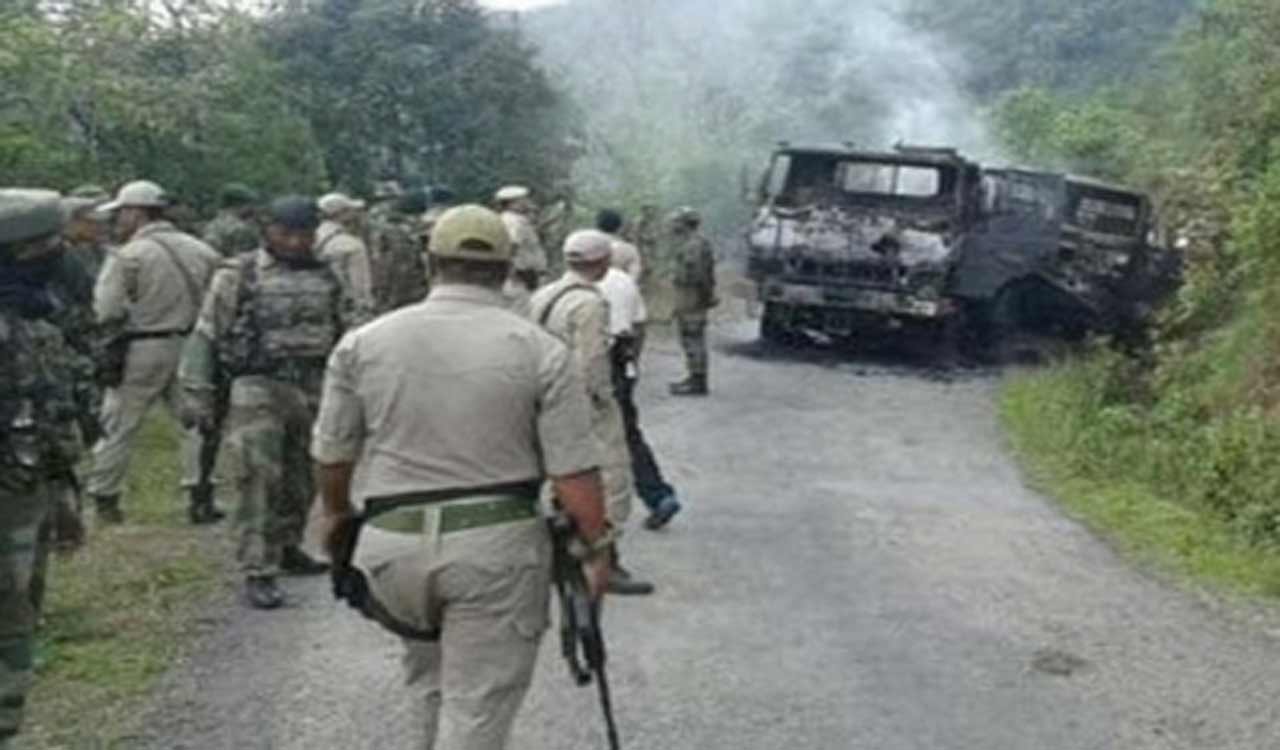
The region consists of 8 states and has some unique characteristics from the rest of the country
Post Date – 06:00 AM, Sat – 05/06/23

Photo: IANS
Imphal: Infiltration from Myanmar, illicit opium poppy cultivation, drug threats, support of some tribal communities by militant groups, perception differences between people living in valleys and mountains, and complex demographics are offshoots of the general unrest in Manipur .
With a population of 45.58 million (according to the 2011 census), the Northeast region exhibits a complex linguistic mosaic and “jealously” preserves more than 200 dialects.
Indigenous tribes make up about 28% of the population, and most of them speak their native or Aboriginal languages.
In addition, a large number of non-tribal populations belonging to Hindu, Muslim and Christian communities, a considerable number of indigenous and Hindi-speaking people live in the region with different lifestyles, cultures, traditions and languages.
Consisting of 8 states, the region has some unique characteristics that differentiate it from the rest of the country.
In Manipur, there are 35 different communities with different lifestyles, cultures, traditions, languages and food habits.
While the Meitei community lives mostly in the valleys and tribes — the predominantly Christian Nagas and Kukis — make up about 40 percent of the state’s roughly 3 million people, living in the mountainous regions that make up most of the state’s land.
Tribes have enjoyed Scheduled Tribal (ST) category status for decades since India’s independence, and they have been strongly opposed to allowing others to have ST category status.
On May 3, thousands of tribals participated in a rally organized by the All Tribal Students’ Union of Manipur (ATSUM) in all 10 hill districts against the inclusion of the Meitei community in the ST class.
The Meitei community – mostly Hindus, who dominate Manipur’s non-tribal population – has demanded ST status for decades, claiming infiltration from Myanmar and Bangladesh has disrupted the demographic structure.
It is worth noting that the fertile and resource-rich valley region accounts for about one-tenth of Manipur’s total land area, while the surrounding mountainous regions, known for militant hideouts and decades of insurgency, account for about one-tenth of the state’s total land area. 90% of the land area land.
The government in Manipur, regardless of which party comes to power in the state, has been dominated by the non-tribal Meiteis, who make up about 53 percent of the state’s population.
In the current 60-member Manipur state assembly, there are 10 MLAs, including five lawmakers from the BJP who belong to the Kuki tribe, while the ruling BJP’s ally, the Kuki People’s Alliance (KPA), has two MLAs.
The Naga Popular Front, which has five lawmakers, is also a partner in the BJP-led government.
About 450,000 people belonging to the Meitei community also live in the Indian states of Assam, Tripura, Meghalaya, Nagaland and other states.
Following the April 3 rally, clashes, attacks, counterattacks and the burning of houses and shops in different communities in different regions forced the authorities to suspend mobile internet services for five days, while also imposing curfews in several tense situations – The mountainous region includes Imphal West, Bishnupur, Jiribam, Tenugopal and Churachandpur.
The state government called up the Army and Assamese Rifles on the night of April 3 to contain ethnic violence in at least six districts.
Earlier, the tribes protested the state government’s move to evict them from forest lands and destroy illegal poppy cultivation in sanctuaries and protected forests and organized protests on March 10 in three districts – Churachandpur, Kangpokpi and Tengnoupal Five people were injured during the rally.
Violence, including arson and vandalism of government properties, erupted in the Churachandpur district on April 27 after tribes launched fresh protests against the state government’s crackdown on illegal poppy cultivation.
Manipur Chief Minister N. Biren Singh has canceled his April 28 visit to Churachandpur district where restraining orders have been banned and mobile internet services have been suspended following violence in April in which ” The gangsters set fire to the venue, burning chairs and damaging other materials.
