It should be used to uphold constitutional values, not against those ideas
Posted Date – Mon, 5/15/23 at 12:33am

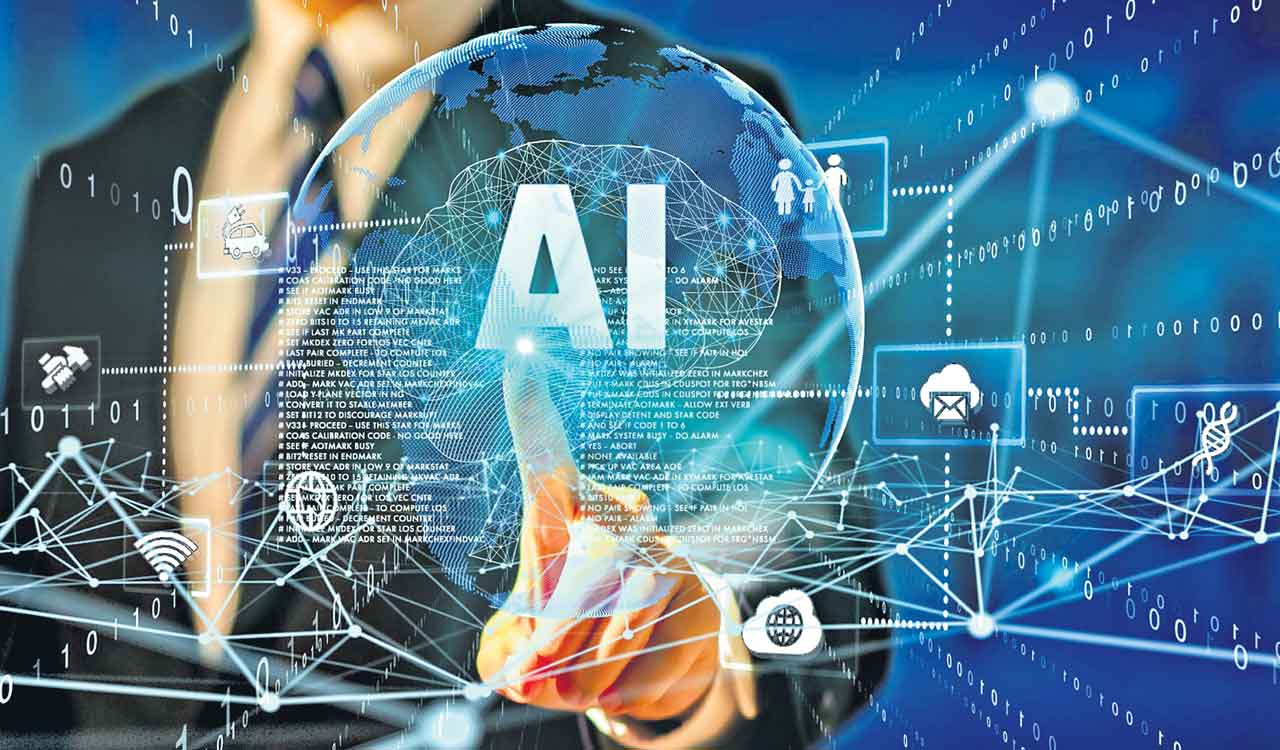
representative image.
by Manish Narwade
Hyderabad: In a recent article in The Economist, Yuval Noah Harari argues that artificial intelligence (AI) has cracked the operating system of human civilization. The AI industry is booming and at its peak, with multinational companies racing to build their own AI. ChatGPT is an artificial intelligence chat box that is trained to follow instructions. Microsoft, Google, and other tech giants have poured billions of dollars into efficient AI toolboxes. However, without formal government guidelines, AI is dangerous not only to the economy but also to humanity.
Apart from the European Union’s General Data Protection Regulation, there are no fixed and clear regulations. Developing countries like India, which have no data protection laws, are far behind in the game. The data protection bill will be tabled in the monsoon session. Hope it gets adopted with proper discussion. The bill may not be a solution to AI regulation, but it will certainly provide some support for developing AI policy.
no clarity
At present, there is a big dilemma in the regulatory process-the government hopes that the industry will have a better self-regulatory mechanism, but the industry says that it needs the government’s explanation to know what to regulate. Developed countries are paving the way to regulate AI. In 2021, the European Commission published a draft artificial intelligence bill. In the US, both houses of Congress have introduced the Algorithmic Accountability Act of 2022. Canada has also proposed an AI and Data Act.
It is important to regulate AI to ensure that it does not impede innovation, but rather aids innovation and the design of efficient systems. The focus must be on risk-based, agile and multi-stakeholder processes rather than one-size-fits-all obligations or prohibitions. Regulation should be guided by three socially conscious ideas – human dignity, diversity and inclusion, and sustainability.
The main challenge that regulators will face is creating a level playing field for AI in the marketplace – with large multinational corporations gaining the upper hand in determining the future of AI technologies. The way forward is to have soft provisions in the innovation segment, such as non-binding codes and standards, and hard provisions, i.e. appropriate codification of data protection and privacy. Regulations should be able to manage the risks of artificial intelligence so that they do not abandon human minds in the future, and at the same time, they should reform and promote the implementation of artificial intelligence.
International authority
The United Nations should create autonomous institutions for AI. These should be fair, and are the torchbearers for nation-states to formulate policies for AI, which can be a tool for reducing inequality. If developed countries own all the innovation, inequality between countries will increase. There will also be a huge gap between developed and developing countries. These autonomous bodies should disseminate information to all countries.
AI tools will also be heavily used in the electoral process. Harari believes that the role of artificial intelligence in the US presidential election may generate a lot of political content, false stories and scriptures to express dissatisfaction with politics, which will lead to social dissatisfaction. One approach is to bring the countries of the Non-Aligned Movement (NAM) under the same umbrella and raise their shared concerns about AI. If poorly regulated, the results will be disruptive and devastating — affecting not millions, but billions. If left unregulated, artificial intelligence will pose a greater threat than nuclear weapons.
Indian case
India is the most populous country, and the impact of AI in the country will be wide-ranging. The Indian government should make the regulation of AI a top priority. The government could form a committee headed by the Ministry of Electronics and Information Technology, union ministers from the Ministry of Science and Technology, the nominee for Leader of the Opposition, lawyers and individuals well versed in the field of AI to formulate policy. India should take the lead on regulation and bring it to the attention of international agencies.
At the same time, countries could set up a committee to examine the changes and reforms that artificial intelligence will bring to their territories. The Indian Economic Monitoring Center reported that India’s unemployment rate climbed to 8.11% in April. Unregulated AI could seriously threaten unemployment. States could also study the impact of AI on unemployment and roll out skills training programs for young people accordingly.
AI should be a tool to bring about political harmony and reduce social and economic inequality, not to create social tension and be a reason for developed countries to exploit less developed ones. Artificial intelligence should not be used as a tool for “technical colonization” of developing and underdeveloped countries. It should be saved from crony capitalism and mercantilism with proper regulation. The technology should be used for the lived experience of democratic and constitutional values, not against those ideas. The only way is through effective regulation.