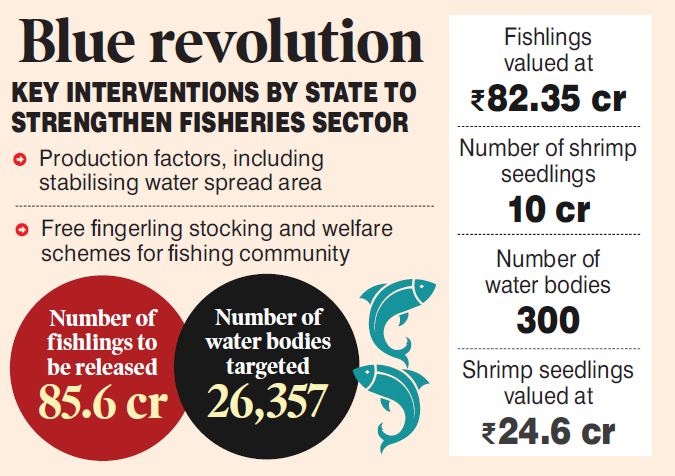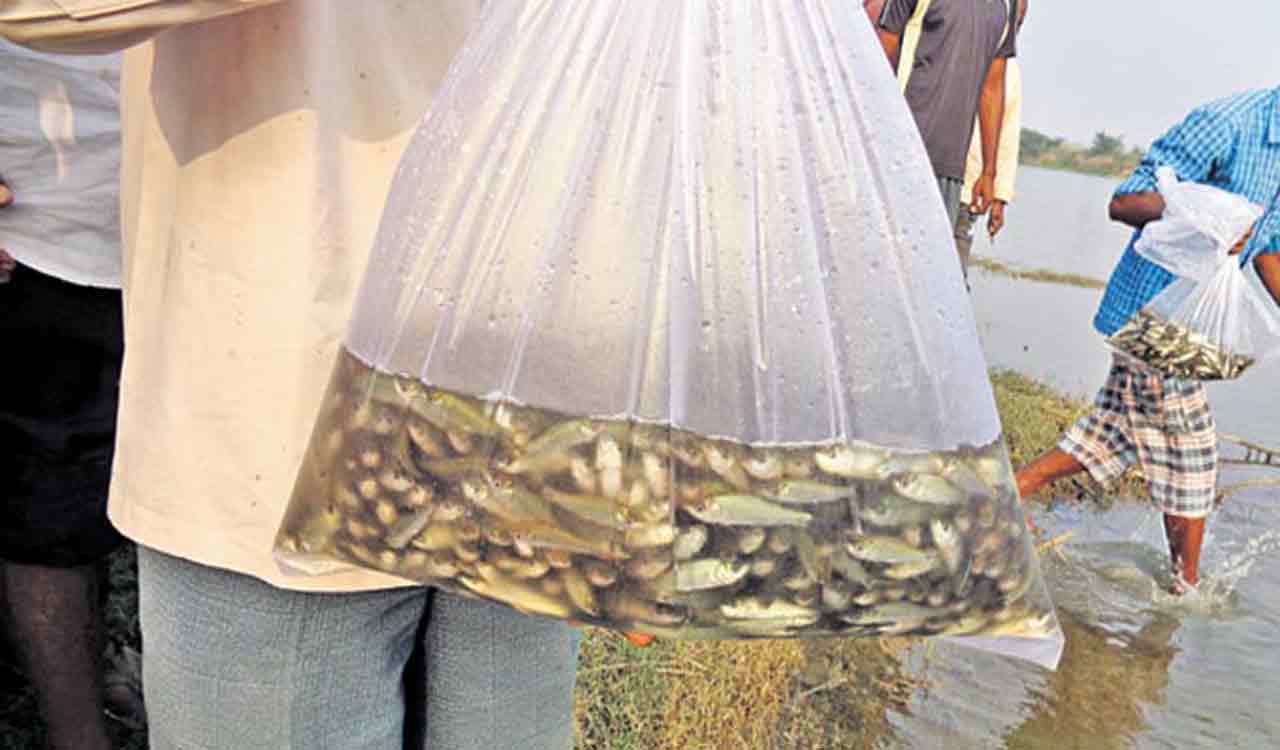
Under the scheme, fish fry worth Rs 823.5 crore will be introduced to 26,357 water bodies including reservoirs, tanks and other aquatic habitats
Published Date – Tue, 23 May 23 at 06:00 AM

file photo
Hyderabad: As the monsoon season approaches, the state government is preparing to release a staggering 856 million fish larvae and another 100 million shrimp larvae into the 26,357 water bodies spread across the region. Tenders have been invited for the supply of fry and prawns at an estimated total cost of Rs 1.07 billion under the fish allocation plan for the current financial year.
Under the plan, which is expected to accelerate the state-led blue revolution, fish fry worth Rs 823.5 crore will be introduced to 26,357 water bodies including reservoirs, tanks and other aquatic habitats. In addition, shrimp fry worth Rs 246 million will be introduced into 300 major water bodies for farming.
Telangana has the third largest inland water body in the country, covering an area of 573,000 square kilometers of various water bodies including reservoirs.
To boost fisheries production and support sustainable livelihoods of fishers, the Telangana State Government started free distribution of fry in about 11,067 water bodies during 2017-18. This resulted in the stocking of about 510.8 million fry at a cost of Rs. 446 crore resulting in a fish production of 2.62 lakh tonnes after 8-10 months.
Since then, the number of fish and shrimp released into water bodies, including reservoirs and tanks, has increased significantly. Currently, Telangana ranks fifth in terms of freshwater fish production with an estimated value of Rs 6,100 crore in 2022-23. This is a three-fold increase compared to the fish production of Rs 1,993 crore recorded in 2017-18. Shrimp production has also experienced a considerable increase over the same period from 7.78 tonnes worth Rs 1,712.3 crore in 2017-18 to 11,734 tonnes worth around Rs 4,250 crore in 2022-23.
The average income level of the Fisherman’s Cooperative Society (FCS) and its members has increased significantly as a result of various intervention programs implemented by the state government. The number of FCSs increased by 15% from 4,002 in 2016-17 to 4,604 in 2020-21, while the number of members increased by 8% over the same period, from 285,000 in 2016-17 to 4,604 in 2020-21 309,000.
The state government has recently invited applications to establish more FCS, with an estimated total membership of nearly 400,000 fishermen.