Biden’s decision to pull out of summit highlights the group’s limitations
Posted on – Wed, 5/24/23 at 12:45pm

james laurenson
Hyderabad: The fact that US President Joe Biden felt he had no choice but to prioritize domestic politics over attending the Quad summit in Sydney, which led to the cancellation of the entire event, highlights one of the group’s limitations.
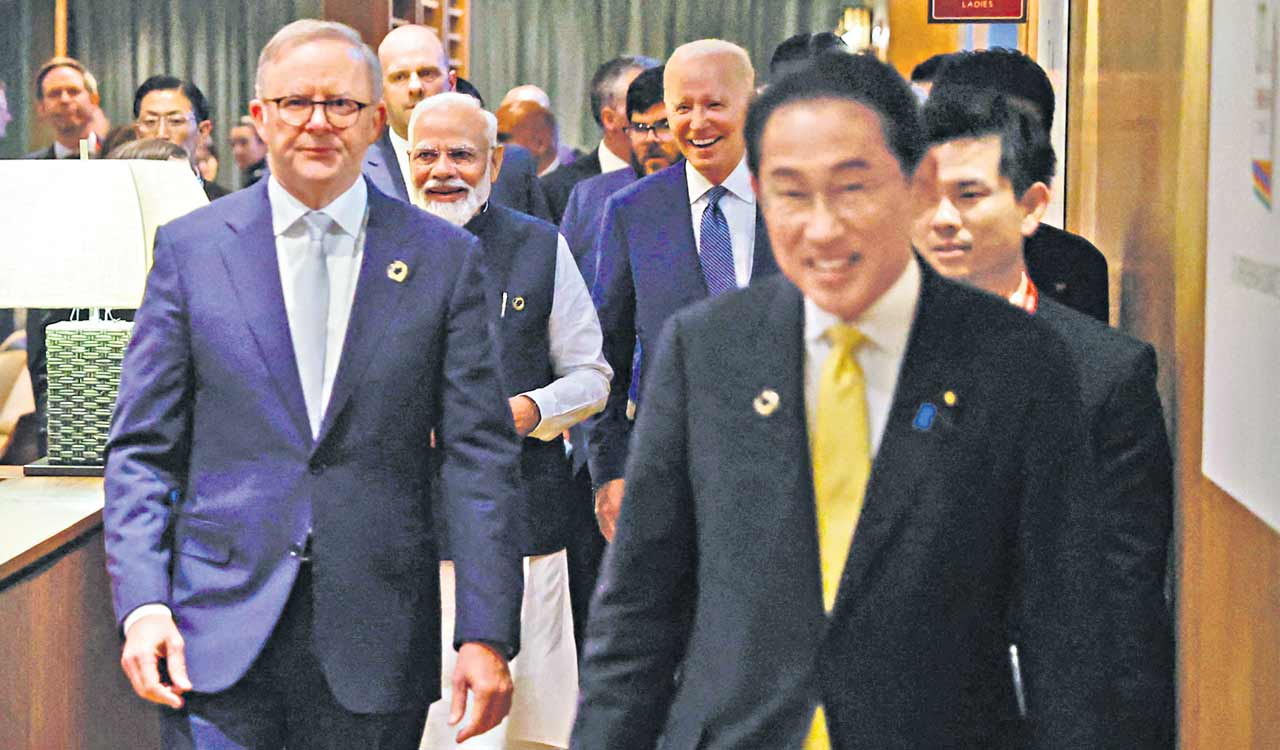
The Quad often draws rousing commentary to the effect that four of the world’s most powerful democracies (Australia, India, Japan and the United States) are rising to meet the threat posed by an increasingly assertive China.
At the Quartet’s first ministerial meeting in 2019, then-Secretary of State Mike Pompeo shined: “We’ve reconvened the ‘Quartet’ — and it turns out that it’s important for the future. It is very important to ensure that China retains only its rightful place in the world.”
Relations with China
Australia’s prime minister, Anthony Albanese, has also embraced the quartet since winning power last May. His first move as prime minister was to attend last year’s leaders’ summit in Tokyo, and he said he was “honored” to “use our collective strength to help Australia advance its interests” when announcing that it would be held in Sydney this year.
But at the same time, Canberra will not only be able to “stabilize”, but also moderately improve Australia’s relationship with China. Evening the circle owes much to the Quad throwing its initial billing as a “safety talk,” even if the excited reviews haven’t quite caught up. In 2020, at another quadrilateral meeting of foreign ministers, Pompeo still insisted that its purpose was to “address the challenge that the Chinese Communist Party poses to all of us.”
But Pompeo’s counterparts didn’t even mention China in their opening remarks. Australia’s then foreign minister, Marise Payne, instead focused on the quartet’s “positive agenda”, describing it as a “diplomatic network”. A Japanese government spokesman said he was not sure what Pompeo meant.
Quartet spirit
By the time the first leaders meet in March 2021, with the Trump administration losing jobs in the US, the new consensus position will be clear. The four leaders said the “quartet spirit” involved providing a “positive vision” for the region. Check out the website of the Australian Government’s Department of Foreign Affairs and Trade today and you’ll learn that the quartet has an “aggressive, pragmatic agenda to address the region’s most pressing challenges”.
These include “Covid-19 vaccines, climate change, infrastructure, critical and emerging technologies, cybersecurity, humanitarian aid and disaster relief, space, maritime security, countering disinformation and counterterrorism”.
Some intransigence from Beijing can be seen in these areas, but it is a far cry from the hard-line quartet that China hawks thought was within reach a few years ago and some urged the group to recapture.
Several factors could explain the angular quad’s demise. India’s growing self-confidence may be most important.
Despite the daunting challenges it faces in dealing with Beijing, New Delhi does not seem to feel the need to align itself with Washington or Tokyo, let alone Canberra.
Consider New Delhi’s different response to Russia’s invasion of Ukraine last February. The move not to condemn Moscow is just the beginning. Six months after the war broke out, Indian Prime Minister Narendra Modi met Russian President Vladimir Putin and said the two countries share an “unbreakable friendship” while saying “this is not an era of war”.
Indian Foreign Minister Jaishankar subsequently visited Moscow and said that in recent years, the two sides “have been looking for ways to expand this relationship”, while describing the India-Russia bilateral relationship as one of the “most stable” bilateral relationships among major global powers.
This year, New Delhi opted out of discussions on the trade pillar of the Biden administration’s Indo-Pacific economic framework, although its end is expected to be non-binding. But it has confirmed “advanced talks” with Moscow on a free trade agreement.
delivery on agenda
China hawk preferences aside, there is nothing wrong with the Quad now having an “aggressive agenda”. It does, however, present challenges to achieving that agenda—a daunting task given its bewildering scope. Early signs are not encouraging.
In March 2021, the quartet of governments announced a “vaccine partnership” that would provide “at least 1 billion [Covid-19] Dose… by the end of 2022”. The idea is to leverage US technology, Japanese financing and Indian manufacturing. Therein lies the first problem: Australia has little to offer beyond a brief reference to a contribution of “$77 million to provide Vaccines and ‘last mile’ delivery support”.
The next issue is speed. The first batch of Quad vaccines will not be shipped to Cambodia until April 2022, and only 3,25,000 doses will be delivered. The “partnership” announcement came amid a virus wave in India, and New Delhi responded by imposing an export ban on vaccines to prioritize domestic supplies. The ban was not lifted in seven months.
The four governments are also betting that a single vaccine, formulated by a US company, will be produced at a factory in Hyderabad. This is understandable, since bureaucrats are tasked with coordinating supply chains with which they have no experience, but from a project planning and risk management standpoint, it’s a failure to wait.
Their bet hit trouble when the U.S. Food and Drug Administration restricted access to the vaccine over concerns it could cause blood clots and the Indian government refused to sign a waiver.
The Quad ended up making its first donation to Cambodia through a different channel than originally planned, and by then the doses had become so plentiful that the problem, one Indian expert told The Hindu, was that “donors were struggling to find willing recipients.” people”.
This should be a learning experience for quartet leaders: stop chasing headlines and spinning narratives, and stick to where real value can be added. A proposal at last year’s Quad summit, the Maritime Domain Awareness Initiative, has real appeal because the region is prone to natural disasters and smaller states often lack the capacity to combat scourges such as illegal fishing.
Others, such as devoting resources to collaborating on critical and emerging technologies, should be treated with the same skepticism as vaccines. Of course, it is also important to harness the potential of these technologies and manage the associated risks. But, for example, setting technical standards cannot be done with just four players. In some technologies, the global leaders are not within the Quad. In the clean energy supply chain, an important partner is China.
That’s why whenever and wherever the next meeting of the quartet leaders takes place, any claim other than seeing it as a diplomatic achievement is taken with a grain of salt. 360 information