


the region is critical to China’s attempt to create an alternative to the liberal order led by the United States
Posted Date – Sat 5/27/23 at 12:45pm
stefan wolf
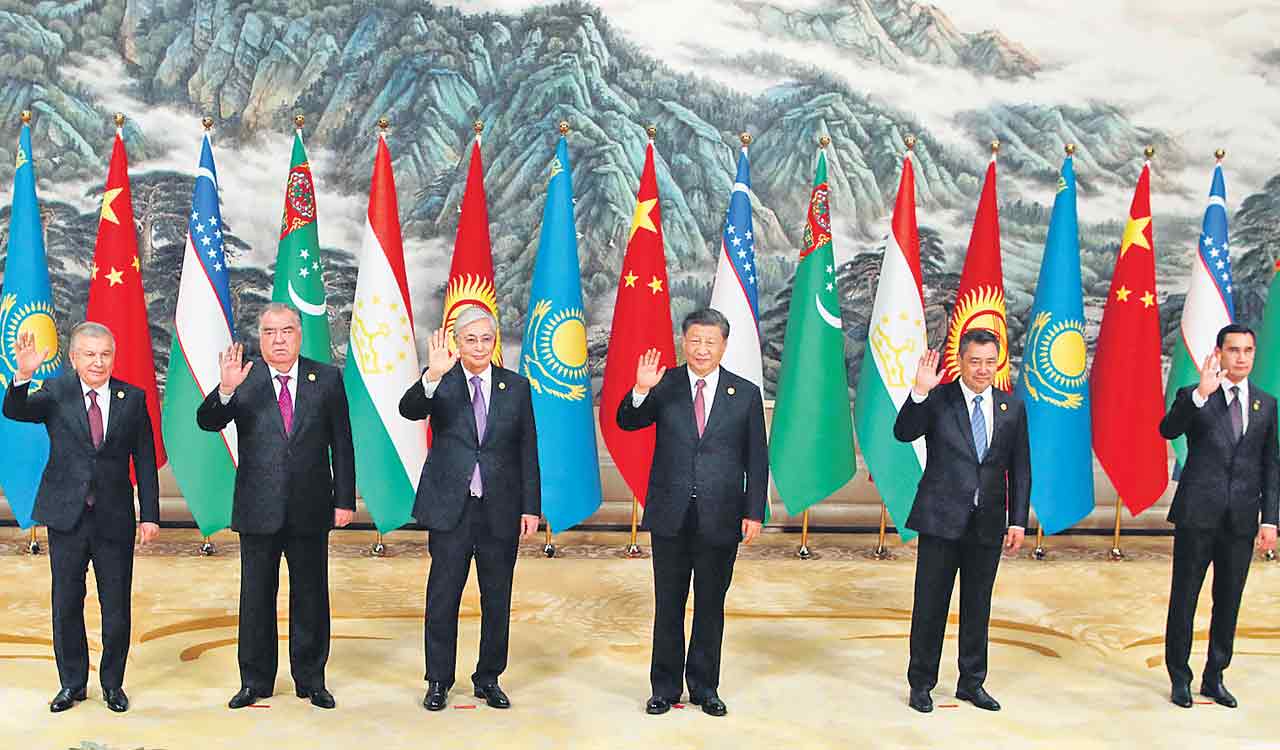
Hyderabad: As G7 leaders prepare for their recent summit in Japan, Chinese President Xi Jinping hosted Central Asian leaders from Kazakhstan, Kyrgyzstan, Tajikistan, Turkmenistan and Uzbekistan.
Central Asia is central to China’s attempt to create an alternative to the liberal order led by the United States, one that is undoubtedly dominated by Beijing and in which Russia is at best a minor partner.
In his opening speech, Xi outlined his “Vision of a China-Central Asia Community with a Shared Future”. This will be based on four principles: mutual assistance, common development, universal security, and friendship from generation to generation.
While the relationship between China and Central Asia is usually defined in terms of security and development, it also has a political dimension. This is on full display in the initiative launched at the Xi’an summit to create more regional cooperation.
These recommendations recommend that Chinese ministries and government agencies establish links with their counterparts in Central Asia, strengthen educational and cultural exchanges, and establish mechanisms such as the Central Asia-China Business Council. All of this could further cement China’s dominance in the region.
In return, China will insulate Central Asia’s authoritarian leaders from Western economic and political pressure to move toward democracy and protect their sovereignty and territorial integrity from any Russian adventurism.
Summit Outcomes
The summit reached an astonishing 54 agreements, 19 new cooperation mechanisms and platforms, and 9 multilateral documents including the “Xi’an Declaration”.
Even if one sees much of this as uncertain about actual implementation, China’s regional importance is unquestionable. For example, according to UN statistics, the volume of trade in goods between China and the five countries in the region has grown from a mere US$460 million three decades ago to more than US$70 billion in 2022, an increase of 150 times.
Historically, Russia has been a major partner in Central Asia, dating back to the days of the Soviet Union and the first decade after its collapse. But Moscow can no longer match the value of Chinese investment and construction contracts in Central Asia, which now total nearly $70 billion since 2005.
Takeover from Russia
The shift toward China is also reflected in the declining importance of Russia’s regional integration project, the Eurasian Economic Union, compared with China’s massive global Belt and Road Initiative. The infrastructure investment plan, launched by Xi Jinping in Kazakhstan in 2013, has since brought the region closer economically and politically to China.
The “Belt and Road” initiative occupies a prominent position in the Xi’an Declaration, clearly linking it to the development strategies of Central Asian countries.
transport connection
Countries at the summit recommitted to building the China-Kyrgyzstan-Uzbekistan railway, building highways from China to Kyrgyzstan, Tajikistan and Uzbekistan, and transport infrastructure for trans-Caspian trade routes using seaports in Kazakhstan and Turkmenistan.
This focus on transport infrastructure in Central Asia, and Central Asia as a whole, underscores the region’s importance to China’s attempt to diversify its trade routes from Russia to Europe. It also means that China will now continue to use infrastructure development and trade to recruit more partners for its alternative international order.
Russia’s “Northern Corridor” is now largely closed due to sanctions related to the Ukraine war. As a result, this route, often called the Middle Corridor, has regained importance not only for China but also for the G7 countries.
However, the only option for an intermediate corridor starting in Turkey and continuing through Georgia and Central Asia is risky for China. Its capacity is low (currently only about 5% of the northern corridor) because goods have to cross multiple borders and switch between road, rail and sea several times.
role of afghanistan
Another option with similar geopolitical implications is shipping to the Arabian Sea via Afghanistan via the Pakistani port of Gwadar. In the long run, the route through Afghanistan is in the interests of both China and Central Asia. It will contribute to (but also depend on) the stability and security of Afghanistan. It will also reduce the risks faced by China related to the existing routes along the CPEC, especially those posed by the Pakistani Taliban insurgency.
With this in mind, China and its Central Asian partners are committed to developing transportation capabilities in the Uzbek city of Termez, which borders Afghanistan. China also now has an official position on Afghanistan, which Xi Jinping singled out in his speech at the summit. Therefore, more regional participation is expected.
Despite the obvious risks associated with Afghanistan, China is likely to include a trans-Afghan trade route in its plans. This can also be seen in the fact that Beijing appears unwilling to engage with Russia and Iran on international north-south transport corridors. Both Russia and Iran face tough international sanctions, and recent tensions between Iran and Azerbaijan have raised further doubts about the long-term viability of the route.
The warm welcome of these initiatives by the five Central Asian heads of state showed how eagerly they embraced China. However, it remains to be seen how sustainable or popular this approach will be, given the rather prevalent anti-China sentiment in the region. www.theconversation.com
