Life is chemistry—organic matter formed from inorganic matter
Posted Date – 12:30 AM, Fri – 09/06/23

Pramod K Nayyar
While philosophers, theologians, biblical experts have been debating the meaning of life, biologists talk about chemicals that are activated under certain conditions to produce what we define as life. But with the advent of evolutionary biologists, we began to think of life not as autonomous, bounded, and independent, but as being made up of multiple life forms, including bacteria.
Influenced by these theories, and anticipating some of them—for literature is not only about what is, but also about what might be—literary texts have always nature Life forms that transform, merge, erode and become something else.
human animal
The horrors of Gregor Samsa in Kafka’s iconic text, this abnormal, not that he turned into an insect, but that the transformation was never complete: even though some of his perceptual frames became insect-like, he kept his human consciousness inside the insect. For those around him, all they saw was a bug. His family was ambivalent about him because they understood in some vague way that Gregor was still there somewhere.
Alan Moore’s classic of the same name, the “swamp monster,” a human plant creature that retains a human consciousness.In David Garnett’s 1922 novella lady becomes fox, Mrs. Tabrick turns into a fox. Immediately after this transformation, Tebrick “saw his wife looking at him with animal eyes.” He found that inside the fox, which was still his wife, she retained her human cognitive faculties and consciousness in Tebrick’s view: he spoke, though she was dumb, she was fluent through expressions and gestures expresses itself well, though never through voice. “
At Marie Darrieussecq’s pig story, A woman, over time, becomes a pig.
In the works of Kafka and Dariuszek, the transition to the animal is often seen by critics as a signal of the dehumanization of humans in contemporary society. As critic Anat Pick put it on Darrieussecq’s story:
“The protagonist’s perversion appears to be merely an accompaniment to her day-to-day experiences in which she is physically violated by male managers and clients who specifically ‘animalize’ her.”
However, the altered human variants don’t just take on human-machine or human-beast forms.
mineral man
Spider-Man has to fight Sandman (Marko) – which is sadly impossible – and he really flows like sand because his molecular structure has the characteristics of sand.In Carol Shields’s stone diary, The main character, Daisy Stone Flett, imagines her body changing: “living cells” will be encased in “mineral deposits” and “the folds of her clothes are so raw and stiff, embellished The edge of sex softens, the calcareous edge of the shell’.
In AS Byatt’s little-known story “The Woman of Stone”, the woman Ines is slowly turned to stone. In the prologue, we are told that Inés is grieving: “sorrow makes her unreal”. As the story progresses, grief makes the age-old trope of the heart knotted into a stone become literal. She “became a mineral”. Byatt charts the slow evolution of women, if so, to stone men:
“Hot liquid welled up in her eye sockets, and pearly drops fell on her ruddy hematite cheeks…her cheeks began to grow silica flakes and dendritic fibers…a liquid of alabaster and olivine Drops gathered in her gray hair like some people’s eggs. Stone lice in mythology.”
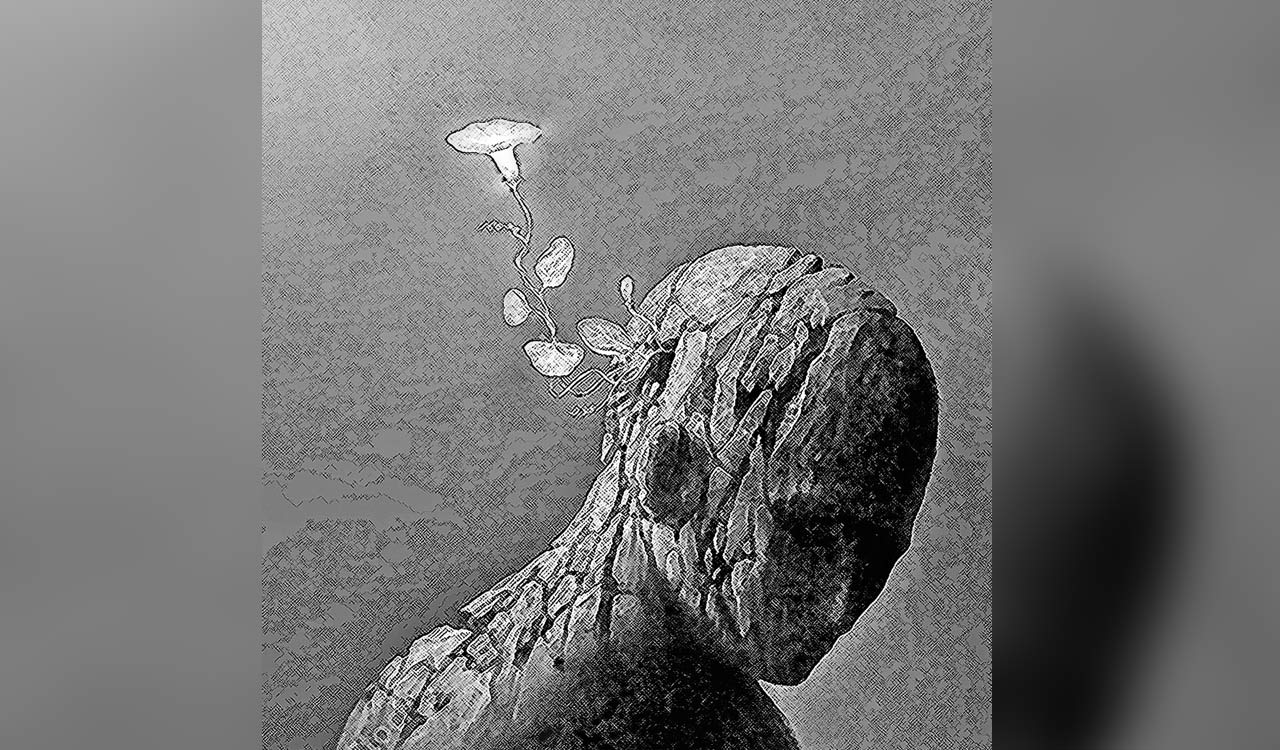
Ines herself becomes a stone garden: “She plants little gardens in the crevices of her body, creepers and wormwood. Creatures run past her—insects first, a stone-coloured butterfly , indistinguishable from her speckled breast, and foraging ants, and a millipede. There were even thin red worms, the color of raw flesh, slithering around with impunity. She started walking more, Take these things with you.”
She began to feel an affinity with the stone statue. Eventually, Ines went to the stone troll on the mountain.
These stories point to another aspect of life. Fossils and bones make up life forms, and when life forms end, they return to Earth to feed the soil and other life forms, and to cycle minerals. Bones and fossils represent a different dimension of time – the passing of life – that intersects with our own. What makes up life forms, then, are chemicals from preexisting life forms. In other words, organic matter is formed from non-organic matter.
Beyond Humanity’s Future
at Greg Bear’s darwin’s childThe offspring that appeared after the SHEVA virus ravaged the world, although they look human, they are hybrids with special abilities. In Jeff Lemire’s sprawling graphic novel, sweet toothLikewise, human animals born after plagues were hunted by human survivors for biomedical experiments. Much of Octavia Butler’s work is designed to suggest that humans cannot survive unless they cross species boundaries.
In Butler and Lemire, the hybrids (human-alien in Butler, human-animal in Lemire) start over. Butler and Lemire argue that hybrids are more likely to continue humans, albeit in new forms. Gus of Lemire – “Deer Boy”, now a man – at sweet tooth:
“The age of man is over. They had a chance to live in harmony with the land, but they failed.
Then we were born. mongrel. We are one with the land. One with the animal that walks it. But we also have a human heritage in our blood and bones, so we are no better than them. We also fall. We can also fail. We must not, like humans, forget the faces of the gods…because their faces are our faces. For this, we leave this hide to feed the wolves. Dedicated to the land that raised us. “
In her stunning novel, dark constellation, Pola Oloixarac speaks of “the strange relationship between plants and insects”, “the secret contract between species”. Most metaphors are species fluid: women are like spiders, palms are like octopuses, lakes are like sluggish blue animals, greenhouses are like insects, spoons are like butterflies, branches are like coral reefs, clouds are like swans, voices are like crocodile eyes, rivers like a snake.
Contemporary literature suggests that the future is irreversibly multi-species.