

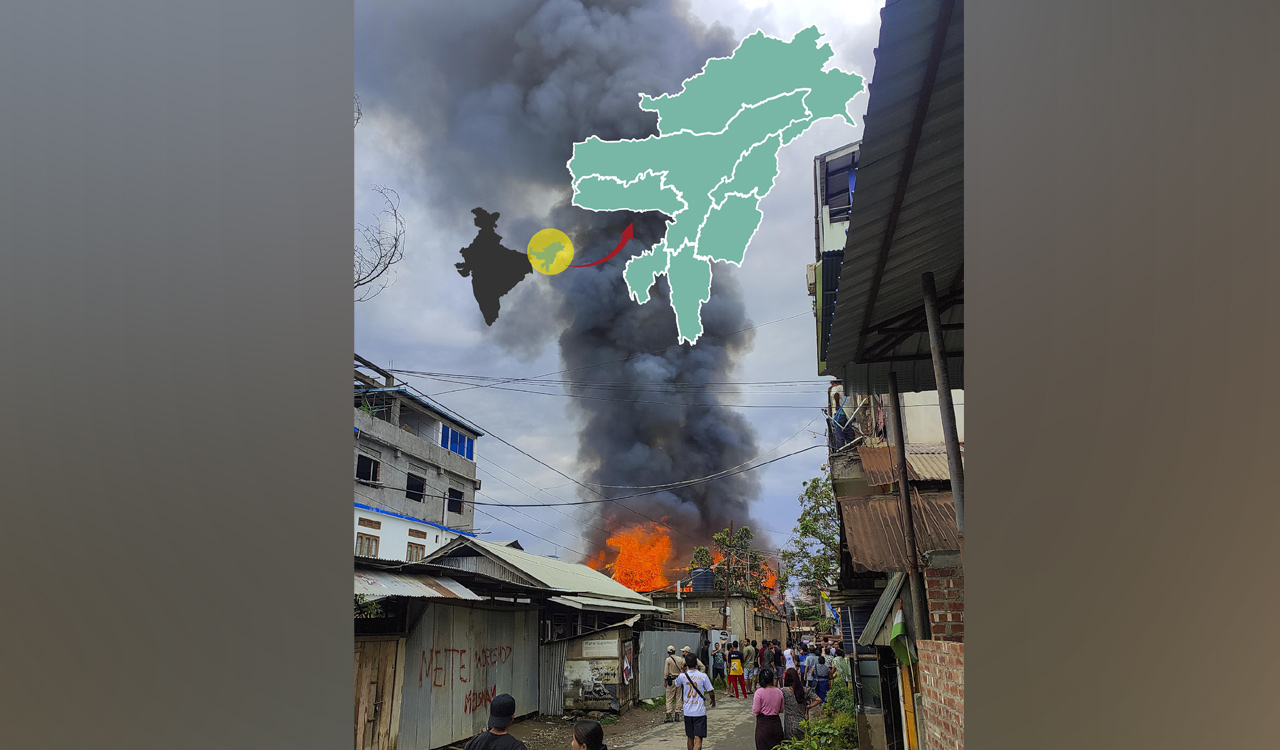
The flames of violence engulfing Manipur are a perfect example of the cracks in the self-proclaimed sisterhood and the collective power and harmony within it
UPDATE – 01:42AM, SUNDAY – 6/18/23

by Rituparna Kaushik Bhattacharya
Northeast India has long been seen as the unifying thread of the Seven Sisters, whose close-knit community, customs and closeness to nature lead to a mystical extended family. While there’s always more to the eye than meets the eye, the uneven terrain and geopolitical differences between and within the Northeast’s states have never been more apparent. The flames of violence that have engulfed Manipur recently are a perfect example of the cracks in the purported sisterhood and the collective power and harmony within it.
To understand the internal dichotomy of Northeast states requires looking back and beyond AFSPA’s perspective [Armed Forces (Special Powers) Act] or rebellion, and take a broader perspective through the lens of community, tribal rights, land ownership, dependence on forests, and economic opportunity.
land at the core
A unique tribal way of life in sync with nature existed in all of the northeastern states even before independence, where land ownership was driven by communities and economic opportunity was attached to the land, creating a unique system of socioeconomic structures. After independence, however, a new system of government ownership emerged in India, with the state or central government becoming the new owner of the land, rather than the community. However, geographic distance and difficult terrain have made the region slow to catch up to union oversight. But, because of the fluidity of the eastern border, the desire to coexist with one’s own community, with one’s own tribal structure and way of life, is very high.
The indigenous versus outsider debate has dogged the states of Assam, Tripura and Manipur since independence, believed to be due to loosely defined communities and boundaries
For too long, the central government has neglected the wishes and aspirations of the region, resulting in many loopholes in the governance system of the northeastern states, which have since become fertile ground for the breeding of a militant ideology echoing ancient living traditions among their own tribal communities. Own land rights and economic dependence on land. For decades, this struggle has been a matter of debate between outsiders and insiders in every Northeastern state. For example, in Nagaland, the main insurgency struggle is/will have a larger Nagalim, indicating greater autonomy for all Nagas in Northeast and Burma in terms of socioeconomic needs, including land rights. A similar struggle can be seen in Tripura, where the rights and way of life of the tribal Tripuri do not align with those of the immigrant Bengali. Eventually, these struggles took a sharp turn and became cultural issues and struggles between natives and outsiders.
race, identity politics
This brings us to several key questions. First, how are racial and cultural identities constructed, and how are exclusive territorial/land claims in Northeast India justified? Second, what are the alleged consequences of this form of racial nationalism? The multifaceted nature of ethnic conflicts in the Northeast reflects the complexities of ethnic and identity politics that exist in multicultural societies.
With a glance at the recent violence in Manipur, we have textbook examples of both issues explained in terms of culture, identity, tradition, territory and ownership. Traditionally, land rights belong to the tribal communities who live there, and as such, they have the right to develop the land and forest economically, while being mindful of natural sensitivities.
In Manipur, the majority of the Meitei community that once ruled the state until joining India lived in the state’s valleys, which accounted for 10 percent of the state’s land area. The rest of the state is mountainous and ruled by Nagas and Kukis, tribes belonging to different groups. Most of these ethnic groups within the Naga tribe would fall under the minority category due to their unique dialects, origins and unique cultural practices. However, there is a process of recognizing the Naga as a people claiming “self-government”. As non-tribes, the Meiteis were prohibited from settling the hills of the state with very few exceptions. However, the tribal population – mainly the Nagas and Kukis, who make up 40% of the state’s population – live in the reserved mountains, which comprise the remaining 90% of the state’s population, and settlement in the valley areas is not prohibited.
Although many will claim that this is a war of native vs non-native, it is more of a war over land and mining rights and a cultural tug of war where no one is willing to budge
Furthermore, the Meiteis ruled the country and exerted political, economic and cultural influence over the country, yet had no access to 90% of the country’s land rights. There has been a political and cultural discord between these communities that has been slowly brewing for decades. Economically disadvantaged, the Kukis and Nagas depend on the mountains and forests for their livelihoods. Since Manipur in general is also discriminated against by the central government, their disadvantage is even worse, then the Kukis and Nagas are further marginalized from the state. The relentless struggle over land rights has prompted the Manipur state government to introduce measures aimed at driving unauthorized migrants out of settlements located in reserved forest areas.
immigration issue
According to officials, illegal Naga immigrants from Myanmar have been settling in Manipur since the 1970s. Instead, tribal communities argue that claims of illegal immigration are an excuse for the Meitei population to dispossess tribal populations of their ancestral lands. In February 2023, the ruling government launched an eviction campaign against the Churachandpur, Kangpokpi and Tengnoupal districts, labeling the forest dwellers as trespassers—an action seen as hostility and discrimination against tribal groups. The development also highlights that despite its geographical distance from the Indian mainland, the Northeast has been facing immigration issues, leading to socio-cultural clashes and political system instability. The indigenous-versus-outsider debate has plagued the states of Assam, Tripura and Manipur since independence. Many believe this happened due to loosely defined communities and international borders that were suddenly drawn on the map after independence.
Following similar arguments, in March 2023 several Manipuri (Meitei) groups staged a demonstration in New Delhi advocating the creation of a National Register of Citizens (NRC) with 1951 as the reference year. Their grievances center on abnormal population growth and deforestation in the mountains. Five people were injured in clashes that initially erupted in the Kangpokpi district, where protesters had gathered for a rally against “the encroachment of tribal lands under the guise of preserving forests, protected forests and wildlife sanctuaries”.
In response, the state cabinet stated that the government will continue to implement measures to protect the state’s forest resources and eliminate poppy cultivation. Subsequently, on April 11, 2023, three churches located in the Imphal tribal colony were demolished for “illegal construction” on government-owned land.
The rights and way of life of the tribal Tripuri people are not in line with the immigrant Bengalis who resort to violent conversion and become a cultural issue and the struggle of natives and aliens
Subsequently, on April 20, the Manipur High Court directed the state government to “consider the appeal of the Meitei community for their inclusion in the List of Scheduled Tribes (ST).” This development sparked outrage among the Kuki and Naga communities. Concern as they fear that granting Meiteis ST status will enable most groups to acquire land in restricted hilly areas, thereby displacing them from their homeland and forests. And just like that, the final nail in the coffin was hammered, with Manipur plunged into severe violence and the state still reeling.
While many will claim this is a war of native versus non-native, it is more of a war over land and mining rights, and a cultural tug of war in which no one is willing to budge. Fears that the Naga will lose their tenure to forestland indicate their economic dependence on a finite resource, but destruction of forest cover, interest in poppy cultivation and rampant drug smuggling all point to exploitation.
cut off from nature
The lack of sustainable economic opportunity and easy money paths through drug trafficking has permeated nearly every state in the Northeast, forcing its people to sever their decades-long ties to nature and develop a stronger sense of national territory.
In February, Manipur’s ruling government launched an eviction campaign against Churachandpur, Kangpokpi and Tengnoupal districts, labeling forest dwellers as squatters
After the end of illegal coal mining which nearly destroyed and hollowed out the Khasi, Jainthia and Garo hills in Meghalaya, people are now starting the illegal timber trade and drug trafficking through Bangladesh to East Asia. However, loose border definitions and an inherent territorial culture have divided Khasis and Assamese over forest development, as Meghalaya-to-Meghalaya forest boundaries are not strictly defined. On November 22, 2022, these disputes led to a deadly clash between rangers in Assam and the Khasis over mining the forest. Similar incidents also took place in Rakhimpur in northern Assam state, which borders Arunachal Pradesh. Conflicts between Assam and Nagaland over forests and territory have been brewing for decades, and all border regions face conflicts of a similar nature.
Whereas in the past ethnic territorialities were created out of the need to address the common concerns of constitutive groups, in the present era they are instrumentally created by outside agencies from culturally diverse and geographically dispersed communities to satisfy the latter’s economic And political purposes. Land remains, as ever, a major political agenda, sparking racial and cultural conflicts among diverse groups. In the geographically limited Northeast, home to numerous ethnic communities, disputes over land ownership and territorial claims naturally fuel conflict.
Nagas’ fear of losing their forest land tenure demonstrates their economic dependence on a finite resource, but destruction of forest cover, interest in poppy cultivation and rampant drug smuggling all point to exploitation
Even among tribal groups, conflicts arise over ownership and territorial issues. A notable example is the conflict surrounding the demand for Moreh, an important economic and political center in Tengnoupal, which the Nagas claimed as their ancestral province. Rather, Moreh is also the focus of the Kuki community’s political ambitions known as “Zale’n-gam”. These territorial politics are repeatedly manifested through the demands of underground extremist groups representing powerful tribes such as the Kukis, Nagas and Mizos. It is important to acknowledge that these conflicts had profound consequences for the smaller intermediate tribes involved in such conflicts.
The recent conflict in Manipur has caused severe displacement and suffering. These conflicts are the result of minorities’ desire for exclusive territories based on their nationalistic and cultural ideals. This desire is bred by the politics of racial identity, culture wars, and resistance. As in all cases in the past, issues of land, culture, and national identity have become central concerns for all ethnic communities and belonging in the Northeast.
Rituparna Kaushik Bhattacharya (The author is an economics researcher from Assam and an assistant professor at FLAME University, Pune. Opinions are personal)
