

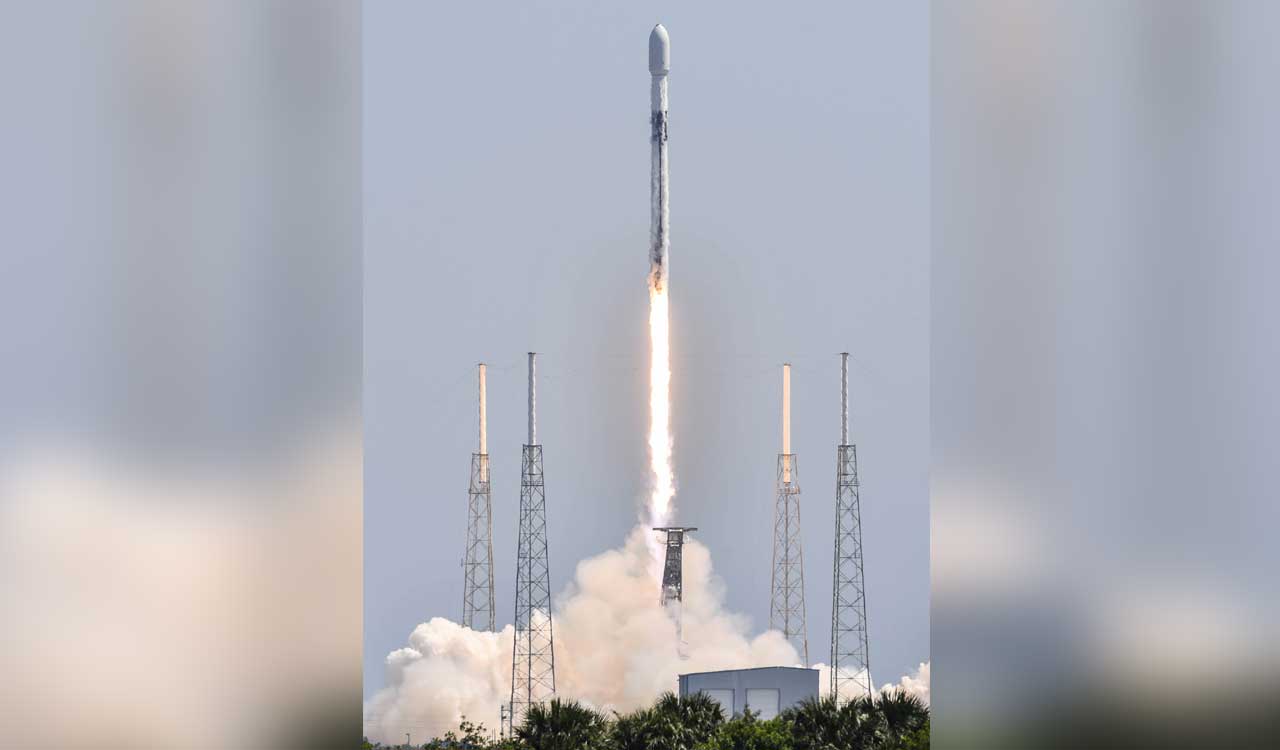
The European space telescope launched on Saturday to explore the mysterious and invisible realm known as the dark universe
Release date – Sunday 23 July 06:20

Cape Canaveral: A European space telescope launched on Saturday aimed at exploring the mysterious and invisible realm known as the dark universe.
SpaceX launched the European Space Agency’s Euclid Observatory 1 million miles (1.5 million kilometers) to its final destination, near the Webb Space Telescope.
It will take a month to achieve this and two more months before the ambitious six-year survey begins this fall.
Flight controllers in Germany declared success nearly an hour into the flight, clapping and chanting “Yes!” and calling home after the telescope lifted off without a hitch.
“I’m thrilled and happy to see this space mission now because I know it’s on its way,” ESA chief Joseph Aschbach said from the Florida launch site.
Euclid, named after the ancient Greek mathematician, will search the billions of galaxies covering more than one-third of the sky. By pinpointing the positions and shapes of galaxies 10 billion light-years away — dating back almost to the Big Bang when the universe was created — scientists hope to gain insight into the dark energy and dark matter that make up most of the universe, keeping it expanding.
Scientists only understand 5% of the universe: stars, planets and us. ESA science director Carol Mundell said before liftoff that the rest “remains a mystery and a huge frontier in modern physics, and we hope this mission will really help push that forward.” cutting edge”.
The telescope’s much-anticipated 3D map of the universe will span space and time to explain how the dark universe evolves and why its expansion accelerates.
Euclid will measure dark energy and dark matter with unprecedented precision, said the lead scientist on the $1.5 billion (€1.4 billion) mission.
“It’s not just a space telescope, Euclid. It’s really a dark energy detector,” points out Rene Laureijs.
Euclid is 15 feet (4.7 meters) tall and nearly as wide, with a 1.2-meter (4-foot) telescope and two scientific instruments capable of observing the universe in visible and near-infrared light. The huge sunshade is designed to keep sensitive systems at a decent cold temperature.
NASA, which contributed to the Euclid Infrared Probe, also has its own mission to better understand dark energy and dark matter: the Roman Space Telescope will launch in 2027. The U.S.-Europe Webb Telescope could also join the mission, officials said.
Euclid was supposed to launch on a Russian rocket from French Guiana in South America (the main spaceport in Europe). After the invasion of Ukraine last year, the European and Russian space agencies severed ties, and the telescope was flown by SpaceX aboard Cape Canaveral instead. Project manager Giuseppe Racca said waiting for Europe’s next generation Ariane rocket, which has yet to make its first flight, would mean a delay of more than two years.
