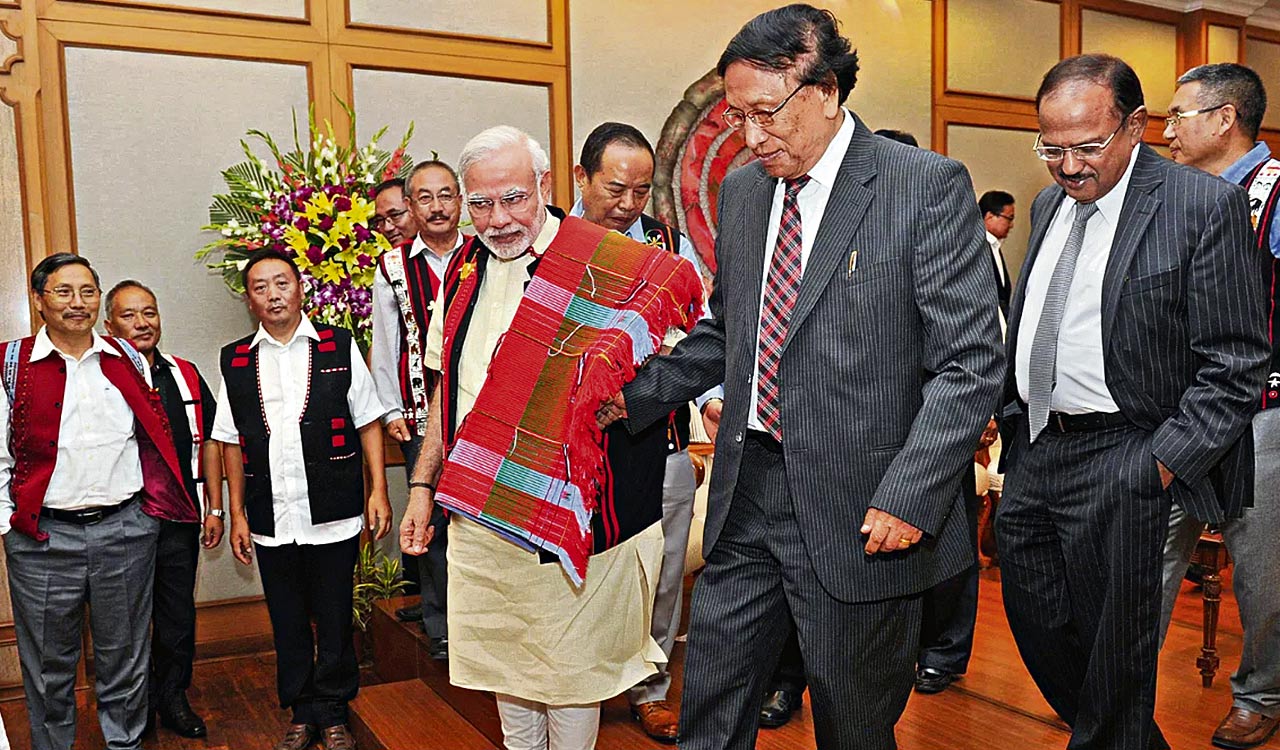
NSCN (IM) Secretary-General Thuingalen Muivah is from Manipur and the situation will be further complicated if the peace talks fail and the Nagas in the Manipur area go on to insurrection
Release date – Saturday 23 July 12:45

Author: Amitava Mukherjee
Another bomb is going off in the northeast. In Manipur, Kuki-Metai clashed over encroachment on forest land and granting the latter pre-determined tribal status. There was no overt or covert tone of secession or denial of state or central government authority. This is a multi-party violent protest against certain actions of the government. But a more dangerous volcano in neighboring Nagaland state is biding its time. If not handled properly and quickly, the Naga Rebellion could throw the entire Northeast of India into utter chaos.
Interlocutor AK Mishra, representing the Indian government, met the leader of the National Socialist Council (Isaac-Muivah) in Nagalim in April last year. It’s unclear what happened in the discussions. This is an area where the Indian government has been consistently getting it wrong for a long time. It’s an old bureaucracy – hide and seek, tricks and tricks, without realizing that what’s needed now is transparency, which will go a long way toward gaining the trust of the Naga people.
deadlock
So far, as far as the public knows, the stalemate has mainly focused on two points: what is the content of the framework agreement signed between NSCN (IM) and the Indian government in 2015, and whether the central government has agreed to set up a separate flag and constitution for India. Naga people. In this regard, the central government again concealed the terms of the agreement for a long time. Despite repeated pressure from NSCN to publish the agreement, the agreement has yet to be officially made public. If the leaked information is true, then the agreement stipulates that the Indian government and the Naga share sovereignty and that the Center and the Naga will establish a comprehensive new relationship for peaceful coexistence.
For a long time, the Iranian government has remained silent on the above-mentioned leaks. The disclosure comes from NSCN (IM). It can be said that from the perspective of the Indian government, the wording of this particular part of the agreement cannot be called the masterpiece of mature people. This caused confusion. What does it mean to “share sovereign power”? Does the agreement pave the way for the creation of another sovereign state by cutting a piece from the map of India? If not, the Indian government must categorically deny the existence of any such clause in the agreement. The discussion of a “new relationship” between the hub and the naga is equally confusing.
Framework Agreement
We do not know the veracity of NSCN(IM)’s claims in this regard. But one thing is certain – the framework agreement has not solved the problem, but made it more complicated. A trust deficit has created this situation. Recently, NSCN (IM) Chairman Q Tuccu described the peace talks between the central government and (NSCN (IM)) as “bluff all the way without seriousness”. This is entirely the fault of the Indian government, as its commitment to the Framework Agreement is increasingly repulsive,” Tudou observed.
It is the toughest test for the central government in the north-east, and even tougher than the situation in Manipur. NSCN(IM) Secretary General Thuingalen Muivah is from Manipur. He is Tangkhul Naga, the Tangkhul people enjoy the majority population in the four mountainous regions of Manipur namely Ukrul, Senapati, Chander and Tamurong. The situation will be further complicated if the peace talks fail and the Nagas in these four districts of Manipur revolt.
Moreover, today’s Naga problems are not limited to Nagaland and the Northeast. This is now a matter of national discussion and deliberation. The central government must try to reach a national consensus on this issue.
peace talks
Four complex issues have long dogged the peace talks: the NSCN’s demand for a larger Nagaland state that would incorporate the Naga-inhabited areas of other northeastern states; the NSCN(IM)’s demand for an independent Naga flag and Naga constitution; and the Naga National Political Group (NNPG), another group of the Naga armed group.
Thuingaleng Muivah was a man of calculations. He knew that the central government could never agree to create a larger Nagaland state—cutting off the Naga-inhabited areas of other northeastern states and merging them into the existing Nagaland state. So he came up with the idea of Pan Naga Ho Ho. Nagas living in other states must be given full autonomy and these areas will be under full administrative control of Panagajoho. This will mean that NSCN(IM) has expanded control over these areas.
How will the central government solve this problem? Muivah is not a son of Nagaland land. Therefore, dropping the demand to integrate other Naga-inhabited areas in other states in the north-east could lead to his position in Nagaland affairs being called into question. This may be another reason why NSCN(IM) is calling for a separate flag for Nagas.
It is understood that the central government is willing to agree to produce a cultural flag for the Naga ethnic group. But NSCN has not yet agreed. Likewise, the Indian government could not agree to any separate constitution for the Naga. There may be arrangements to grant some form of constitutional recognition to Naga customs. But I believe that not much progress has been made in this regard.
There may be something brewing at the NSCN (IM) think tank following the unrest in Manipur. The group has named certain Naga tribes living in the hills of Manipur and warned against any attacks against them. Now is the time for the central government to ensure that inter-communal mistrust does not spread in Nagaland like Manipur. There is already enough discord between NSCN(IM) and NNPG.
The NSCN enjoys considerable support among the Sema and Zeliang tribes apart from the Tangkhuls, while the NNPG inherits the legacy and leadership structure of the NSCN (Khaplang), with great influence over the AO and Konyak tribes. NSCN (IM) has expanded its influence in Assam’s North Chahar and Kalbianlong districts, while possibly acting as a counterbalance, the Nagas of Thirap and the Changlang district of Arunachal Pradesh also Announcing support for NNPG.
The Naga rebellion has been called the “mother of all rebellions in India”. Solving this problem requires considerable flexibility. Do central government appointees and intelligence officials in New Delhi have this capability?