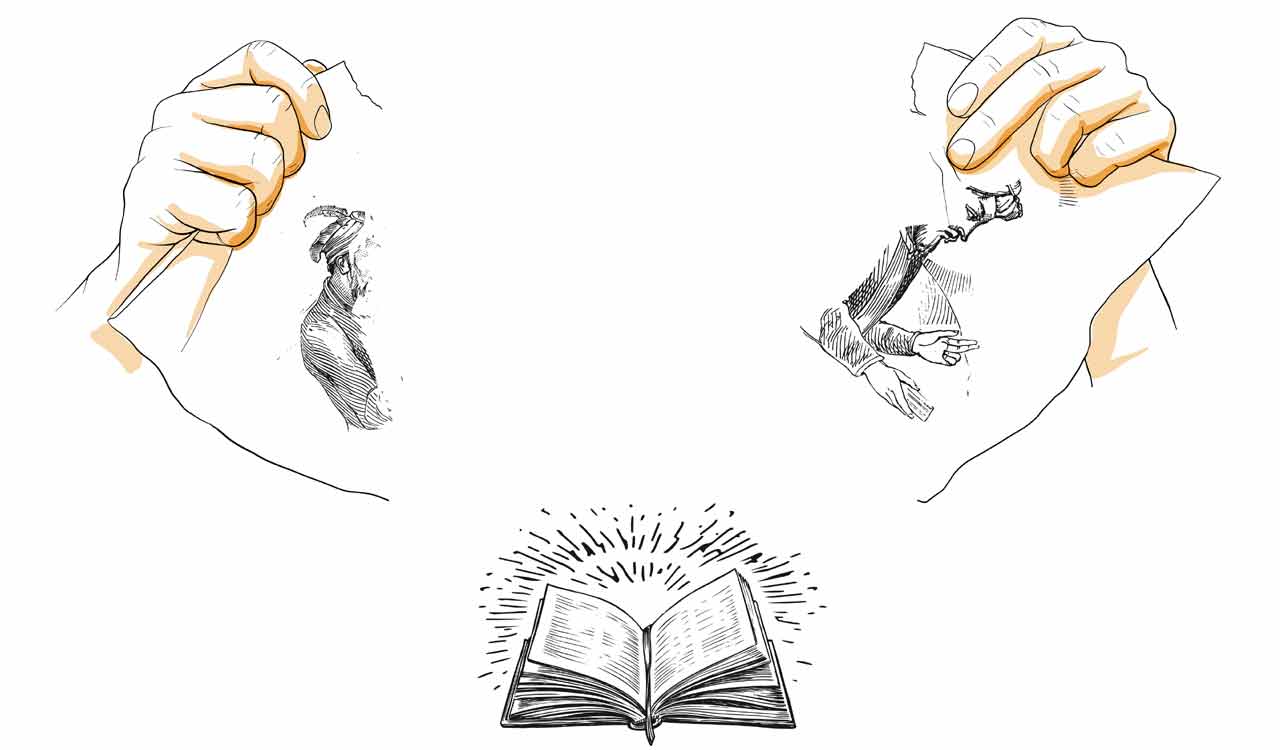
To alter the historical facts of the past to suit the preferences of the present is to deprive a generation of a solid foundation of truth
Release date – Sunday, July 23 at 12:20
Author: KSS Seyama
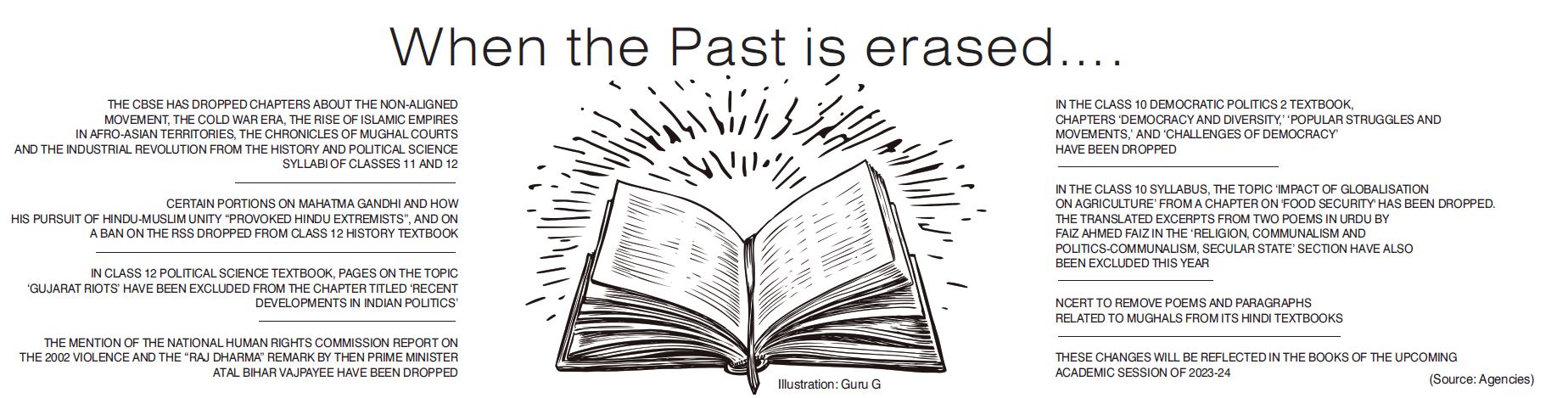
Every right-thinking person has been shocked by the wanton deletion of several chapters on India’s medieval history of the Mughals from the school textbook syllabus under the guidelines of the new education policy by the Indian government. This practice of censoring textbook history embarrasses historians, researchers, and teachers of history, to say the least.
In his final days on St. Helena, the invincible French warrior Napoleon Bonaparte mused on his past achievements, which by then had become part of history, reportedly saying of history: “History is truth the torch of prejudice, the destroyer of prejudice”.
If everything in the past is bottled up and all the efforts and struggles of past generations are completely forgotten, humanity will become poorer for it
Although this comment is made in passing and is not a definition of the subject of history, it is so fitting and appropriate that it transcends all formal definitions so far crafted on the subject by any academic practitioner. Napoleon accurately emphasized the role history plays, but whether we allow it to play a role is the question that pops up today.
action philosophy
History is philosophy in action. To a schoolchild, history is nothing more than a list of kings and queens, wars and dates. But to mature minds, history has a deeper meaning. It is a record of the lives and conditions of peoples, their struggles, their successes and failures, their shortcomings and progress. As recorded in the pages of history, this social story is sometimes stirring, sometimes sad, but it has an inspiring and ennobling effect.
As British historian Thomas Carlyle believed, history is not limited to the lives of great men, “whose contribution to human civilization deserves admiration…” History, on the other hand, is the story of fascinating and glorious experiences . Nan’s journey on the road of civilization.
What is needed is a revision of the syllabus, not the removal of chapter locks, butts and barrels as is now the case in order to cater to the ideological leanings of the ruling nation.
Every possible sphere of human activity has been recorded in history. It includes literature, economics, political science, sociology, anthropology, philosophy, science, technology, medicine, and possibly every branch of knowledge. Therefore, historians are not only concerned with dynasties and dates. Their main task is to understand the spirit of the ages, to trace the main principles governing and guiding peoples of all ages. They work to discover the factors that lead to the rise and prosperity or decline and demise of an empire or a nation.
current basis
Although history represents the “past”, it is only the foundation of the present and future buildings. It is inappropriate to review past historical events based solely on present-day conditions and developments. It would be wrong to defend the current move to seek historical asylum. Since history is the quintessence of human experience in a given time and space, no two historical events can be very similar.
More recently, there has been a perception in the establishment that the social sciences (in general) and history (in particular) do not contribute knowledge necessary for practical life. For those who believe that human well-being and development depend solely on material prosperity through science and technology, history is redundant. But unfortunately, they ignore the fact that when human development is sought only through material progress, then such a policy is itself suicidal. If we think that studying history is of no benefit to humanity, we are mowing the grass.
History is not, as Thomas Carlyle believed, limited to the lifetimes of great men “whose contribution to human civilization deserves admiration…”, but rather the story of human beings’ fascinating experiences on the road to civilization
If all the past is bottled up and all the efforts and struggles of past generations are completely forgotten, humanity will become poorer for it.
If we’re making better progress today, it’s partly because of what we know about the past. The study of past experience gives us the ability to reason and to tell right from wrong. If we believe that all our hopes and aspirations depend on a correct understanding of the past, we cannot but renew our interest in the study of history. Throughout our lives, even in the most scientific of times, we need milestones to guide our search for truth.
Negative attitudes toward history also result in part from how textbooks at all levels represent the discipline of history. The development of the history textbook syllabus has also largely contributed to the weaning of students from the subject, the frowning of parents, and ultimately the government’s consideration of abolishing the subject.
Analysis
It’s only natural that we often tend to look in history for what we think is important to society today. If this adage is kept in mind, history books should give far more pronounced weight to past socioeconomic conditions than is articulated today. History teaching should move from the current memory-oriented teaching to an analytical one. To some extent it is simply the arbitrariness of dynastic history over government policies and the lack of impact of those policies upon the people, as it does today, which is in part responsible for the tragic state of the subject of history main reason.
While at the research level we have made great strides in history that have been lauded by scholars around the world, at the school and university level these studies have not yet been incorporated. The content of history should always include aspects relevant to the governed, not just those pertaining to the managers. References to economic conditions, social movements, peasant struggles, scarcity and famine find little place in historical texts.
The arbitrariness of purely dynastic history over government policies, and the lack of impact of those policies on people, as it does today, is the main reason for the miserable state of the history discipline
These aspects may not be the very bright side of the past, but they do reveal the harsh realities and situations of the past. Who would deny that “our sweetest songs are the ones that tell the saddest thoughts”. Therefore, there is an urgent need for an overhaul of the history syllabus at all levels of teaching in schools, colleges and universities. When this is done, no one needs to make a special effort to preserve history as a subject of study. The intrinsic social value inherent in the subject becomes self-evident, and the subject itself stands up to any critic or government.
What is needed is a revision of the syllabus, not the removal of chapter locks, butts and barrels as is now the case in order to cater to the ideological leanings of the ruling nation.

(The author is a retired professor of history at the University of Hyderabad)