

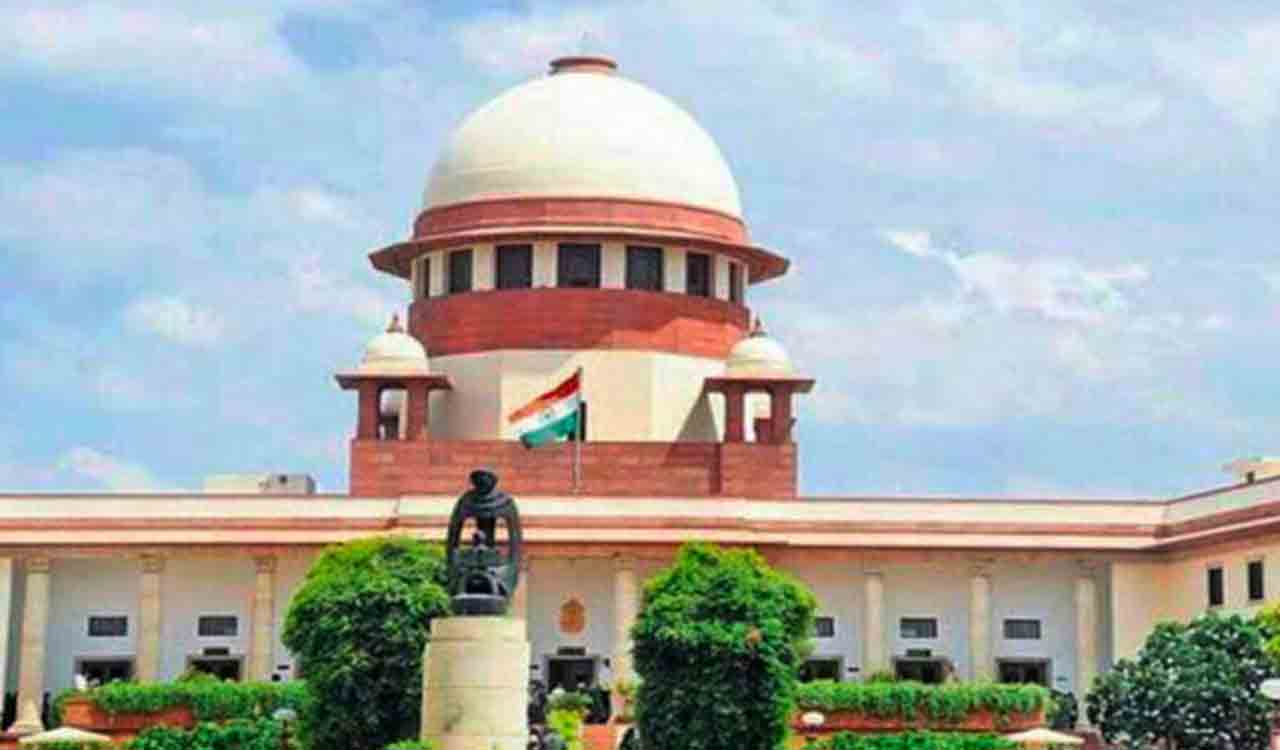
During the hearing, Vrinda Grover, representing Jamiat Ulema-i-Hind, urged the court to consider the request to stay the proceedings.
Post Date – Tuesday 23rd – 2:04pm – July 11th

New Delhi: In a series of petitions challenging the Places of Religion (Special Provisions) Act 1991, the Supreme Court on Tuesday again gave the Center extra time to lodge a counter-affidavit.
Given the far-reaching implications of the case, the judges, led by Chief Justice of India DY Chandrachud and Justices PS Narasimha and Manoj Misra, directed the Center to submit a response by October 31.
During the hearing, Vrinda Grover, representing Jamiat Ulema-i-Hind, urged the court to consider the request to stay the proceedings.
“There was a provisional application to seek residency. Litigation was being filed across the country on related issues while the Act was in place. As of today, the Act still applies,” Grover said.
However, the court said it could not use the bill to blanketly suspend ongoing lawsuits and legal proceedings in courts across the country related to controversial religious sites.
The judges said that parties involved in a specific case must individually request a stay from their respective courts, stressing the existence of the act and noting that the Supreme Court has not put a stay on it.
Former Rajyawan MP Subramanian Swami, who also appeared, said he believed the Center was showing an inclination to seek an adjournment of the matter, stressing the need to schedule a final hearing.
In January, the Supreme Court extended the time for the central government to submit responses to a batch of petitions challenging the validity of certain provisions of the 1991 Act.
It asked the center to submit responses by the end of February 2023.
On November 14 last year, the Supreme Court gave the central government until December 12 to file a sweeping affidavit on a petition challenging the validity of certain provisions of the Act.
On October 21, the judge directed the center to file an affidavit on or before October 31. It has listed the matter for a further hearing on November 14.
On March 12, 2021, the judges, led by then Chief Justice SA Bobde, sought the Center to respond to a plea raised by lawyer Ashwini Upadhyay, one of the petitioners in the case, challenging the validity of certain provisions of the law.
Upadhyay’s defense stated: “The 1991 Act was promulgated under the guise of ‘Public Order’, which is a State subject (Schedule 7, Schedule II, Entry 1), and ‘Holy places in India’ are also State subjects (Schedule Table 7, List II, Entry 7). Therefore, the Center cannot promulgate this law. Also, Section 13(2) prohibits the State from enacting laws abolishing fundamental rights, but the 1991 Act deprived Hindu Jains and Buddhist Sikhs from restoration The right to “places of worship and pilgrimage” destroyed by barbaric invaders.
“The act excludes the birthplace of Lord Rama but includes the birthplace of Lord Krishna, although both are incarnations of the creator Lord Vishnu and are equally worshiped throughout the world, so it is arbitrary of.”
