China has invested too much money in its relationship with Pakistan over the past 60 years to abandon the project or loosen relations with Pakistan.
Post Date – 23rd Monday 17th July 11:50pm

Dr. Claude Rakisitz
The ambitious $60 billion China-Pakistan Economic Corridor, which was launched 10 years ago in July this year, stretches from the port of Gwadar in Pakistan’s rugged southwestern province of Baluchistan to Kashgar in western China’s Xinjiang region. 3000 kilometers.
Dubbed a “game changer” by its backers, the 30-year project includes developing Gwadar, laying gas and oil pipelines from Gwadar to China, building small dams and hydroelectric power stations, upgrading and building roads and railways and the development of many other projects, including Lahore’s metro system.
Once complete, the corridor will be a jewel in China’s multi-trillion-dollar Belt and Road Initiative across continents. It would also give Beijing access to the Indian Ocean, effectively making China a country with two oceans.
heavy burden
But in the decade since it was launched, the project has become a heavy burden for Pakistan, whose economy is reeling under the weight of massive foreign debt. While economic activity generated by the project boosted Pakistan’s economic growth from 2015 to 2018, continued imports of machinery and other construction materials without a corresponding increase in exports, as well as the repayment of Chinese loans that financed corridor projects, significantly worsened Pakistan’s economic growth. balance of payments crisis.
Pakistan’s total external debt has almost doubled to $131 billion since 2016, about a quarter of which is owed to China. Simply paying back the interest to China paralyzed the country. Today, Pakistan’s central bank has only enough foreign exchange to cover a month’s worth of imports at most. The country must negotiate with the International Monetary Fund to free up more than $1 billion of a $6.5 billion bailout. But the situation is so dire that Pakistan recently borrowed an additional $1 billion from China to help keep the country financially stable.
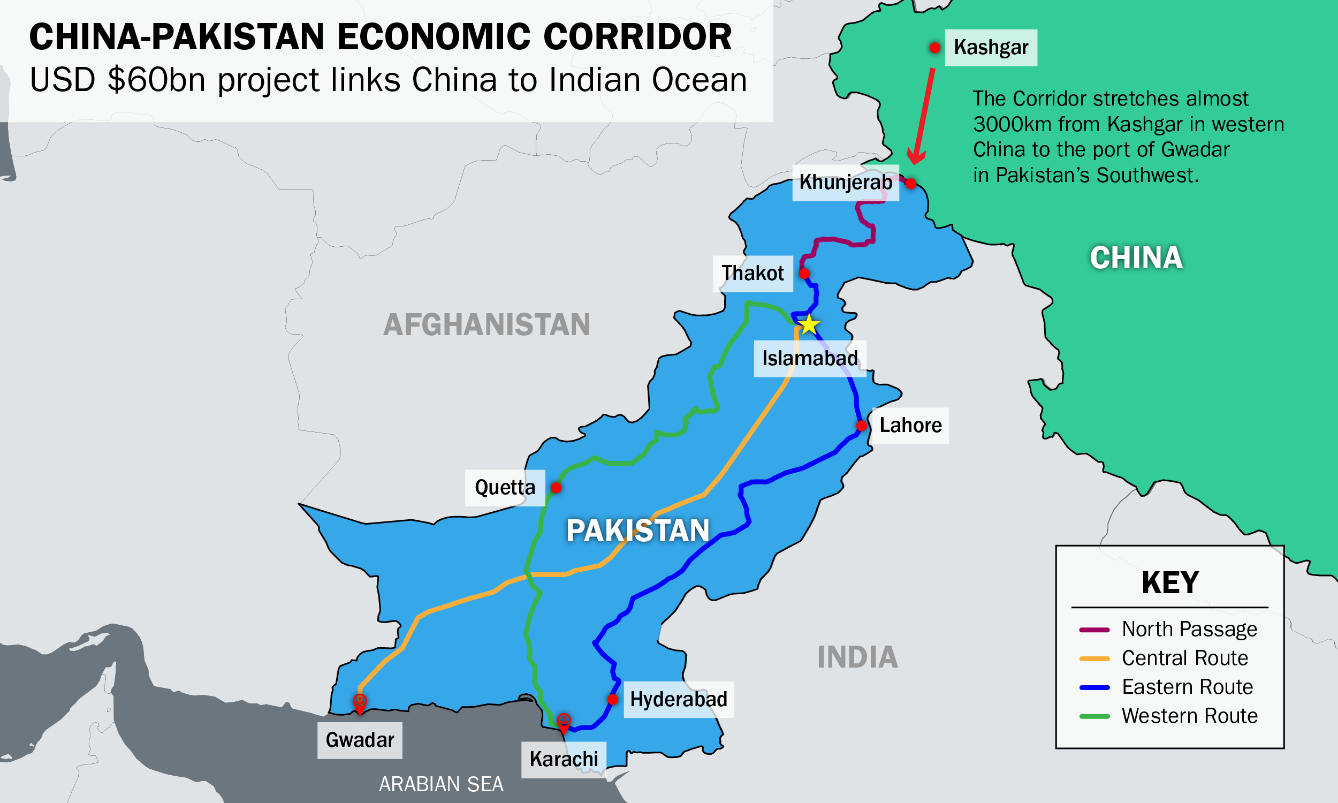
Source: China-Pakistan Economic Corridor
failed to deliver
A variety of factors could explain why the corridor did not bring Pakistan the economic stimulus it hoped for. First, China brought its own labor force and housed them in remote colonies away from the natives. No one knows how many Chinese workers are in Pakistan today.
All the construction subcontracting and resulting jobs that Pakistani businesses have been hoping for have not materialized. This created tension with the local community. The port of Gwadar was leased to the Chinese government for 40 years in 2017, but it has not provided the maritime traffic everyone had expected.
The plan is to build a massive port that will serve as a gateway to Central Asia. Instead, Gwadar port is underutilized and cut off from its immediate environment, with the surrounding area actively threatened by violent separatist Baloch terrorists. Local Baloch armed groups are not the only ones threatening and killing Chinese workers. Since the Taliban recaptured Kabul in August 2021, the Afghanistan-based Pakistani Taliban movement has increased its activities across Pakistan and has regularly attacked Chinese targets.
The most spectacular was in northwestern Pakistan in July 2021, when nine Chinese workers were killed. The attack came despite the fact that 15,000 military personnel, part of Pakistan’s special security services and maritime security forces, are dedicated to protecting Chinese personnel and 34 CPEC-related projects, including Gwadar port.
China is unhappy with these attacks and has put a lot of pressure on Pakistan to rein in the group. However, Kabul has ignored calls from Islamabad to hunt down militants hiding in Afghanistan, given the Taliban’s close ideological ties to the group. Therefore, given Pakistan’s poor security and economic conditions, it is not surprising that the level of Chinese investment in Pakistan has declined over the past two years.
Despite these serious complications in corridor implementation and the ongoing security situation in Pakistan complicating an already difficult investment environment, China has invested too much in its relationship with Pakistan over the past 60 years, So much so that it cannot abandon the project or loosen relations with Pakistan. For that matter, Pakistan.
Pakistan has played a key geostrategic role in China’s confrontation with India and its expansion into the Indian Ocean. Likewise, Beijing has been staunch in its support of Islamabad’s stance on Kashmir. Every country benefits from this relationship.
Thus, the implementation of CPEC will continue to falter and may eventually be completed — possibly a stripped-down version of it. But whether the corridor is in Pakistan’s long-term national interest remains to be seen. 360 information