

Posted: Post Date – 11:10 PM, Sunday – November 20

Nalgonda: Groundwater fluoride levels in fluoride-affected areas of the Nalgonda region have decreased by at least 50 percent due to improvements in the groundwater table at Mission Kakatiya.
The state government, through Mission Bhagiratha, has provided safe drinking water to every household in fluoride-affected villages, thus successfully preventing new cases of fluorosis in the area. It is also working in the Shivannagudem reservoir to bring the fluoride level to normal level (1.5 ppm) in the groundwater of Marrigudem, Chandur and Nampally mandals.
After New York State began supplying drinking water to all fluoride-affected villages under Mission Bhagiratha, groundwater use dropped dramatically. Meanwhile, under the leadership of Mission Kakatiya, some 142 irrigation tanks in Marrigudem, Chandur and Nampally have been rehabilitated in the most fluoride-affected areas of the region. These two factors lead to an improvement in the groundwater table, which in turn leads to a decrease in fluorite content in the groundwater.
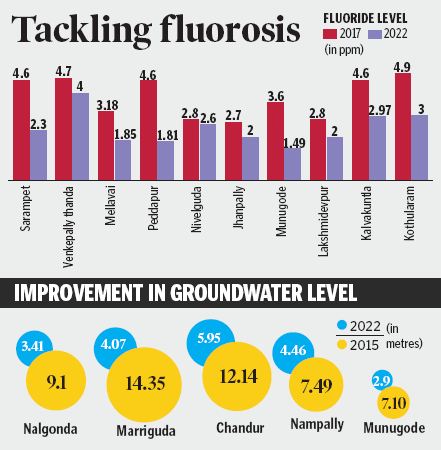
The groundwater level in the region has soared from 9.1 meters in 2014 to 3.41 meters in 2022, according to groundwater department officials. Groundwater levels in Maliguda, Chandur, Nampali and Munugodmandar affected by fluoride have improved significantly as well.
The groundwater level of Marriguda mandal increased from 14.35 m in 2015 to 4.07 m in 2022, while that of Chandur mandal increased from 12.14 m to 5.95 m in 2022. In Nampally, the water level rose from 7.49 m in 2015 to 4.46 m in 2022, while the Munugode mandal increased from 7.10 m to 2.9 m during this period. According to officials, this led to a 50 percent drop in fluoride levels in groundwater in several villages.
Water Testing Laboratory consultant Veera Reddy told Telangana Today that groundwater testing has almost stopped since 2017 as people stopped using groundwater for consumption after Mission Bhagiratha started supplying safe drinking water to every household.
“We recently tested groundwater collected from 43 fluoride-affected villages for our research.
Interestingly, we found significantly lower levels of fluoride in these water samples,” he added.
Fluoride levels in groundwater had dropped in 90 percent of the villages tested, he added.
Water quality analysis expert Vikas Ratan said that when the water table rises, the level of fluoride in the groundwater decreases.
Fluorosis Vimukthi Porata Samithi Kanchukatla Subash hopes that once the Cherlagudem reservoir is completed and filled, the fluoride in the groundwater of Marriguda, Chandur and Nampally mandals will drop to normal levels. The reservoir will also solve irrigation problems in the area, he said.
