

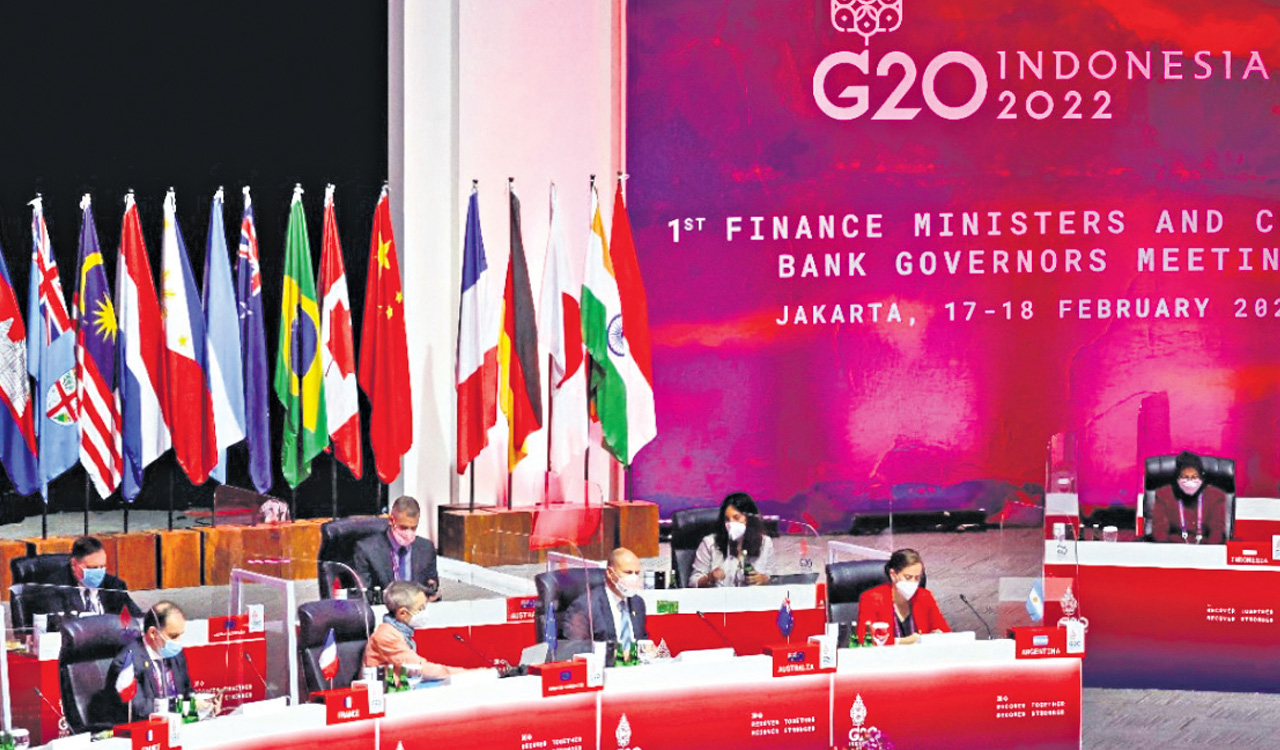
Most of these talks indicated that Chinese leaders were seeking to improve relations, especially with Australia and Japan, which have had troubled bilateral relations in recent years
Release Date – 12:45 AM, Thu – 24 November 22

Nick Beasley
Every November, the annual summit of major regional institutions in Asia attracts worldwide attention. The APEC leaders’ meeting kicked off the trend in 1993 with the much-mocked awkward practice of having presidents and prime ministers photographed in “local” attire. ASEAN’s own leaders’ summits and their outcomes, notably the East Asia Summit (EAS), are scheduled in close proximity to APEC, creating an annual “summit season”.
This year, Indonesia hosted an extravaganza of G20 leaders, adding even more meaning to the season. The war in Ukraine, global economic turmoil and the downturn in U.S.-China relations have created an extremely challenging environment for these organizations.
Sideline show
At all ASEAN-centric summits, as well as the G20 and APEC summits, the sidelines stole the show. The three-hour discussion between Chinese President Xi Jinping and U.S. President Joe Biden was the most important. Both leaders came to Southeast Asia with more confidence thanks to recent domestic political successes. Xi Jinping was re-elected as the top leader for a third time and consolidated his control of the Chinese Communist Party at the 20th party congress.
Beating historical odds and pundits’ expectations, Biden kept Democrats’ Senate majority in the midterms while minimizing losses in the House.
As leaders, they had only met online before, and their first face-to-face interaction seemed to go well. There was no major breakthrough, but they agreed to resume some high-level discussions that had been interrupted. Considering how worrisome things are, this is a positive move.
Xi Jinping took this opportunity to re-emerge on the global stage in the post-Covid era. In addition to the Biden meeting, he held a wide-ranging series of bilateral talks throughout the week. This included discussions with Australian Prime Minister Albanese, French President Emmanuel Macron, Japanese Prime Minister Fumio Kishida, South Korean President Yoon Suk Yeol, Philippine President Ferdinand “Bonbon” Marcos, Singaporean Prime Minister Lee Hsien Loong and Canadian Prime Minister Justin Trudeau , while plans with the new British Prime Minister Rishi Sunak had to be rescheduled.
Most of those talks indicated that Chinese leaders were seeking to improve relations, especially with Australia and Japan, whose bilateral relations have been difficult in recent years. Uncharacteristically, Xi publicly warned Trudeau about allegedly leaking the contents of their talks to the media.
Putin absent
Ahead of the summit, much speculation had focused on who would and would not attend, with Russia’s involvement causing the most unease. As a member of the East Asia Summit, G20, and APEC, the risk that a war in Ukraine will split members and derail the summit is enormous. For a while, it appeared that several countries might boycott the summit if Russia participated.
In the end, Vladimir Putin was not in attendance. It shows a lack of confidence in him due to the circumstances of the war and the awkward way China treated him at the recent Shanghai Cooperation Organization meeting in Uzbekistan.
Russia was represented by Foreign Minister Sergei Lavrov, who firmly pushed Russia’s line. This frustrates EAS’ efforts to develop its usual joint communiqué. While the G20 statement came through with plenty of Indonesian efforts, its criticism of Russia was not as unified or firm as many had hoped. Likewise, the APEC statement did appear, but with similar ambiguity.
Biden’s decision not to attend the APEC meeting – which clashed with his granddaughter’s wedding – meant the Chinese leader’s indirect accusations of the US destabilizing the region received more attention. But in Bangkok, a sense of summit fatigue was palpable.
Same target
So, what exactly is achieved?
The improvement in U.S.-China relations is certainly a positive, and the less hawkish face Xi Jinping is showing the world is also encouraging. But summit season has shown us that the institution itself is out of balance.
ASEAN as an organization is resilient, but the group’s apparent failure to deal with the ongoing unrest in Myanmar has led to doubts among even its most ardent supporters.
APEC, whose main focus is international trade, has found the rise of economic nationalism particularly challenging. This has been exacerbated by geopolitical headwinds, and the 2022 summit has shown no sign of the bloc’s ability to keep up with the times.
EAS appears to be the most affected. The meeting brought together the highest levels of the 10 ASEAN members as well as Japan, China, South Korea, the United States, Russia, Australia, New Zealand and India. On the face of it, it has a full range of policy remit. The group’s potential was huge, but it failed to capitalize on it. Crowded almost invisible in the middle of more high-profile and politically rewarding meetings, the EAS may be grateful for that given its inability to reach any significant common ground.
While Russia’s involvement has created tensions, the G20 has shown that member states take it seriously enough to offer a degree of adaptability and flexibility. While its ability to provide the kind of macroeconomic coordination behind its establishment was suboptimal, it and its president had a generally healthy week.
But what is clear is how significant a gap exists between many of the world’s most important powers. These institutions can only do so much to close these gaps. Institutions exist to help countries work with each other, build trust and facilitate cooperative action. These bodies seem more attractive to members because they are convenient meeting places than mechanisms for coordinating common policy goals.
This is not surprising given the heightened geopolitical tensions in the world today. But it is a sobering reminder of the limits of collective action in an age when it has never been more needed.

(The author is Dean of the Faculty of Humanities and Social Sciences and Professor of International Relations, La Trobe University. theconversation.com)
