

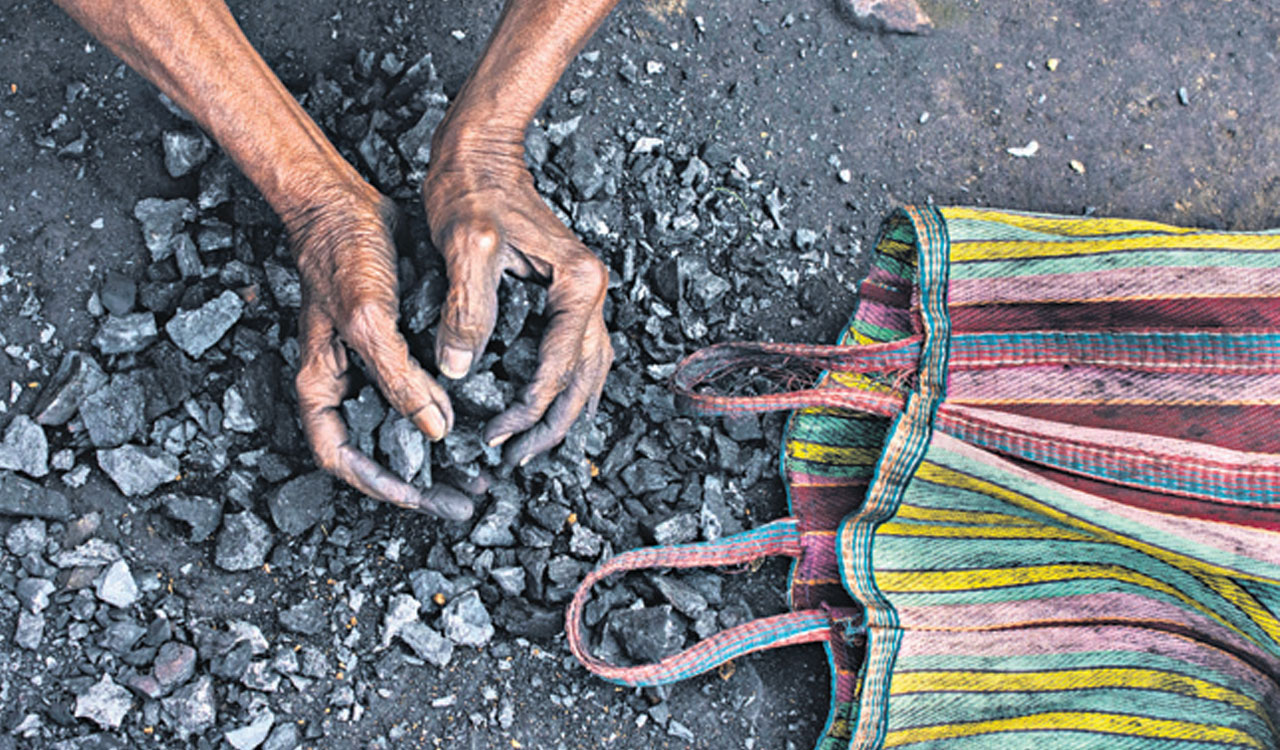
According to “The State of Work in India” published by Azim Premji University in 2018, upper castes are “disproportionately represented” in high-paying jobs while SC, ST are “disproportionately represented” in low-paying jobs
Post Date – 12:40 AM, Tuesday – November 29 22

Arun Sinha
Public employment has been shrinking since liberalization. The government has been gradually relinquishing the powers it enjoyed during the Permit rule, so it doesn’t need as many people to enforce them. It is using technology to reduce human effort. It is selling its business.
As the private sector expanded, more and more jobs moved there. Here, a question arises for the Indian government: where do SC, ST and OBC fit? The private sector is not allowed to remain, which, in FICCI’s words, would damage the “merit and competitiveness” of Indian industry. The fact that the same industry ignores merit in choosing the sons and daughters of its promoters for its supreme leadership is a testament to its gross hypocrisy, but we will leave that here. We will continue to focus on the industry’s efforts to right the historical wrongs suffered by low-caste societies. We are talking about compensation for social injustice.
private sector jobs
Doesn’t the private sector have a responsibility to build a fair society? Shouldn’t we be working on inclusive growth? After all, it enjoys huge benefits of public finances – cheap land, subsidies, incentives and tax breaks. Do you only care about your own prosperity and not the prosperity of the people at the bottom?
The private sector may refuse to book. But what about affirmative action? What about equal opportunity? Even in Western countries, corporations follow these policies to provide jobs to racial and ethnic minorities. Western businesses are biased against dominant communities like whites. There is a bias in favor of higher castes in Indian businesses. They need to reinvent themselves.
Studies have shown that entrepreneurs and top executives in the Indian private sector are mostly savannas (twins). They have historically enjoyed the privilege of holding higher offices. They also enjoy the advantage of having people everywhere to recommend and help them. The Shudras failed because not only did they lack educational, family and cultural background, but they also lacked the kind of higher-level references that the savanna enjoyed.
According to The State of Work in India, published by Azim Premji University’s Center for Sustainable Development in 2018, higher castes are “over-represented” in high-paying occupations (professionals and senior managers) and scheduled Occupation) “too many people”. This cannot be called inclusive growth.
The industry’s delay in affirmative action is only self-defeating. One of the reasons for maintaining public office and university admissions for Scheduled Castes, Scheduled Tribes, and other British Columbians was to prevent collective grievances among these castes from erupting into rebellion. This could pose a serious threat to the stability and security of the country.
lack of affirmative action
About a decade after Congress opened up the economy, the party senses growing unease among lower castes that they will lose out in jobs as the public sector shrinks and the private sector expands. “What does liberalization do to us other than exclusion?” said the leading voice of these communities, demanding quotas in the private sector.
To tame their sentiments, the Manmohan Singh government formed a coordinating committee for private sector SC/SW affirmative action in 2006. . It’s a guide to business class, not a mandate, to accommodate the “disturbance” of marginalized groups.
Top leaders of Ficci (Federation of Chambers of Commerce and Industry), Assocham (Confederation of Chambers of Commerce and Industry) and CII (Confederation of Indian Industry) joined committees working under the PMO and agreed to implement affirmative action “voluntarily”. They drafted a voluntary act Code (VCC) for members to commit to the SC and ST’s 4E initiatives – Education, Employability, Employment and Entrepreneurship.
The industry’s progress on affirmative action has been modest. A 2019 report, 13 years after the commission’s establishment, said only about 19 percent of the 17,788 member companies across the three industry associations had adopted VCCs. Even these companies are only doing a lot of work on three of the 4Es (education, employability and entrepreneurship) and not focusing on the key E (employment).
They provided free education, mentoring and scholarships to 311,218 SC/ST candidates, vocational training to 653,347, entrepreneurship training to 18,901, and employment opportunities to 127,973. Considering a time span of 13 years, they employ 9,844 SC/STs per year. Is that a majestic figure? Does this prove that the industry is contributing to structural change in society? The industry doesn’t even reveal who these 9,844 SC/STs are employed each year. Do they come from the education and training of the 93,098 candidates it supports each year? Or are they from SC/ST that usually work low paying jobs and are counted towards affirmative action? Or is the contractor’s number added?
charity
It is clear that what the industry is doing in the name of affirmative action is not action for social change, but just another form of philanthropy. In a neoliberal economy, they are job creators; they must look beyond the corporate social responsibility badges worn on coat lapels for years. The era of philanthropy is over. This is the age of social justice. They must work with the state to end social segregation.
Today, lower castes face two problems in terms of private sector employment. One is exclusion; higher castes control appointments and contracts and are found to be incestuous in society. The industry must reverse this trend. It must ensure that its employment and outsourcing policies are consciously guided by principles of social equality.
The second problem is that lower castes are “over-represented” in lower-paying jobs. The industry has to pick candidates from lower castes for higher paying jobs. It must retool its training programs to equip lower-caste workers for higher positions. And on such figures, the dominance of the high castes is over. This will be a transformation of Indian industry from philanthropy to social justice.
The author is an independent journalist and author of Standing Against the Minority: The Struggle of Rural India’s Poor
