

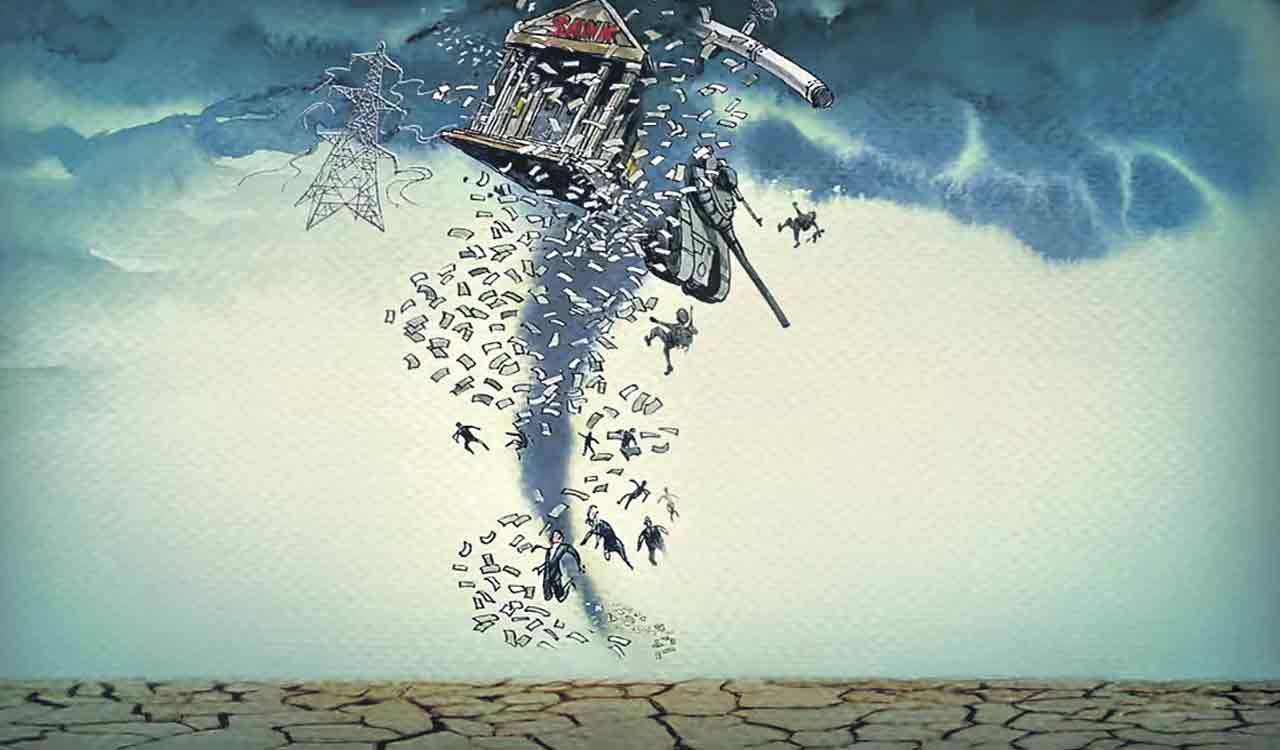
If this concept is used with greater clarity and focus, it can yield new insights into our current predicament.
Post Date – 12:30 AM, Wednesday – 12/14/22

Michael Murray Lawrence
Hyderabad: A growing number of commentators are warning that the world is firmly locked in a “multiple crisis”, a tangled knot of crises spanning the global system. But if we have any hope of getting rid of it, we must think more carefully about what multicrisis really means.
This is a bad sign, because it is difficult to even name the crisis that is going on in the world, and words like catastrophe, catastrophe or emergency are not enough. Experts scrambled to coin new terms for many of humanity’s problems.
“Permacrisis” is Collins Dictionary’s 2022 word of the year. Economist Nouriel Roubini warns of 10 “mega threats”. A growing number of commentators are declaring multiple crises. In a barrage of doom and gloom, these labels may prove to be empty buzzwords. But the last one, while vague, may be particularly useful as we gaze at the crisis in 2023 and the years to come.
crisis worsens
The term multilateral crisis illustrates how global crises are interconnected, intertwined and exacerbated. If this concept is clearer and more focused than before, it may yield important and novel insights into our current predicament.
However, these efforts have only just begun.
Columbia University historian Adam Tooze is perhaps the most famous proponent of the multiple-crisis label. He recently noted that “in multiple crises, the shocks are distinct but they interact so that the whole is even greater than the sum of the parts.”
This is a fundamental feature of our age. The impact of the recent shock to world energy markets from Russia’s war in Ukraine has been multiplied by deficiencies in global food production, some of which are linked to climate change, and higher inflation caused in part by government spending to deal with the Covid-19 pandemic.
We are in an entirely new predicament, Tooze said, that lacks the single cause and single solution that have characterized past crises. Here, he’s less convincing. From the collapse of empires to the oil shocks of the 1970s, it’s not hard to think of multiple causes that conspire to produce interrelated crises that cannot be directly resolved.
However, our current multiple crises are indeed unparalleled in some respects. Never before has human activity unbalanced Earth’s ecosystems to such an extent that every other global system is at risk, from food production to global trade to international security.
multiple crisis dilemma
Some scholars have added additional layers to the concept of multiple crises, noting that multiple crises create a dilemma in which trying to solve one crisis exacerbates another, such as poverty reduction measures that increase fossil fuel emissions . Multilateral crises are especially tricky when there is disagreement over the definition of the issues involved and what constitutes a solution, and to whom.
Instead of recommending research and action, some argue that the core value of the multi-crisis concept is that it captures the ambiguity and uncertainty of our times and highlights a gross ignorance of our condition.
However, if the multivariate crisis is to prove to be a useful concept, it should yield new and unique insights that help reduce at least some of the uncertainties prevailing in current events and inform more effective action . It must start with a clear definition to facilitate productive research.
That’s why the Cascade Institute, a not-for-profit think tank in Victoria, British Columbia, launched a research program on multiple global crises, of which I am lead researcher. My colleagues and I argue that global multiple crises occur when crises in multiple global systems become entangled in ways that significantly reduce prospects for humanity. We specialize in the complex causal mechanisms that lead to the mutual exacerbation of global crises.
The interconnectedness that creates multiple crises may include common drivers, such as Russia’s war on Ukraine, which has rocked the world’s energy and food systems. They may involve domino effects, such as when the Covid-19 pandemic led to supply chain shortages and the need for fiscal stimulus, factors that contributed to the inflation we are experiencing today.
Most perniciously, multiple crises can create vicious circles, such as those exacerbated by the effects of climate change, when violent conflict diverts international resources and attention from climate action. We may be on the cusp of such a cycle, which could spell disaster for millions.
how crises interact
But do we really need more research to solve the world’s major crises? Some would argue that we already have all the knowledge we need to act effectively — about climate change, for example. What stands in our way is the delusion of powerful interests.
Greed and power structures have undoubtedly exacerbated multiple crises, but our knowledge is still lacking. Experts know a lot about personal risk and crisis, but not how they interact.
Epidemiologists are warning that a pandemic is coming, but who could have predicted that public health measures would interact with political polarization, rampant misinformation and extremist ideology to produce so-called Freedom Convoys that would have swastikas To Ottawa? Who knows what economic impact the volatile combination of pandemic spending, inflation, energy shocks and supply chain disruptions will ultimately have?
It is still difficult to see the full picture of crisis interactions. A major study of global risks even found that “failure to account for feedback across systems” was itself a key risk.
Armed with the multiple-crisis concept, we can begin to fill in this research gap. Whether we can do it fast enough is another question.
(The author is a Postdoctoral Fellow and Polycrisis Lead at Cascade Institute, Royal Roads University and University of Waterloo. theconversation.com)
