

Penchikalpet rural development postgraduate Enagandula Rajanna has become a role model for young people successfully running a traditional cold pressed oil unit
Post Date – 12:15 AM, Mon – 26 December 22

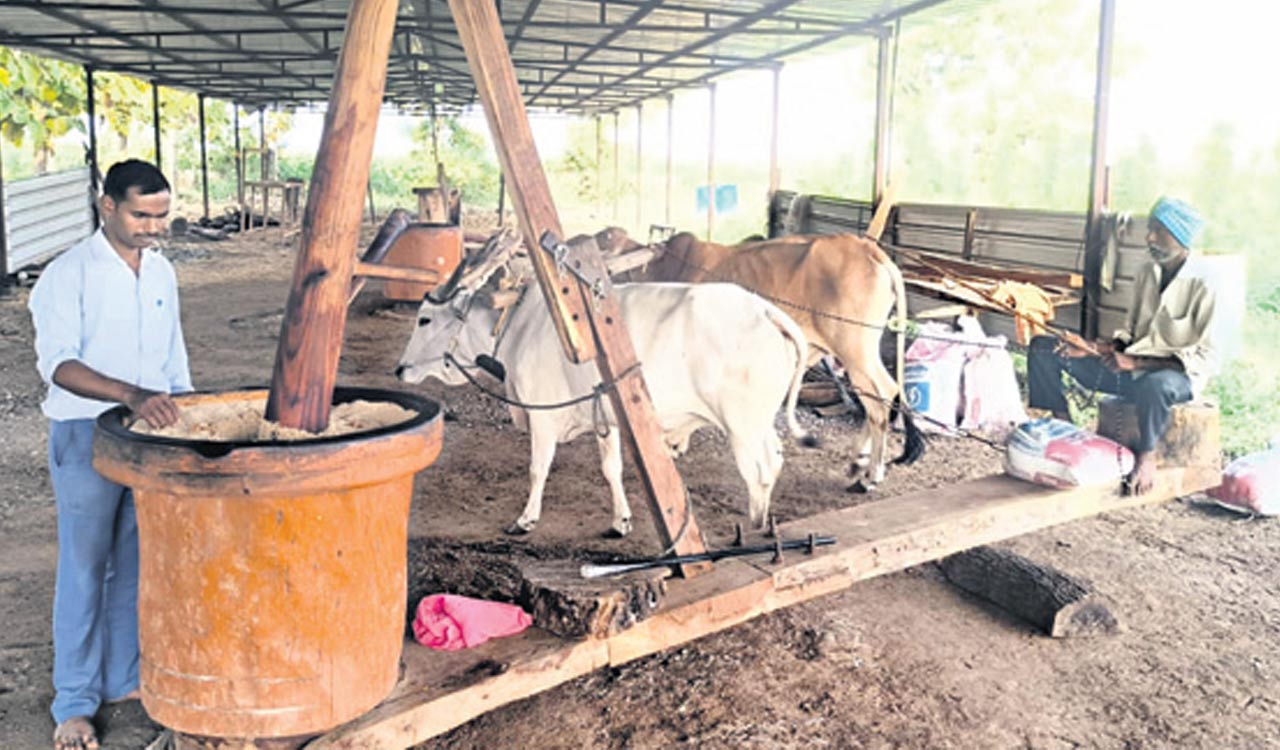
E Rajanna, postgraduate student in rural development, in his unit.
Kumram Bheem Asifabad: In the backward Kumram Bheem Asifabad district, access to higher education remains rare among young people. Graduates tend to either try to work in government or the private sector.
But a graduate student from remote Penchikalpet has become a role model for young people after successfully running a cold-pressed oil factory.
Enagandula Rajanna, a graduate student in rural development, uses four wooden grinders, known locally as Ganuga, to make cooking oil in the ancient cold-pressing method in Andevelli village in Kaghaznagar. Not only did he find a job for himself, but he also supported four others.
“Cold pressed oil is in high demand. The oil extracted by this method is ancient and good for health. I tried this because there is a high demand not only from the surrounding area but from the whole state,” Rajanna told Telangana todayHe invested about 2 million rupees in setting up the refinery in a tin-roofed shed to hire workers and bought bulls and a meat grinder.
1,000 liters per month
Rajanna insists that his unit can produce about 1,000 liters of oil a month from groundnuts, sesame and coconut. His income will be between Rs 30,000 and Rs 50,000 per month.
His customers come not only from Kaghaznagar town and surrounding villages but also from Hyderabad, Karimnagar and Warangal.
expansion plan
Encouraged by the response, he plans to expand the production unit to produce 2,000 liters of oil per month within a month or two.
He plans to launch five different organic oils in the near future: Mustard (Avalu), Twist (Ippa), Castor (Amudam), Neem (Vepa), and Pongame (Kanuga). He would like to invite students to educate them about traditional methods of producing cooking oil in the near future.
He noted that visiting students not only learn about traditional methods of cooking oil manufacturing, but also learn about the physics, chemistry, history and geography involved in the manufacturing process.
