

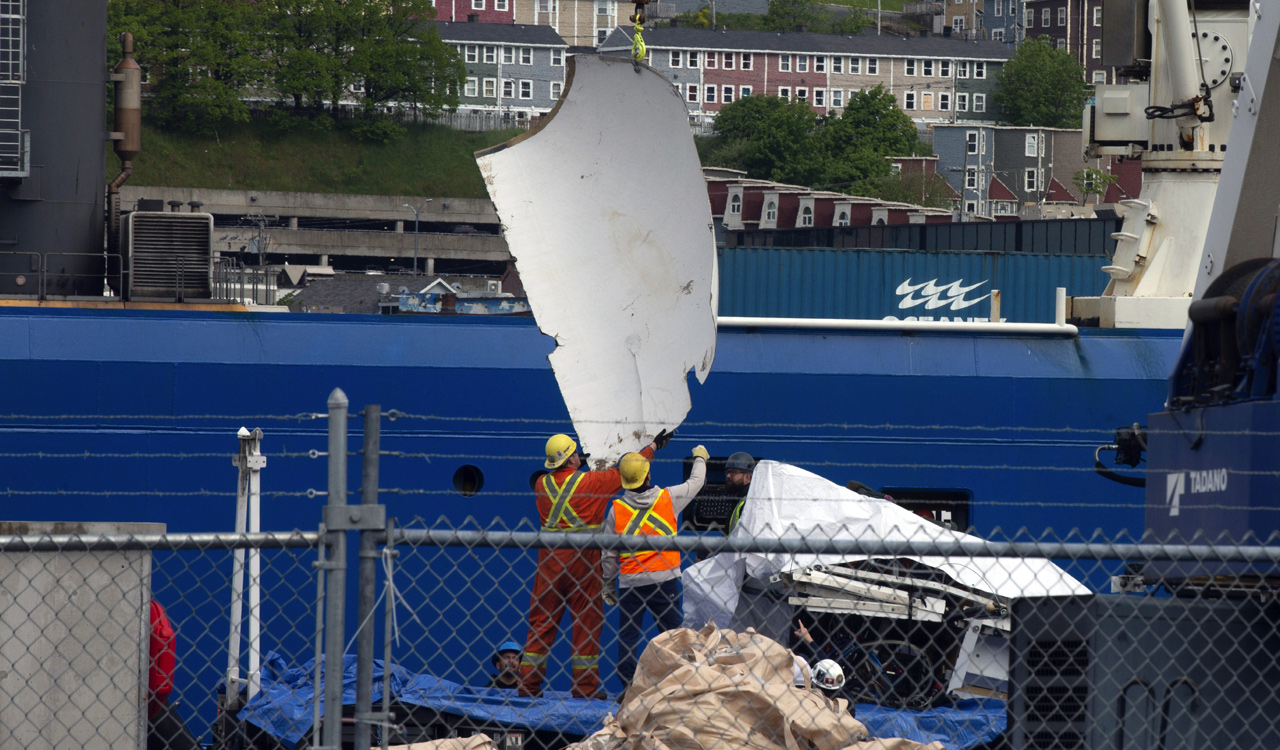
Returning the wreck to port in St. Johns, Newfoundland and Labrador, is a key part of the investigation into why the submersible imploded, killing all five people on board
Post Date – 11:45 PM, Wednesday – June 28

Poftland: The deadly implosion of the lost Titanic submersible during its voyage to the wreck of the Titanic wreck, which has been returned to land, has captured the world’s attention last week.
Returning the wreckage to port in St. Johns, Newfoundland and Labrador, is a key part of the investigation into how the submersible imploded, killing all five people on board. The twisted fragments of the 22-foot submersible came ashore at the Canadian Coast Guard dock on Wednesday.
The Canadian vessel Horizon Arctic carries a remotely operated vehicle (ROV) to search for debris from the submersible on the sea floor near the wreck of the Titanic. Pelagic Research Services, a company with offices in Massachusetts and New York and an ROV, said in a statement Wednesday that it had completed the offshore work.
Pelagic Research Services said its team “remains on mission” and was unable to comment on the ongoing Titan investigation, which involves multiple government agencies in the U.S. and Canada.
“They have worked around the clock for ten days, experienced the physical and mental challenges of this operation and are eager to complete the mission and return to their loved ones,” the company’s statement said.
The Coast Guard said last week that the wreck of the Titanic lies about 12,500 feet (3,810 meters) underwater, about 1,600 feet (488 meters) below the bottom of the Titanic. The Coast Guard is leading the investigation into why the submersible imploded during its June 18 descent. On June 22, officials announced that the submersible had imploded, killing all five people on board.
The U.S. National Transportation Safety Board said the Coast Guard has declared the Titan submersible’s loss a “major maritime casualty accident” and that the Coast Guard will lead the investigation.
Coast Guard representatives declined to comment on the investigation or the return of the wreck to the coast on Wednesday. Representatives of the National Transportation Safety Board and the Canadian Transportation Safety Board, which are involved in the investigation, also declined to comment.
“As the investigation is still ongoing, we are unable to provide any additional information at this time,” said Liam McDonald, a spokesman for the Canadian Transportation Safety Board.
OceanGate Expeditions, the company that owns and operates the Titan, is based in the United States, but the submersible is registered in the Bahamas. OceanGate was based in Everett, Washington, but shut down after the Titan was discovered. Meanwhile, the Titan’s mother ship, the Polar Prince, was from Canada, and the victims were from Britain, Pakistan, France and the United States.
The operator charges $250,000 per passenger for the voyage. The Titan’s implosion has raised questions about the safety of private subsea exploration operations.
