

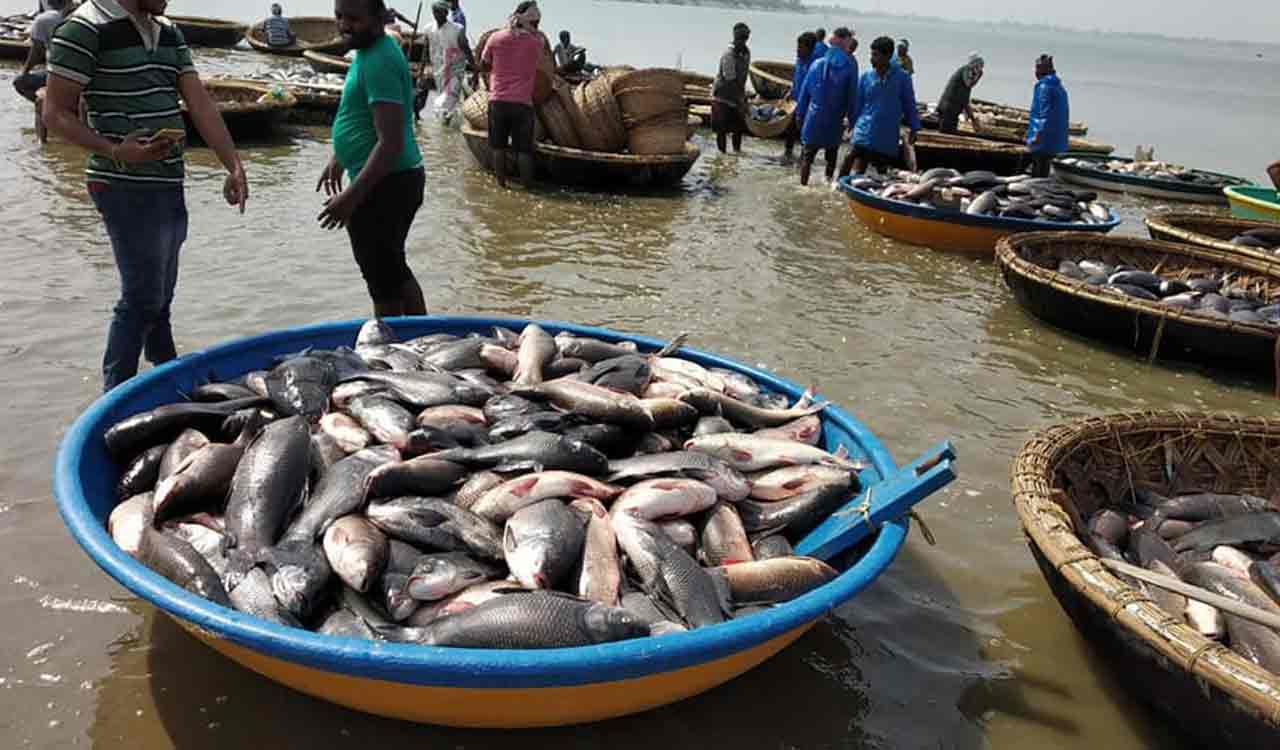
The Nalgonda District witnessed an impressive fish production of 26,435 tonnes in the last financial year, representing an annual growth rate of approximately 10%
Posted Date – 05:16 PM, Wednesday – 07/06/23

Fishing in a reservoir in the Nalgonda district.
Nalgonda: Over the past three years, with the efforts of the Ministry of Fisheries, the price of fish in the market has remained stable. Through various initiatives, fish production has multiplied, greatly benefiting the livelihood of fishermen.
The prices of rohu (labeo rohita) and bocha (catla) have remained at Rs 160 per kg during this period. Also, the price of moray eels has been stable at Rs 450 per kg.
In the last financial year, fish production in the region was as high as 26,435 tonnes, representing an annual growth rate of about 10%. These results can be attributed to the implementation of an integrated fisheries development plan. Hence, fish prices are still affordable for the general public and there has not been a significant increase even on special occasions such as ‘Mrigasira Karthi’ observed last year. Traditionally, people eat fish on this day.
As fish production exceeds local demand, the remainder is exported to markets in Hyderabad, Guntur and Vijayawada. The modification of irrigation tanks and the stocking of fry have greatly boosted fish production in the area. Importantly, the irrigation tanks have been supplemented with Krishna water through AMRP-SLBC and Nagarjuna Sagar Project’s low water canals to ensure sufficient water supply even in summer. Therefore, there is no shortage of fish in the markets of the region all year round, including in summer.
Before 2014, fish was scarce and expensive on the market as irrigation tanks often dried up throughout the year and reservoir levels remained low. These conditions have seriously affected fish growth and caused fishermen to lose their jobs.
The Fisheries Department has made significant progress releasing fry into 1,341 irrigation tanks and nine reservoirs in the Nalkunda district. This effort has not only increased fish production, but made fish available to people in all parts of the region. Thus, roadside fish markets pop up in towns, mandal headquarters and major grama panchayats. Now fresh fish is easily available and people prefer to eat fish because its price is lower than mutton and chicken. This shift has proven profitable for fishermen, increasing business opportunities.
The region currently produces 26,435 tonnes of fish per year and has maintained a growth rate of 10 percent for the past three years, said Venkaiah, deputy director of the Fisheries Department. Fishermen’s cooperatives provide fry for free and have submitted a proposal to the state government to stock 6.15 million fry in 1,341 irrigation tanks during the upcoming 2023 monsoon season. As of now, 30,000 fishermen from 181 societies earn their living in the area year-round.
Fish food lover Kathroju Naveen Kumar expressed his joy at the fact that prices of basic commodities have risen but fish prices have remained stable.
