H5N1 subtype raises concerns about its ability to jump effortlessly to humans
Posted on – Thu, 5/25/23 at 12:45am

representative image
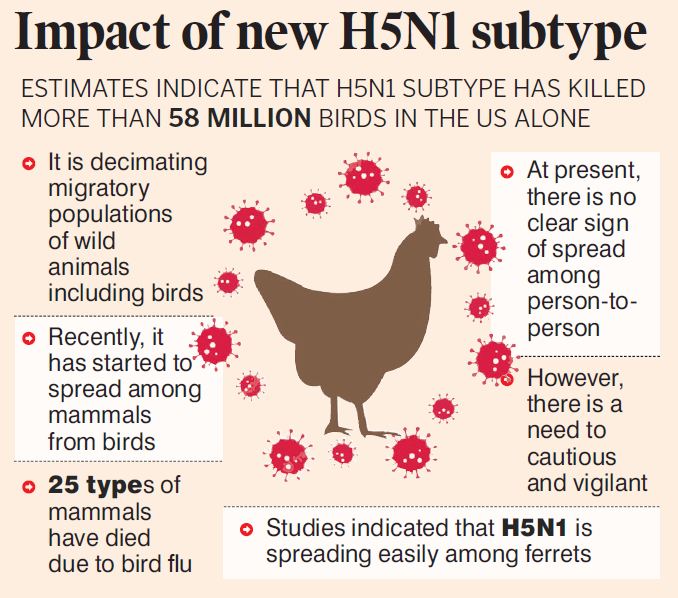
A highly pathogenic and deadly subtype of the H5N1 bird flu virus has killed millions of animals worldwide in the past few months. Studies by researchers in several countries have shown that the H5N1 subtype has the potential to spread efficiently from birds to mammals, raising concerns among public health experts about the virus developing the ability to infect humans effortlessly.
Currently, there is no risk of a human pandemic from the H5N1 subtype. However, given the speed at which this (H5N1) virus is spreading and past experience from Covid pandemics, experts are urging caution and vigilance.
Concerns about large-scale transmission of H5N1 among birds and other mammals are due to its high risk factor. H5N1 is estimated to be between 50% and 60% fatal in humans, which is serious considering that the Covid-19 fatality rate (depending on the country) hovers between 1% and 4%.
A few days earlier, in the UK, two people had tested positive for the H5N1 virus. The development prompted the chief medical adviser to the UK Health Security Agency (UKHSA) to clarify that there was no clear evidence that the H5N1 virus was spreading rapidly in humans.
“Current evidence suggests that the avian influenza virus that we see in birds around the world does not transmit easily to humans. However, we already know that the virus can be transmitted to humans after close contact with infected birds …Globally, there is no evidence of human-to-human transmission of this strain, but we know the virus has been evolving and we are wary of any evidence UKHSA Chief Medical Adviser quoted by UK government website (gov.uk) Words from Professor Susan Hopkins.
The rise of bird flu
While India has reported few such cases, new subtypes of H5N1 have had a devastating impact on farmed and wild bird populations worldwide over the past 18 months. H5N1 has already begun to affect mammals such as foxes, sea lions, domestic dogs and cats. Therefore, there is a clear risk of different subtypes of H5N1 viruses combining and infecting humans.
In February, the World Organization for Animal Health (WOAH) responded to the risk of the H5N1 virus. “Since October 2021, an unprecedented number of outbreaks have been reported in multiple parts of the world, spreading to new geographic areas, with devastating effects on animal health and welfare. Cases of H5N1 avian influenza have been reported in several terrestrial and aquatic mammals Increasing numbers lead to morbidity and mortality. The current situation highlights the risk that H5N1 may be better adapted to mammals and spread to humans and other animals.”
Given the experience with Covid-19, an influenza virus of questionable origin that managed to spark a three-year global pandemic and killed many people in the process, public health groups and experts are urging caution and vigilance.