The idea is to provide multidisciplinary care for patients that includes both modern and traditional Indian medicine
Posted Date – Thursday, 18 May 23 at 12:15pm

The idea is to provide multidisciplinary care for patients that includes both modern and traditional Indian medicine
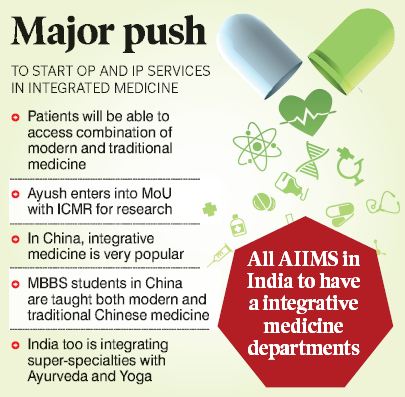
Hyderabad: In the near future, public hospitals across the country are expected to adopt an integrated healthcare model, where outpatient and inpatient departments will have dedicated integrated medical wards to provide patients with the best of both worlds, the best of both modern and traditional medicine.
A major and ongoing effort is underway to ensure that government hospitals, including top medical institutions, have integrated medical centers at all AIIMS branches in the country. The idea is to provide multidisciplinary care for patients that includes modern medicine as well as traditional Indian medicine.
A few days ago, the Ayush Union Ministry and the Indian Council of Medical Research (ICMR) signed a Memorandum of Understanding to facilitate collaboration in the field of integrative health research. The MoU will focus on producing high-impact research to generate evidence using modern scientific methods and strengthen the research capacity of Ayush researchers in the country. The concept of Integrative Healthcare Medicine is a major step towards having a ‘One Country and One Healthcare System’ policy, which is being proposed by the Government of India.
According to various media reports, ICMR’s collaboration with Ayush Ministry will also establish Ayush-ICMR Centers of Advanced Research in Integrative Health at all AIIMS, including the Bibinagar facility in Hyderabad. The agency will explore the possibility of conducting public health research, addressing diseases of national importance, and jointly conducting high-quality clinical trials across diseases. The study will generate evidence-based data on Ayush therapy that will eventually lead to wider acceptance.
In the next few months, OP and IP services for traditional Indian medicines are likely to start at AIIMS in New Delhi, followed by other branches of AIIMS. A combination of modern and traditional medicine is expected to be offered to patients. The focus will be on expanding the functions of the existing Ayush departments in all government general hospitals.
Inspired by China, where the comprehensive medical system has flourished for many years, government hospitals in India will also set up dedicated general medical departments, which will not only provide clinical treatment facilities, but also focus on academics and research.
Criticism of Indian Medicine
The Ayush stream of traditional Indian medicine, which includes Ayurveda and yoga, has drawn a lot of criticism over the past few years from modern medical practitioners, who often point out that mixing two different systems of healing will only increase the disease burden on patients.
The most common objection raised against Ayush therapy is the lack of evidence-based peer-reviewed research on the efficacy of traditional Indian medicine. Allopathic practitioners often argue that mixing different healing systems will only end up exacerbating the patient’s health condition and leading to a greater risk of disease progression.
Aware of these challenges, there has been a concerted effort to develop and implement appropriate traditional medicine approaches and standards. With the promotion of integrative medicine by centers and even state governments, the approach and protocols of disease treatment and protocols in India, especially in government-run medical institutions, are expected to change in the coming years.