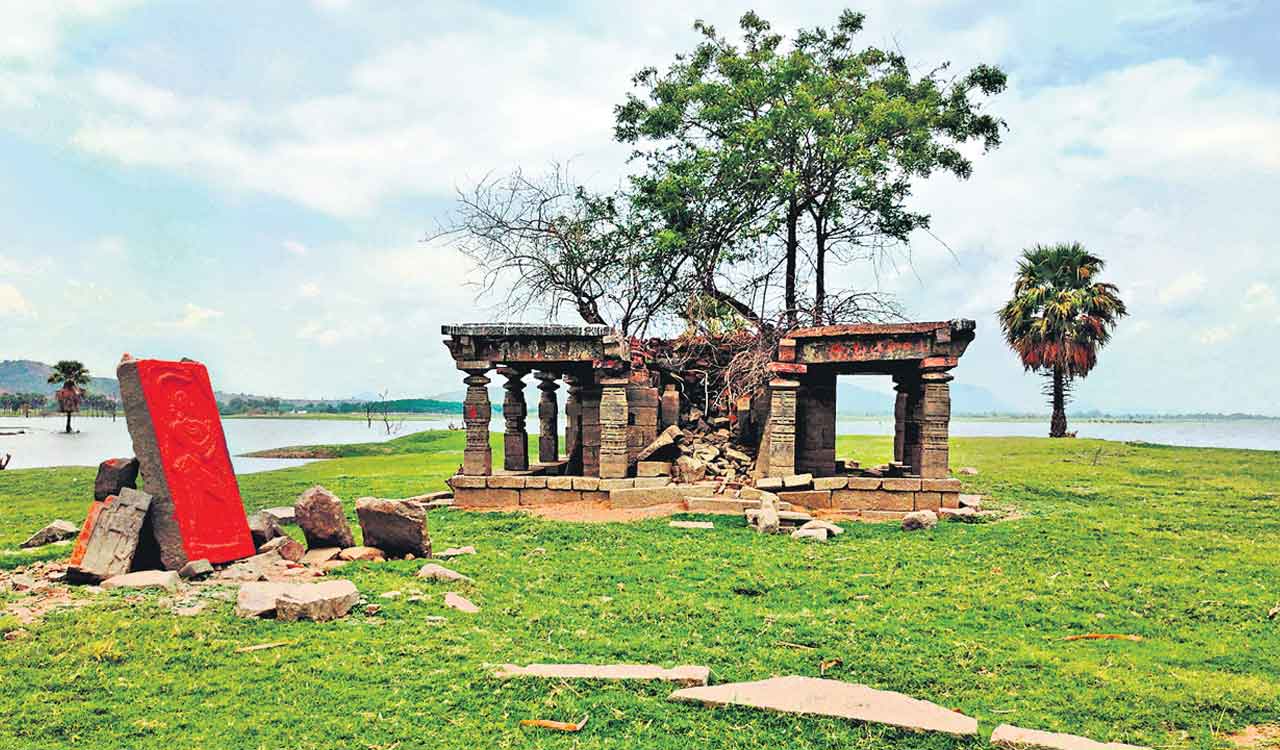
Located in the small village of Maggalagadda in the Jagitial district, this temple dates back more than 2,000 years
UPDATE – Sun 14 May 23 at 12:49 AM

Hyderabad: Everyone knows about the Rajanna (Rajeshwaraswami) temple in Vemulawada. But most people are unaware of another contemporary Rajeshwaraswami temple located on the right bank of the Godavari River in the abandoned hamlet of Maggalagadda, Velgatur mandal Cheggam village, Jagitial district.
The temple also has a thousand-year history and is unique in terms of architectural style, history, inscriptions and cultural ethos. The rectangular stone shrine has a 2-foot parapet surrounding the shrine with carved pillars. It has four entrances in four directions.
In addition to another legendary inscription from nearby Suryachandrarajulabanda, the National Archaeological Department also acquired the imprint of an inscription now submerged in the backwaters/channels of the adjoining Godavari River, the essence of which was published in its 2008-09 annual report for the year.
Front projection of temple Shikhara has beautiful Keertimukha in Chalukya/Kakatiya architectural style. Locals call it Rakshasi (demon) and they say the temple was built thousands of years ago by rakshasas who could only lift the temple’s heavy stones. Several sculptures of deities like Bhairava, Bheemanna (gada), Naga, Dwarapala, Anjaneya, Shivalingas, Nandi, Poshamma and Potalinganna are placed in the southeast direction of the temple.
Yagnyam to Cheggam
Dr VV Krishna Sastry, then state archaeological officer, visited the temple about four and a half years ago and recorded in his memoirs that the temple’s roots date back more than 2,000 years, when Emperor Satavahana of nearby Kotilingala performed yagnyam Here, hence its tadbhava name Jeggam came into being and subsequently Jeggam became Cheggam.
Dr. Sastry observed that the temple was developed according to the plans of Yagnya Vedika and thus still resembles Yagnya Vedika, which is said to have Vedic roots. Also, during the dynasty of the Satavahanas, several villages named after professionals/castes arose, one such specialized village was Maggaalagadda, meaning the platform of the handloom; a subsequent corrupt name is Mangaligadda where the temple is located. Until 1980, only weaver families ever lived in this small village.
King Vemulawada Chalukya seems to have built the extant temple more than 1000 years ago because apart from the architectural style, the temple is also given the same name as Vemulawada Rajeshwaraswami.
Historical Jathara Market
The annual Great Bazaar (Jathara) used to be held on the grounds of the Rajeshwaraswami temple. Merchants and peddlers would come from distant places such as Warangal and Kolipaka (Kolanupaka). Some wealthy merchants acquired large tracts of land around the temple; hence we hear names like Manchala Chenu/Bodalu and Kolipaka Chelka being acquired by wealthy merchants with surnames Manchala and Kolipaka respectively.
Visit Possana
About 600 years ago, the famous poet Bammera Pothana came here from the village of Bommera (south of Warangal) and prayed to the god on the Godavari sand dunes and started writing his famous work “Bommera Pothana” in this temple. Gavatam, his writings show.
cultural association
Until 1980, regular worship, fairs and festivals were held in the temple, and Inam land was donated to Jangama priests for the maintenance of the temple. Until recently, pilgrims bathed in the Godavari river near this temple, and villagers used to bathe here. Villagers here hold special events such as the first haircut (puttu ventrukalu) and ear piercing (chevulu kuttichuta).
Project effect
Due to the frequent flooding of Godavari, Mangaligadda was subsequently moved to Cheggam, the worship of Rajeshwaraswami ceased and the temple was vandalized by treasure hunters. In addition, through Ellampally’s mixed-use project, the submerged village of Cheggam was moved from its original location to the foothills of the nearby mountains. As a result, the Rajeshwaraswami Temple is submerged in the project’s backwater during the rainy season and emerges when the water recedes in summer.
shift selection
Now, the villagers hope to build a temple for their daily worship and to celebrate festivals and special occasions. Instead of building a new brick and concrete temple, they attempted to transfer the 1,000-year-old Rajeshwaraswami temple to their current village.
Earlier, the government also relocated several temples during construction projects in Nagarjunasagar, Srisailam, Tungabhadra, etc. under the salvage archaeological procedure. Villagers called on the government to relocate the temple with technical support from the archaeological department and financial support from the water conservancy and donation departments.