

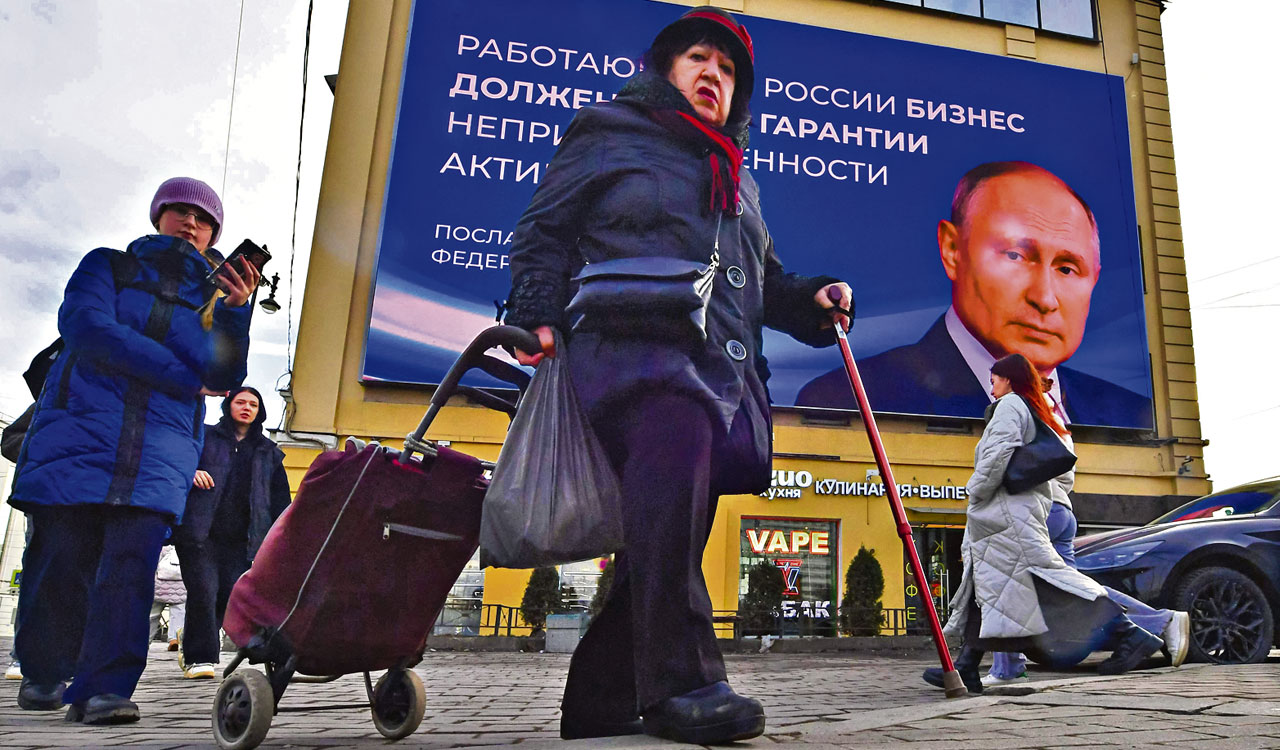
This election is the largest public test of the Russian state’s ability to shape its desired result at home since its invasion of Ukraine
Published Date – 14 March 2024, 11:59 PM

By Adam Lenton
Russians will vote in a presidential election from March 15-17, and are all but guaranteed to hand Vladimir Putin a comfortable victory, paving the way for him to remain in power until at least 2030. While the result may be a foregone conclusion, the election offers an important glimpse into the Kremlin’s domestic challenges as it continues a war against Ukraine that recently entered its third year.
As an expert on Russian politics, I have identified three key developments worth paying attention to during and after the upcoming election. Yes, we already know Putin will win. Nonetheless, this election is the largest public test of the Russian state’s ability to shape its desired result at home since its full-scale invasion of Ukraine in 2022.
Don’t Mention the War
The 2024 election is taking place during the largest interstate conflict to take place this century. With Russian domestic media and politics all but gutted of dissenting voices, the war has become the organising principle of post-2022 Russian politics, shaping all major policies and decisions. Yet, while the context of the war looms large, its role is largely implicit rather than occupying centre stage. And for good reason: Banging the drums of war is not particularly popular.
In fact, the Kremlin’s strategy throughout the conflict has relied upon the general public’s acquiescence and disengagement from the war effort in exchange for a degree of normalcy at home. Officially, the war remains euphemistically termed a “special military operation,” yet it is also frequently framed by Moscow as an existential struggle for Russia and a proxy war between Russia and the West.
Unsurprisingly, perhaps, the Russian public still doesn’t agree on what its aims are. There are relatively few ardent supporters of the war, outweighed by a more general sense of fatigue among the public. This is supported by survey data that shows that consistent majorities in Russia would prefer to start peace talks – though this of course does not tell us what type of peace they prefer.
Yet the war is putting pressure on the government’s ability to juggle ensuring a disengaged population and bolstering support for a grinding war that demands unprecedented resources. Putin’s public communication in the buildup to the election reflects this tension. He announced his intention to run during an awkward, poorly staged interaction with an officer at a military award ceremony in December 2023. That choice surprised some insiders, who expected Putin to weave his announcement into a high-profile, choreographed event focusing on domestic achievements and not the ongoing war.
More recently, his state of the nation address on Feb 29 began and ended by lauding the achievements of the war, yet the bulk of the address — the longest of the 19 he has delivered since he first became president in 1999 — was devoted to a laundry list of achievements, programmes and goals largely disconnected from the war itself.
Pressure to Deliver
While autocratic regimes like Russia’s have proved adept at managing the electoral process to squeeze out rivals and mitigate against upsets, elections are still high-stakes events. For officials, the election is a litmus test for their ability to muster administrative resources and deliver Putin an electoral windfall. Most reports suggest the Kremlin is hoping to engineer that the turnout is at least 70%, with around 80% of the vote for Putin — which would surpass his 76.7% share from 2018.
For observers of Russian politics, what will be of interest is not the result itself, but how the result is produced during wartime conditions. Take, for example, securing high turnout. One prominent tactic used by local officials in Russia is pressuring state employees and workers at state-owned corporations to turn up at the polls en masse.
But with the economy on a war footing, and with an acute labour shortage, it is unclear whether this tried and tested approach will work. Moreover, political disengagement and the certainty of a Putin victory mean that interest in voting is at an all-time low. For local officials, the pressure is on.
At the head of efforts to engineer the election is Sergey Kiriyenko, Putin’s technocratic domestic policy czar dubbed “viceroy of the Donbas” due to his role in administering the occupied territories of Ukraine. Recent leaked documents obtained by the Estonian website Delfi reveal how Kiriyenko’s team spent over $1 billion in “pre-rigging” the election, sponsoring creative content such as films, TV series and video games replete with pro-government and anti-Western messaging.
Of course, it’s hard to say in advance whether such efforts will directly bear fruit. But the scale of the Kremlin’s investment in shaping the broader ideological environment indicates a degree of uneasiness with the public’s disengagement. There are also new technical regulations that will boost Putin’s vote. The election will be held across three days instead of one. Together with this, the rollout of electronic voting, first used in Moscow elections in 2019, will make it easier to maximise turnout. These changes also make it difficult for observers to monitor the degree of fraud.
Beyond these subtler forms of manipulation, however, there are also overtly coercive ways to ensure vote targets are met. This is particularly the case for the millions of Ukrainians currently under Russian occupation, who are subject to intense pressure from the occupying authorities to acquire Russian citizenship and to vote.
Silencing Opposition
The death of longtime Putin critic Alexei Navalny in February was a huge blow to the opposition but is representative of the state of political repression in Russia. Since 2018, some 1,16,000 Russians have faced political repression. Under such circumstances, the presidential election will be the least pluralistic in post-Soviet Russia, with only four candidates on the ballot box and no openly anti-war figures featured among them.
In previous elections, there has usually been a candidate from the so-called “liberal opposition.” For a while, it looked as though this trend might continue in the form of independent Boris Nadezhdin, whose explicit anti-war programme saw him gain unexpected traction compared to other would-be candidates.
But by barring Nadezhdin from running, the Kremlin likely wished to avoid a repeat of 2018, when the Communist Party’s Pavel Grudinin unexpectedly struck a chord with voters for his down-to-earth populism. This forced state media to go into overdrive, turning the election into a mudslinging contest. Yet the scale of public mourning for Navalny and the enthusiasm for Nadezhdin reveal that despite draconian wartime censorship and repression, there remains a sizable bloc of Russians eager for authentic political alternatives.
For now, the closest candidate to an alternative appears to be Vladislav Davankov from the liberal-leaning party “New People,” who will likely draw votes from some of this anti-war constituency. Indeed, the first point on his manifesto calls for “peace and negotiations,” though “on our own terms.” Fresh polling data from state-owned VTsIOM suggests that he might well take second place.
Adam Lenton is Assistant Professor of Politics & International Affairs, Wake Forest University, United States. theconversation.com
