

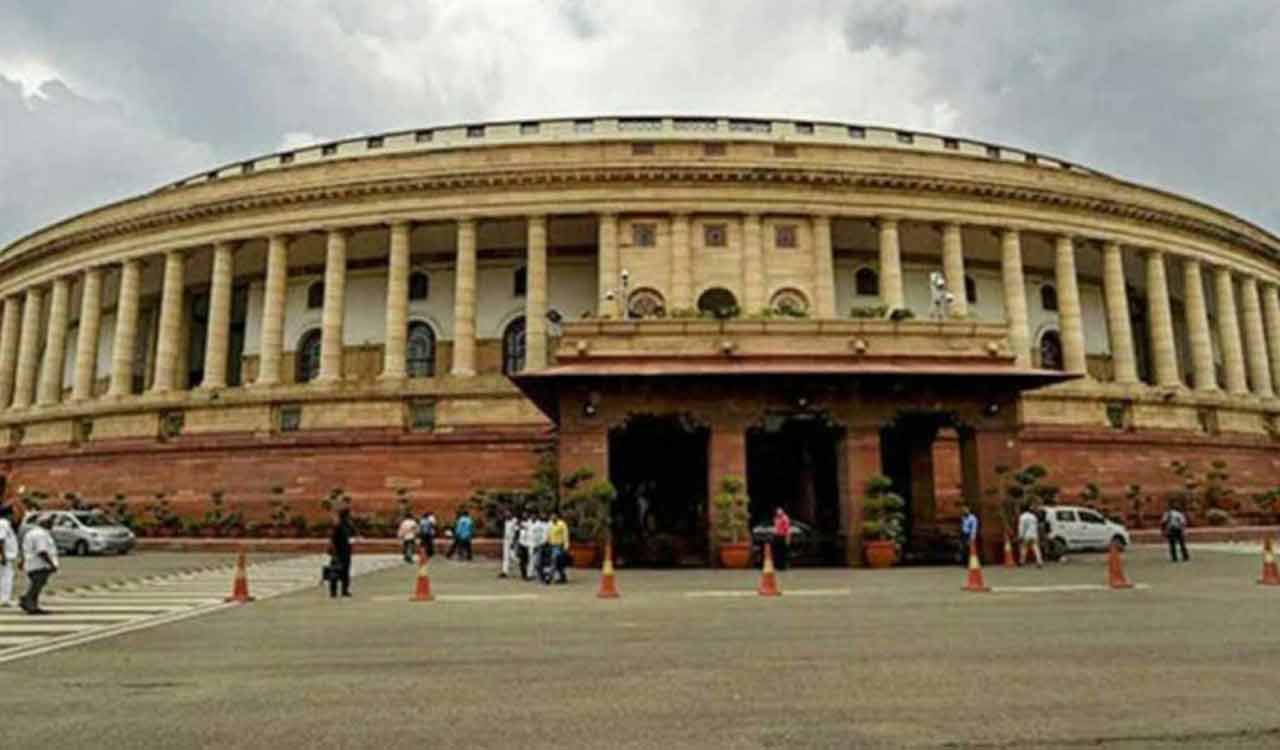
Back half of budget meeting held up by frequent disruptions before Thursday’s indefinite adjournment
Published Date – 07:00 AM, Fri – 7 April 23

file photo
New Delhi: Due to daily disruptions and frequent adjournments, the Lok Sabha’s budget session could only run for 45 hours, compared to the originally scheduled 133.6 hours, think tank data showed.
Data shows that Rajya Sabha worked more than 31 hours out of 130 hours in the same session.
The second half of the budget meeting was held up by frequent interruptions before Thursday’s indefinite adjournment.
As the 17th Parliament enters its final year in office, the think tank said the average number of days in session for the current Parliament is 58 days a year, which could be the shortest term since 1952.
The parliamentary budget session runs from 31 January 2023 to 6 April 2023, with recesses from 14 February to 12 March.
According to data compiled by PRS Legislative Research, the House of Commons’ productivity (ie the percentage of time the House is functioning) in the Budget session was 34.38%.
The only time the Lok Sabha’s productivity was low was during the 2021 monsoon session, when it worked just 20.93% of its scheduled time.
Meanwhile, parliamentary productivity hit its weakest level since 2019, running just about 24% of its scheduled time. During the 2021 monsoon, its productivity will be around 28%.
In the just-concluded session, there was limited legislative activity and little discussion of the budget amid ongoing disruptions.
Legislative business in the Lok Sabha took less than an hour while in the Rajya Sabha it took only about two minutes. Financial operations spent 17.25 hours in the Lok Sabha and 18.23 hours in the Rajya Sabha.
Throughout the session, both houses witnessed multiple adjournments in question time.
Throughout the budget session, the Lok Sabha could answer questions for 4.32 hours, while the Rajya Sabha’s figure was worse at 1.85 hours.
In his concluding remarks, Lok Sabha Speaker Om Birla said the House of Representatives had a 14.45-hour discussion on the total budget with the participation of 145 MPs.Thanks for the discussion on the motion
The President’s address lasted 13.44 hours and was attended by 143 members of Congress.
Birla said the Lok Sabha introduced eight government bills, six were passed and answered 29 questions orally.
Apart from the Finance and Appropriations Bill, the Competition (Amendment) Bill 2022 was the only bill passed during this session. Both houses passed the bills without discussion.
Three bills have been tabled, one of which, the Forests (Conservation) Amendment Bill 2023, has been tabled in a joint parliamentary committee.
Productivity was higher in both chambers during the first half of the budget session.
In the Lok Sabha, the productivity rate in the first half of the year was 83.80%, which fell to 5.29% in the second half.
Rajya Sabha chairman Jagdeep Dhankhar meanwhile informed the House that its production rate in the first part of the budget session plummeted to a dismal 6.4 percent from 56.3 percent. According to PRS, Parliament has been in session for 230 days so far.
Of all the Lok Sabhas that completed the full five-year term, the 16th Lok Sabha – elected in 2014 – recorded the lowest number of sitting days, having sat for 331 days in five years.
With one year left in the term and an average of 58 days in session a year, it is unlikely that the 17th Lok Sabha will be in session for more than 331 days. That could make it the shortest full-term Lok Sabha since 1952.
It was the sixth shortest budget session since 1952.
