President’s inauguration of Houses of Parliament will send strong message of inclusive governance
Published Date – 12:30 AM, Thursday – 29 June 23

Nayakara Veresa
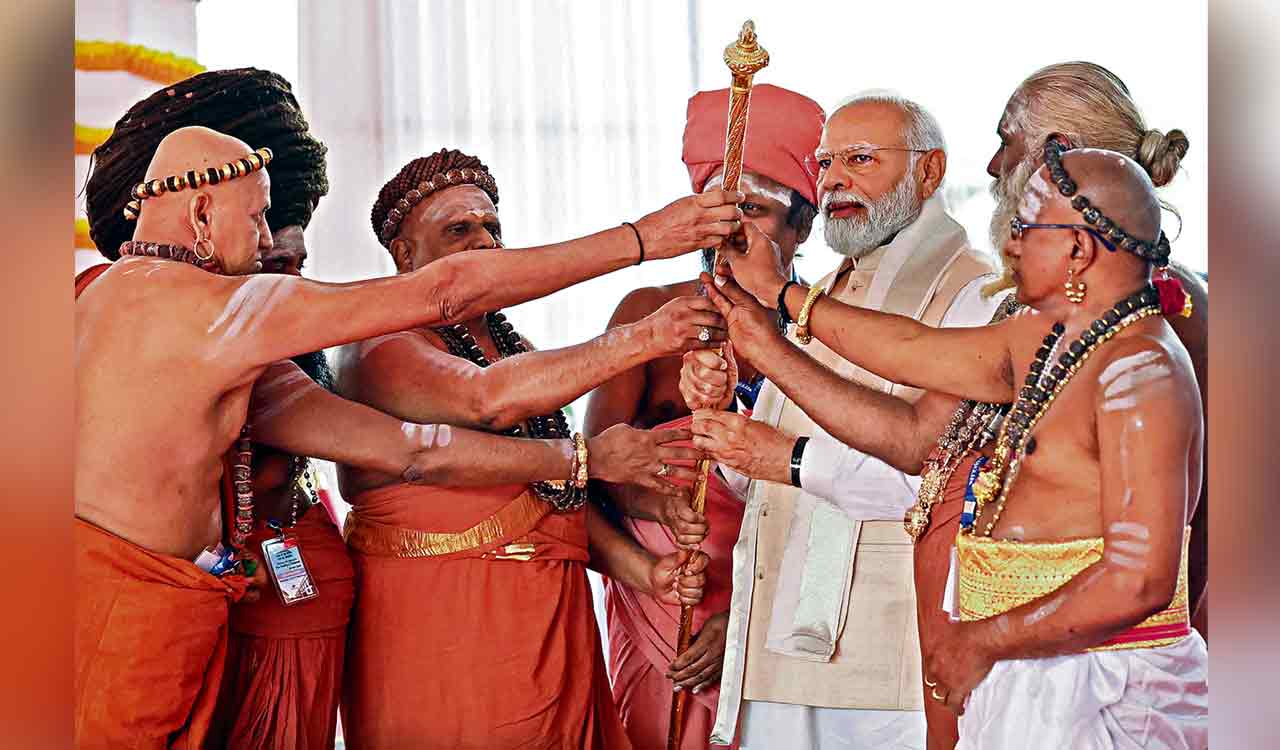
On May 28, Prime Minister Modi grandly unveiled the new parliament building. It also witnesses the Sengol or scepter being placed in the House of Representatives. The inauguration took place without the participation of opposition parties – 21 political parties, including the Congress Party, boycotted the event. The subversion of democratic traditions by not inviting the constitutional heads — the president and vice president — has come in handy for critics of the ruling system.
The Supreme Court rejected PIL’s request for the president to inaugurate the new parliament building. The BJP-led National Development Alliance has missed a golden opportunity to expand the idea of inclusive governance by denying the president his democratic right to inaugurate new buildings as constitutional head. Even in a symbolic way, it would send a strong message to those who criticize the government’s appointment of Drupadi Murmu as president as appeasement politics or a populist measure.
democratic decline
After taking power in 2014, Prime Minister Modi said his government would try to uphold the constitution and, most importantly, the role of parliament in democratic governance. By 2023, the country will witness the declining role of parliament, not only in terms of legislation, but also in terms of attacks on constitutional values such as personal liberty, fraternity, equality and justice.
This democratic decline is a global phenomenon, and India is no exception. What is extraordinary, however, is that these hard-won civil democratic rights have been severely suppressed on the basis of religion and identity politics – rights that the founders of modern India vehemently refuted and discarded through the Constituent Assembly Debate (CAD). The ongoing ethnic conflicts in Manipur and other northeastern states demonstrate this fact in a reasonable way.
The rise of the nation-state and its expansion into the world, especially to countries that became independent after colonial rule, had a major impact on democratic principles. The idea and concept of the nation-state, rooted in the separation of political and ecclesiastical governance in Europe, became popular in the modern era and became firmly established as a rational-based form of democracy.
modern state
German philosopher Hegel called the state the ethical order, while Karl Marx saw imperfect civil society as the reason for the emergence of the modern state. When India gained independence in 1947 and established a democratic republic in 1950, Winston Churchill and other Western leaders believed that Indian democracy was unsustainable because of its undemocratic nature and social and cultural divisions.
The inauguration of a new parliament reminds us of our undemocratic attitudes and unchanging culture. Undoubtedly, all religious leaders were invited and attended the ceremony, however, the ceremony was performed on the basis of only one religion. Manifestations of personality cults and rituals based on alternative religions are antithetical to Indian ideals, where religious pluralism is a hallmark of our democratic heritage. In democracies, favoring one religion or its practices over the marginalization of others can exacerbate the marginalization of other religions. Such an approach not only reflects an undemocratic nature, but also reinforces a notion of religious nationalism, which the CAD unanimously refuses to subscribe to.
It must be noted that while the Constitution does not confer any religious privileges, it allows the state to impose its own personal laws on religious minorities. The creation of religious minorities always has an inherent effect on other religions being marked as majorities. This dual creation is a serious problem for India and its secular principles. Preferential treatment of religious minorities is a special case, as is the rejection of reservations for women’s participation in politics and governance. The inauguration of a new parliament reflects this dichotomy and further deepens existing social divisions, albeit in a silent and subtle way.
The inauguration of the new parliament building was supposed to take place more democratically, including ceremonies and ceremonies of all religions in the country. This would support the government’s claim of “Akanda Bharat” or “New India” or “Mother of Democracy”. The government has indeed missed the opportunity to show the world the democratic credentials of the principle of “unity in diversity” or “vasudhaiva kutumbakam”. The President’s inauguration will send a strong message to Indigenous communities about inclusion in governance. Exclusive governance in the name of majority rule is unacceptable and needs radical change.
social democratic party
The gains of political democracy have yet to reach marginalized groups in society. From the perspective of what the government claims to be the “New India,” successive governments’ prioritization of citizens’ well-being over empowerment is no longer feasible or sustainable.
As described by Dr. BR Ambedkar, the social character of the society has not changed and radical changes are needed to maintain political democracy at the highest level. The construction of social democracy requires citizens’ constitutional awareness and morality, and questioning the undemocratic behavior of the ruled. Constitutional morality is not formed naturally, it needs to be cultivated. Social democracy and constitutional morality are two sides of the same coin, and they complement each other.
The strict separation of state society or religion from politics applies only in part to our country. The deep entanglement of the dominance of religion over society (including politics and governance) made the application of the Treaty of Westphalia and the concept of the nation-state difficult. When religion is seen as part of culture, the hegemonic forces that build cultural nationalism gain strength in what Antonio Gramsci called republican democracies. Only vigilant and informed citizens can maintain checks and balances on such a system and ensure that how and how it works does not eat away at the very foundations of democracy and its institutions.