While public school undersupply is a good sign, teacher shortage needs to be addressed
Published Date – Thursday, 5/25/23 at 12:30pm

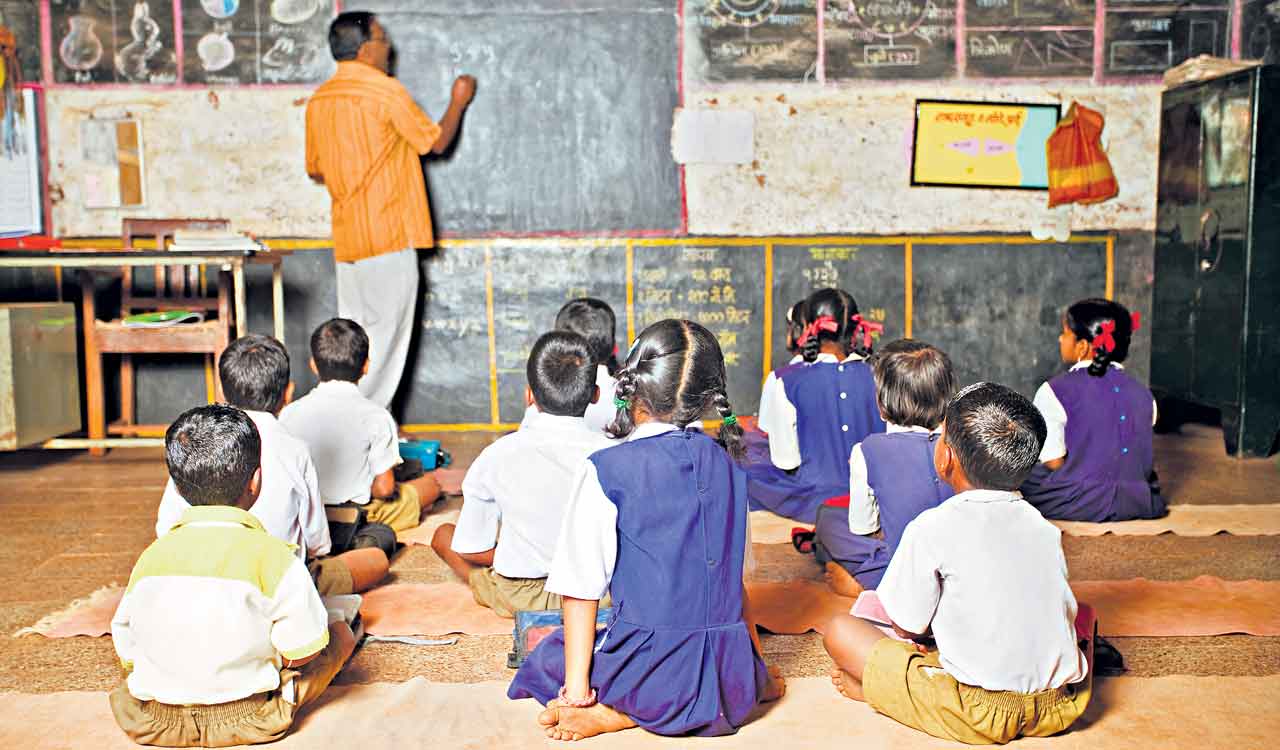
representative image.
Dr. Siluveru Harinath
Hyderabad: The country’s schooling sector, while moving forward, still faces many challenges. A UNESCO-led report on the State of Education in India Report (SOER): 2021 has revealed that the country is in dire need of infrastructure and human resources. According to the report, 9.43 million teachers are educating 248.3 million students studying in 1.551 million schools in the country. In addition, 7 percent of schools are single-teacher schools.
Overall, there was a 17 percent increase in the number of teachers in both private and public schools during the 2013-18 school year. Interestingly, however, the number of teachers in private schools has increased by 14%, while the number of teachers in public schools has declined year-on-year.
right to education
In accordance with the Right to Education Act, the school has a student to teacher ratio of 26:1. But in the current situation, the student-teacher ratio is less than 10% in private schools and less than 6% in public schools. Worryingly, teacher shortages are mainly in primary schools, the foundation of higher education. Primary schools must have appropriate teachers to teach subjects such as mathematics, science, social and language. But the lack of such subject teachers is a clear indication that the quality of education is not up to par.
According to NITI Aayog’s School Education Quality Index released in 2019, only 30% of eighth-grade students in the country are proficient in mathematics. This suggests that student learning is declining due to a shortage of subject teachers. State governments have a duty to expedite the process of filling teacher positions on a regular basis without delay. But most schools operate with the help of Vidhya volunteers and contract teachers.
The Right to Education Act and Article 21 of the Constitution aim to provide a life of dignity for all children. But the ruling government has failed to take adequate steps to fully implement these laws. As a result, according to the ASER 2020 report, 5.3% of children aged 6 to 10 are still out of school.
weaken the system
How can the education system be strengthened without such teachers in schools? Yet many state governments tend to weaken public schools without doing anything to strengthen them. It turns out there are still many more schools run by single teachers. About 19 percent of the country’s schools are experiencing severe teacher shortages, a sign that state governments are weakening the education system. Given this, one can understand how one teacher can teach in 21,077 schools in Madhya Pradesh and 17,683 in Uttar Pradesh.
job vacancies rising
UNESCO pointed out in its report that according to the current proportion of students in schools across the country, about 1.116 million teachers are still needed. Uttar Pradesh had the highest number of teacher vacancies at 323,000, followed by Bihar (222,000), Madhya Pradesh (87,630) and West Bengal (84,912). Telangana had 37,204 vacancies and Andhra Pradesh had 27,398 vacancies.
According to the latest National Crime Records Bureau 2020 statistics, youths in Uttar Pradesh and Bihar are at the forefront of their criminal histories, committing more robberies – a detrimental effect of undermining the schooling system.
Additionally, many states are failing to fill teacher vacancies through direct hiring. In the states of Mizoram, Odisha, Madhya Pradesh, Punjab and Jharkhand no new recruitments will be made until special appointment or promotion of those working in these schools. Consequently, the school administration was forced to accept the services of Vidya volunteers.
It can also be said that the relevant departments are indirectly responsible for the increase in the education business of private schools. On the other hand, many educated people refuse to enter the teaching profession due to years of lack of formal recruitment.
government school
Many low-cost private schools in rural areas have closed due to the pandemic. Therefore, students from these schools have come forward to join government schools. In Haryana, for example, there were 2 million students in public schools last year but this year the number has increased to 2.5 million. This compares with an increase of 500,000 students this school year.
Likewise, in Telangana state, more than 250,000 students are already enrolled in public schools and more will be added in the coming days. This can place a heavy burden on existing teachers. Therefore, additional teachers will be required. While this bodes well for public schools as they see classes resume, authorities have a responsibility to strengthen these schools without undermining student confidence.