

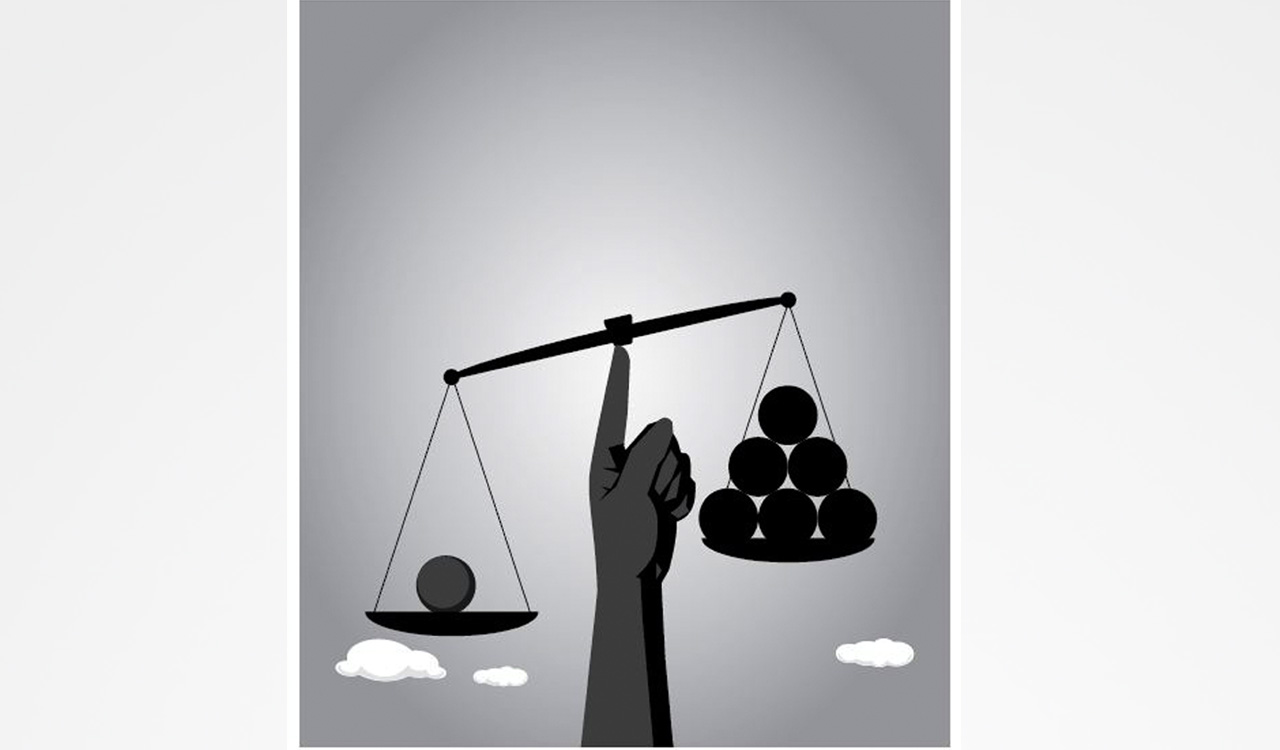
The discussion of dualism misses the broader democratic context and the role of the judiciary in it
Release Date – 12:45 AM, Thu – 29 December 22
by Nayakara Veeresha
The battle between the judiciary and the executive has reignited the debate over judicial appointments in the country. The fierce arguments and counterarguments attracted global attention, especially from prominent figures in the legal profession. The conflict is less about how judges are appointed and more about bringing transparency and accountability to the existing (collegium) or proposed system (NJAC). The current discussion of binary classifications—academies versus committees—seems to miss the broader democratic context and the role of the judiciary within it.
Unlike the United States, India’s constitution takes a flexible approach to the separation of powers between the different institutions of the state. In Asif Hameed v State of Jammu and Kashmir reported in AIR 1989 SC 1899, the Supreme Court stated that
Although the doctrine of the separation of powers is not recognized with absolute rigor in the Constitution, the framers of the Constitution have carefully defined the functions of the various institutions of the state…No institution can usurp the functions assigned to another institution…Democracy depends on the functioning of each The strength and independence of organs…
The question of parliamentary sovereignty or legislative supremacy is a recent addition to the discussion, although the democratic principles and practice of judicial independence are well settled.
Institutional interaction
From a democratic perspective, it is crucial to understand the interaction between the legislature and the judiciary. Describing the dynamics and subtleties of this interaction is crucial to understanding institutional interactions in functional democracies. The relationship between the two variables in the structure-function framework is crucial to explain the processes behind this battle between the two institutions of the state. Understanding the dialectical interactions between the different agencies of government is critical to the healthy functioning of a democracy. Any governing body in a democracy is immune to criticism because the people are supreme and the only source of legitimacy. In this context, the collegiate system is the law of the land and derives its legitimacy from judicial decisions.
However, our Framers were aware of these future developments, and so nearly all institutions were left open for further development or reform. The constant stream of constitutional amendments is evidence of this testimony.in case of dispute Griswold v. Connecticut, 381 US 479, 501 (1965), Justice Harlan said judicial self-restraint was needed,
The “specific” clauses of the Constitution, no less than “due process”, are easily interpreted by judges personally, and their constitutional views are simple, allowing the Constitution to keep the so-called “advancing with the times”….
irresponsible independence
Whether it is the reform of the NJAC or the collegiate system, the discussion around these aspects is to ensure due process, and more importantly, to ensure the institutional arrangements or mechanisms of legal, especially judicial due process. The constitution does provide the governing framework for the country. However, it is politics that determine the form, shape and direction of governance. The judiciary is an integral part of the overall institutional arrangement of governance. The Supreme Court’s disapproval of giving access to the proposed NJAC, in which issues of transparency and accountability were incorporated while prioritizing judicial independence through an extraconstitutional academy system, was an important factor.
Recognizing that collegiality is superior to appointed committees made up of ruling and opposition leaders, including members of civil society, the court sidesteps questions of the logic of democratic representation, institutional soundness, and modus operandi. Ordinary citizens wonder how the Supreme Court misses including democratic voices and representation that are reasonable for the health of the democracy. Disapproval of NJAC’s actions and conduct can be attributed to undemocratic attitudes and approaches to governance reform. Even in most decisions in the NJAC case, the justices pointed to the need for transparency and accountability of the collegiate system and its operation.
Bowing to the pressure of majority politics and the fear of losing the legitimacy of the system as the executive agency of justice, the court in this case was unable to fulfill its constitutional duty (the law) and its organizational goals (justice). This amounts to questioning the will and sovereignty of parliament in the area of legislative competence. In the context of a democratic governance framework, the Court’s rollback in the NJAC ruling has exacerbated the democratic rollback, thereby contributing to the erosion of Montesquieu’s doctrine of the separation of powers. Democratic regression begins when any organ of state attempts to turn toward authoritarian or authoritarian governance, thereby deepening what is known as a policy crisis or failure of governance, as the Supreme Court has noted in several cases.
self-regulating justice
Emphasizing the need for judicial self-restraint, Frankfurter, J of the US Supreme Court in the case of Tropp v. Dulles, 356 US 86 observed
It must strictly abide by the limits of its own powers, which preclude courts from enforcing their own conceptions of what is sensible or political. This kind of self-restraint is crucial to honoring the judicial oath, because the Constitution does not authorize judges to pass judgment on what Congress and the executive branch do.
Democracy and governance are two sides of the same coin. There is a need to strengthen democracy to improve governance outcomes rather than shrink the same. Any institution in a democracy must be open to reform or change over time. This is all the more evident in the Indian socio-political context where the separation of power is very weak. Every institution of the state must strive to ensure democratic content and rigor and absorb it into every sector in order to achieve democratic robustness.

(PhD Fellow in Political Science, Institute for Social and Economic Change, Bangalore. Opinions are personal)
