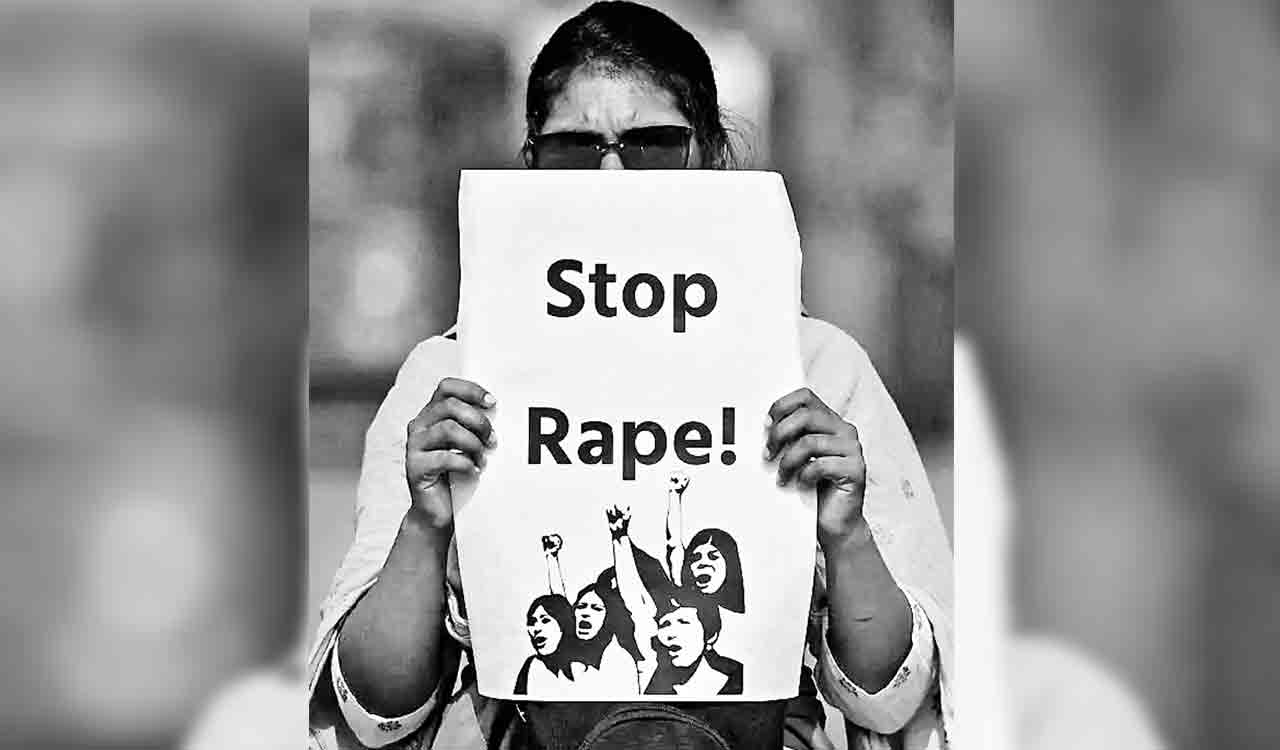
The center created deadly laws to punish rapists and also passed orders to forgive them
Release Date – 12:45 AM, Mon – 12 December 26

Arun Sinha
Have women been safer since popular outrage erupted over the looting of Nirbhaya in Delhi and the rest of the country a decade ago? In Delhi alone, in 2012, the year she was abused, 706 women were raped. In 2021, a year after four of her sexual predators were hanged, 1,969 women have been raped. Does it sound like women in Delhi feel more secure? Or is the long list of measures taken by the Delhi Police to protect women after Nirbhaya nothing more than a necklace studded with synthetic gemstones?
In 2015, the Delhi Police launched an app called “Himmat,” on which women can register to call or text the police in an emergency. The police will know where she is and come to her aid. Few women signed up because they found the app deaf and dumb. Police upgraded the app and renamed it “Himmat Plus,” but even that failed to attract many women to sign up.
invalid change
Of course, the Delhi Police has changed organizationally after Nirbhaya. It now has a special police unit for women and children, housed in a separate building. It has Crimes Against Women (CAW) teams in police stations. It has a women’s desk in every police station. It has a special women’s helpline and an anti-stalking helpline. These organizational changes may have made it easier for women to seek help from the police, but they have not proven effective in reducing crimes against them. Crimes against women in Delhi rose from 10,093 in 2020 to 14,277 in 2021, a jump of 41%.
One of the main reasons why crimes against women continue to surge not only in Delhi but in other parts of the country is the lack of honest professionalism in the police. First, the head is a political appointee. Despite the Supreme Court order, neither the central nor state governments have agreed to let police chief appointments be handled by autonomous organizations such as the Public Service Commission. Even the JS Verma committee formed after Nirbhaya strongly recommended a non-partisan choice for the police chief.
The hand-picked chief of police is a robot whose remote sits on the desk of the secretary of the interior. We saw what happened in September 2020 in Boolgarhi village, Hathras district, Uttar Pradesh. A 19-year-old Dalit girl went to a field to gather grass to feed her cows when she was caught and gang-raped by four high-caste men. The police first refused to register the FIR. She died two weeks later in a Delhi hospital. Police cremated her body without the family’s presence or consent.
Two years later, Uttarakhand police cremated the body of a 19-year-old girl who was allegedly murdered by the son of a BJP leader who owned the resort, in the absence of her family. Police destroyed vital evidence by tearing down a resort where the defendant allegedly “provided” women to its “VIP” guests and asked the girl who was his receptionist to be one of them.
After Nirbhaya, some laws related to crimes against women were changed. A man can be jailed for three to five years for stalking (IPC section 354D) a woman. The law on rape (IPC section 375) was amended to include not only penile penetration, but any object or body part into a woman’s vagina, mouth, urethra or anus. Violators could even face the death penalty, as did the barbarians who brutalized Nirbhaya. The rape case will be heard in fast-track court.
worse and worse
Despite these amendments, crimes against women are on the rise not only in Delhi but across the country. Why? Because these amendments are intended to serve as a water cannon to extinguish public anger over Nirbhaya’s barbaric actions, not as the ultimate weapon to punish and deter barbarians. Much like the old laws, the new laws are kept in written codes. They are like unsheathed swords, hanging on the walls of the police station as decorations. How will looters stop preying on women unless the police run through town with swords unsheathed?
The police in the Hathras case did not even follow the basic law of registering an FIR. They did not arrest the accused for interrogation, even though the wounded victim was fighting for his life in the hospital. In the Uttarakhand case, the police took over the case four days after the discovery of the young woman’s body, four crucial days to allow the defendants enough time to destroy evidence. Police then dismantled the resort, where the events leading up to the victim’s death took place, destroying further evidence.
Bilkis Bano case
We have the Bilkis Bano case. How did the 11 defendants who gang-raped her get their sentences reduced? On the one hand, the Indian government enacted the death penalty law to punish rapists, and on the other hand, it issued an order to forgive rapists. What does the serious contradiction indicate? As the state touts its commitment to making women’s lives safer, it’s also working to make life safer for predators. This country is feminist in theory and misogynistic in practice.
Warn women in India that the fight against violence against them will be very long. Because the state—an alliance of politicians and police—pursues where political and personal interests lie, not where social interests lie. Monsters are not necessarily relatives of politicians, as in the case of Uttarakhand. They could be ordinary people like Bilkis Bano’s rapist who can influence the vote. They may be from the upper caste who voted for you, like in Hathras.
In a system where the police are not independent and unprofessional, female tormentors and attackers can easily find protectors in politicians—a sarpanch, a mayor, an MLA, a congressman, a ministers – they can influence the investigation process and weaken the case. They are also helped by their social environment. After all, India is still a man’s world. Men can find the sympathy and support of men everywhere – in the home, in society, in the workplace, in the medical profession, in political parties, in the police, you name it.