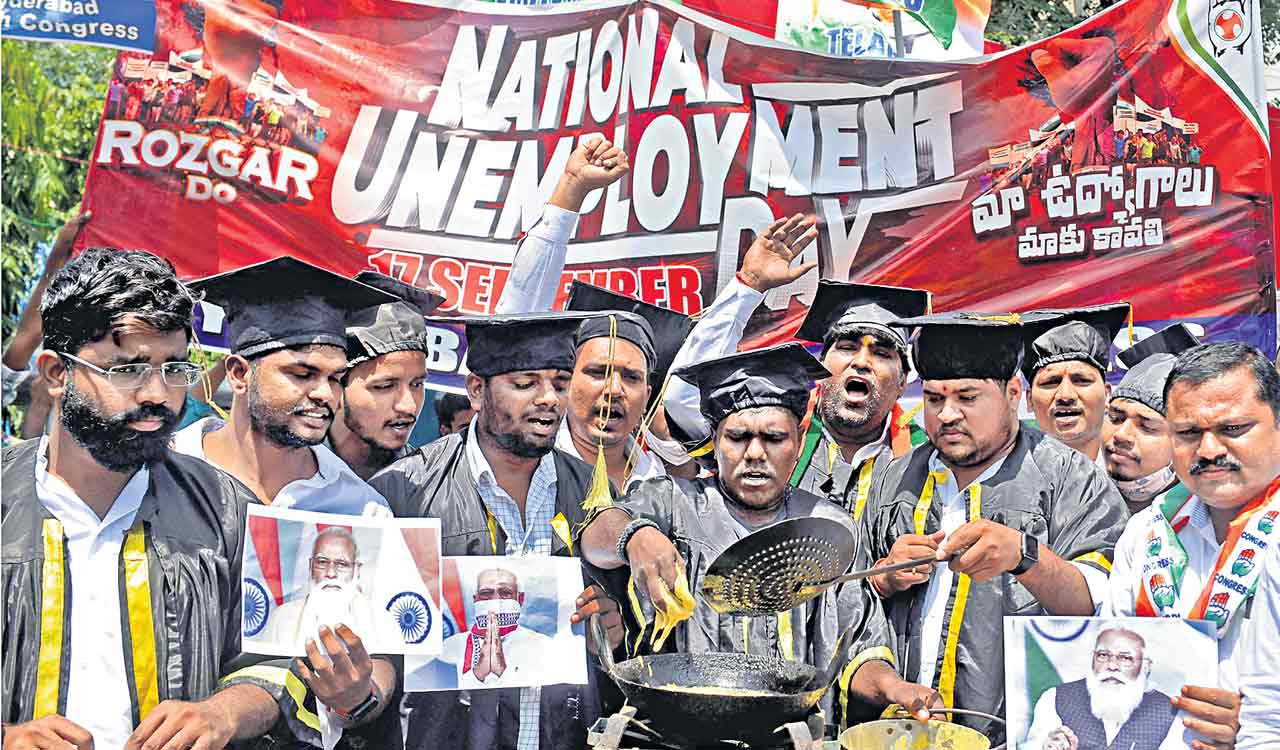
Rather than transforming manufacturing from capital-intensive to labor-intensive, the government is obsessed with appearances
Posted Date – Mon, 5/29/23 at 12:45pm

Arun Sinha
Hyderabad: Remember Asha Bhosle’s classic song “Padhoge likhoge hoge nawab/Jo kheloge kudoge hoge kharab” from the 1958 movie “Malick”? It has a simple message to the children of newly independent India: Education is the path to a good life. In India today, millions of educated youths are discovering that this is not the case. In order to make a good living, they must have a good job that pays well, and they just can’t find it anywhere. The more educated you are, the less likely you are to find a job. According to Azim Premji University’s Center for Sustainable Employment, the unemployment rate for graduates and above is three times the national average.
No wonder the educated unemployed are desperate. They and their families invest a lot of money and time in education. They want to start making money. Something is better than nothing. As a result, they apply for jobs that require far less education.
strange paradox
In 2018, Uttar Pradesh police advertised for 62 positions as phone couriers, who transport documents by bicycle from one police station to another. Anyone who passes the fifth criterion is eligible. As many as 93,000 people applied. The selection committee was appalled to find out that there were 50,000 graduates (even BTech), 28,000 postgraduates (even MBA) and 3,700 PhDs. In the same year, the Railway Recruitment Board announced about 63,000 vacancies for “tier one” jobs – the lowest level, including jobs such as journeymen, janitors and porters – with tenth-level qualifications. As many as 1.9 million people applied, most of them graduate and graduate students.
In 2019, 12 out of 13 waiters selected by the Maharashtra government canteens were graduates. The minimum qualification is the fourth standard. Jobs include chopping vegetables, wiping tables, washing dishes and sweeping floors.
Why are the better educated driving the jobs of the less educated in droves? Because there are not enough jobs. We live in the paradox of an expanding economy but shrinking employment. According to a joint study by the Center for Monitoring the Indian Economy (CMIE) and the Center for Economic Data and Analysis (CEDA), manufacturing employment plummeted from 5.1 million to 2.7 million, a drop of nearly 50 per cent in 2016-17 and 2020-21. Worse, most of the job losses have occurred in labour-intensive industries such as textiles, construction materials (such as tiles) and food processing. Jobs in the textile industry fell from 1.26 million in 2016-17 to 5.5 million in 2020-21, and jobs in construction materials companies fell from 1.14 million to 4.8 million.
wrong direction
The experience of Western countries is that when the economy grows, the labor force permanently shifts from agriculture to manufacturing. But in India, it’s the opposite. Manufacturing labor is returning to agriculture. The CMIE-CEDA study found that agricultural employment increased over the four-year period from 2016-17 to 2020-21. Those working in agriculture include not only the uneducated but also the educated who are out of work or laid off by manufacturing.
It is clear that the Indian economy is heading in the wrong direction. It is not becoming more labor-intensive (more labor, fewer machines) as the economy of a country with the largest ocean of labor in the world has become, it has become more capital-intensive (more machines, fewer workforce). Neither the UPA nor the NDA governments have done anything to reverse this direction over the past two decades as GDP has been growing. After all, investment increases GDP. Even “Make in India” and “Production-related incentive schemes” encourage capital-intensive manufacturing.
However, GDP is not everything. The joy of India’s race to become one of the world’s fastest-growing economies cannot mask the deepening sadness over the country’s jobless growth. What’s the use of economic growth without people growing? Nearly half of India’s population is under the age of 25. According to the Wall Street Journal, 1.2 million Indians join the labor force every year, but only 5.5 million find jobs. According to the Periodic Labor Force Survey, the youth unemployment rate in the 15-29 age group was 25.5% in the April-June 2021 quarter. India’s young population – known as the demographic dividend – is said to be a boon. But that benefit could turn into a curse if the economy doesn’t create jobs for youth.
dealing with unemployment
What is worrying is that instead of changing the manufacturing process from capital-intensive to labour-intensive and thereby creating enough job opportunities for young people, the government has been obsessed with appearances. For example, it announced in mid-2022 that it would recruit 1 million youth across its ministries over the next year and a half. In a country where more than 10 million people will be looking for work from mid-2022 to the end of 2023, even offering government jobs to 1 million of them in that period won’t ease unemployment, despite the large number of people who lost their jobs in previous years The same is true for the next few years. Public employment cannot solve the country’s unemployment problem, only private employment can.
This is the four-pronged strategy that India must follow to effectively tackle unemployment. First, governments must adapt their policies and incentives to encourage labor-intensive industries (such as textiles, clothing, leather and footwear, food processing, wood manufacturing, and furniture). In May 2023, the government also announced the PLI scheme for labor-intensive industries, which is a good step.
Second, the government must make its skills training program – Pradhan Mantri Kaushal Vikas Yojana (PMKVY) – really meaningful. The review found significant deficiencies in PMKVY’s training and placement.
Third, industry must share responsibility for skills. Companies like Google and IBM run their own training programs to acquire the skills they need. Indian industry must do the same.
Fourth, education must serve as a bridge between the school/college and the workplace. Curriculum must be career-aligned and integrated with work-based learning.