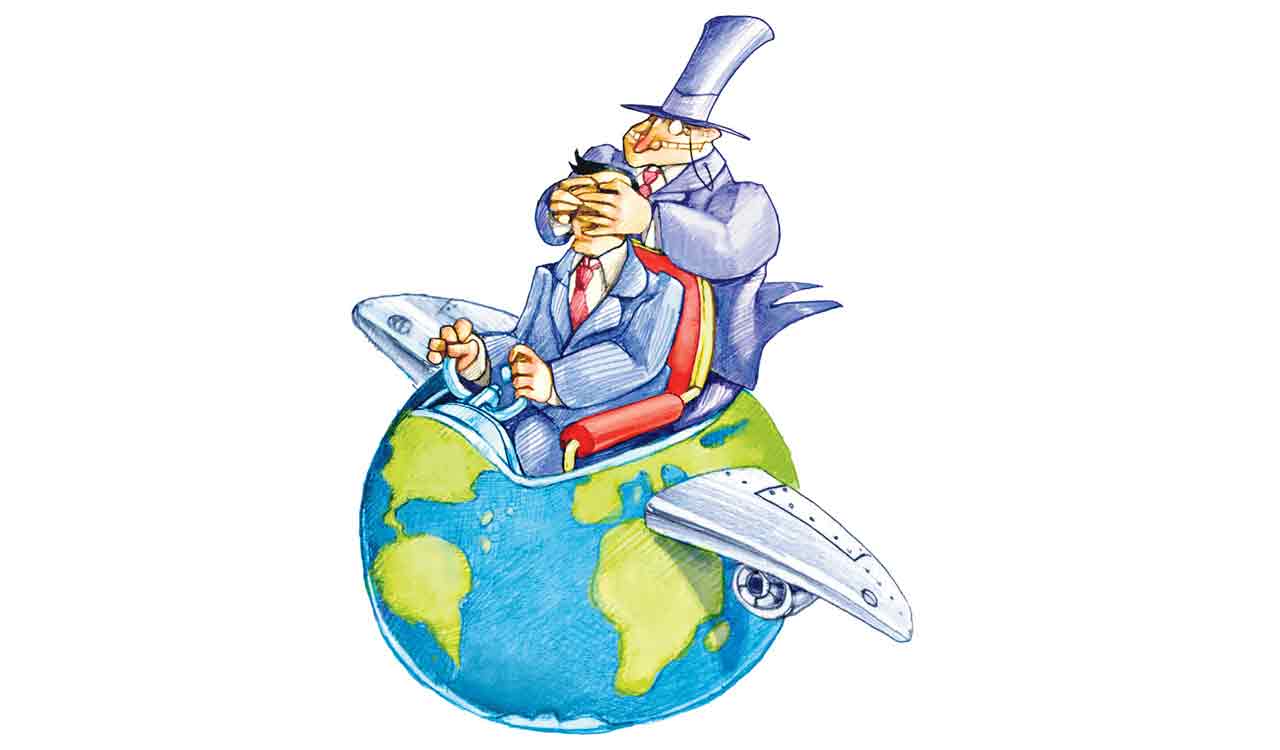
Not only has the idea of democracy been derailed, but so has the ideals upon which the modern state rests.
Post Date – 12:45 AM, Mon – 2 January 23

by Samudrala VK
With the world grappling with a major health crisis on the one hand and income inequality of unimaginable scale on the other, economic doomsday looms, and political institutions around the world must rethink pervasive socioeconomic and political strategies.
Peace, cooperation, harmony, liberty, equality, well-being, happiness, are the oaths that modern political entities make to their citizens in order to attain sanctity to rule. Sadly, with the advent of neoliberalism, not only the idea of democracy, the means to achieve and sustain the above, has been derailed, but also the ideals on which the modern state (political authority) rests and the values it guarantees.
leave a mark
As a derivative of capitalism, neoliberalism emerged at a time when corrective measures in the postwar world economy were seen as threatening the core principle of capitalism – the accumulation of capital or profit. Since then, neoliberalism has left its mark on every aspect of human life. Simply put, it is a ghostly force that seems inescapable, leading, directing, controlling and directing every move of human life.
Although neoliberalism started as a measure of a purely economic nature, it soon found its way into the political, social, cultural, private and psychological spheres. As the saying goes “every cloud has a silver lining” and “a blessing in disguise”, Covid-19 acts as an external force to destabilize the foundations of neoliberalism and expose neoliberalism to a largely uninformed and unknown population fundamental flaw. It compels intellectuals as much as seamen to articulate key aspects of this invisible but ubiquitous neoliberal empire.
Neoliberalism, hailed by its pundits or supporters as an unchallenged political and economic philosophy, is now damaging the physical and mental health of the working class around the world. One might wonder what constitutes neoliberalism and how it diverts from the real purpose of human life. Let’s dig a little deeper.
political and economic front
Neoliberalism demands that the role of the state be minimized in the economic sphere, that is, the state should be prohibited from participating in activities that necessarily benefit the working class. Ironically, it uses the same country to advance the economic interests of a few at the expense of others. Apparently, it looks flawless because it is masked by the veneer of political democracy.
It denounces welfare and social security measures under the guise of draconian measures. It developed and propagated a rather anti-welfare narrative, albeit untraceable in nature. It is this possibility of tailoring discourse to its whims and fantasies that makes neoliberalism clearly an “all is well” political philosophy. It breeds an environment in which freebies or subsidies are seen as unforgivable crimes that a modern state can commit.
Neoliberalism weakens the state’s weapons against its interests and strengthens the institutions it believes help expand its reach. Unbalanced development policies contribute to social and economic inequality. Vested interests of corporations, bureaucracy and the political class overshadow those of the ruled. It is important to understand that neoliberalism gradually plunders the economic and social rights of the working class, which can only be realized after round after round of struggle.
cultural narrative
Competition, ownership and possession are integral elements of neoliberal culture. In neoliberalism, competition among individuals is seen as a harbinger of progress. It forces individuals to live in a false reality filled with myths and fantasies, thereby undermining the true purpose of life. The tendency to accumulate wealth can dilute human emotions and feelings. Cooperation and compatibility are considered dirty words. “Live for yourself” will be replaced by “love for the market”. The social status of individuals is closely related to brands and commodities, which in turn breeds consumerism. Belief systems are designed in such a way that out-of-the-box thinkers are humiliated, controlled, and bullied. Material needs and desires invade people’s brains.
social obligation
As countries abdicated their obligation to provide decent living conditions for their citizens, corporations and private lobbies stepped in, banking on financial opportunities on their doorstep. Citizens are forced to buy their services at the cost of real happiness, and sometimes their lives. Health, education and other aspects become too expensive. Debt traps became commonplace. Citizens are forced or persuaded to purchase insurance policies due to concerns about affordability and accessibility. Most importantly, given the scale of inequality, it is absurd to conclude that GDP figures in modern economies reflect the real conditions of people’s lives.
In neoliberalism, people’s wants, wishes, and needs are predetermined rather than based on necessity. Religion and education will be used as lubricants to maintain its profit engine. Academic education becomes a mundane and monotonous exercise. The curriculum becomes rotten, leaving no room for free, critical and creative thinking. Fear of failure takes over the minds of young people. The arts and humanities took a back seat. As a result, it corrupts young minds with comparisons, compulsions, and bad competition. The long-standing neoliberal environment has provided fertile ground for new trends in stereotyping and stigma, which in turn undermine not only social capital but also creative capital.
Covid-19 offers the modern state an opportunity to change its perception of neoliberalism. If left unchecked, neoliberalism can become dire to the point of killing the sources at which it is directed. It is time to examine the inherent and inherent flaws of neoliberalism, at least in order to save its parent – capitalism.