

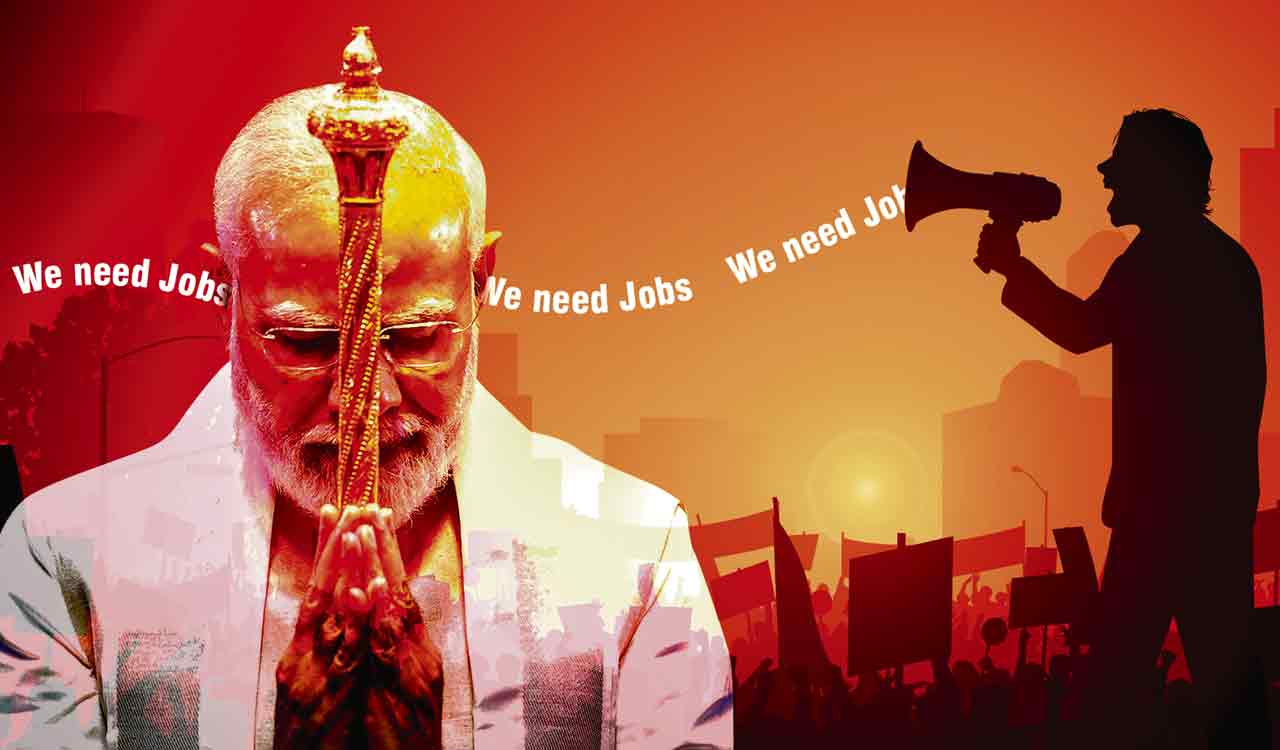
Still no sign of Modi government having any sweeping thoughts on job creation
Posted on – Thu, 15 Jun 23 at 12:45am

Amitava Mukherjee
Comments should describe the sentiment of the reviewer. Maybe India doesn’t have the type of commentator like Walter Lippmann, but we have guys like Nikhil Chakravartty, KR Sundar Rajan, BG Verghese and TVR Shenoy who always try to come forward. Their worldviews may not be the same, but their columns express reason and sound judgment.
So we have every reason to be taken aback when we read a widely circulated English-language daily that attempts to compare Jawaharlal Nehru to the recent events at the newly built Capitol. The background is the installation of Sengol representing the symbol of the Chola era at the New Capitol. This article attempts to make an argument that Nehru also participated in Hindu religious ceremonies at the dawn of independence despite his support for the secular character of the newly independent state. But this article can’t understand the heart of India’s first prime minister at all.
colonial ruling?
History is full of evidence that Congress had a powerful Hindu conservative lobby, which Nehru had struggled to achieve his own progressive secular ideals and plans. For him, the real pantheon is the steel mill, power station and multi-use river valley project proposed in the five-year plan. To try to equate Nehru with Narendra Modi’s grateful acceptance of Sengol is absurd.
What is the need to build a new parliament building at an astronomical cost? We don’t yet know why. The old Capitol remains intact. Is there any evidence that parts of the building are falling off? No, is it structurally fragile? The building was delivered to our country by the British in 1927. Concrete structures weaken at a faster rate only in monsoon regions. Now Delhi is not such an area. Therefore, any certificates issued by some “experts” that the building is structurally weak should be taken with a grain of salt.
Does Narendra Modi want to get rid of symbols of colonial rule? Well, there are many other avenues – two of the most important being separate foreign and economic policies. The Old Parliament House provides 543 accommodations for the Lok Sabha and 250 accommodations for the Rajya Sabha. The Lok Sabha will have 770 seats and the Rajya Sabha will have 530 seats. Does the BJP government want to increase the number of MPs in both houses? What good is it for other than wasting more money by giving all kinds of perks to more MPs? What is the quality of debate in our parliament?
urgent need
So, what does the country need at this critical juncture? This is employment for our unemployed youth. This is a critical area. Threat to our social stability. Why? Because we are now the most populous country on earth. Demographic experts, economists and politicians, most of them unrealistic, applaud India’s “demographic assets”. They praise the dynamism of India’s working-age population compared with China’s aging population. But these experts miss a crucial point – the type of economy that China and India have each chosen.
red flag
Now let’s consider the red flags. People under the age of 25 make up more than 40% of India’s total population. But nearly 45 percent of them don’t have any jobs. In this regard, the views of Kaushik Basu, a professor of economics at Cornell University and former chief economic adviser to the Indian government, are very instructive. In an interview with CNN, Basu believes that the growth rate of India’s youth unemployment rate has been rising slowly for a long period of time, such as 15 years, but has been rising sharply in the past seven or eight years. Which government has been in power for seven or eight years now? This is the Bharatiya Janata Party government.
Unemployment is close to 8%, and urban unemployment tends to be higher. The International Monetary Fund predicts that India’s economy will grow by 6% this year. Even if it happened, the country would not benefit. We may witness further concentration of wealth in the hands of a few. It would be a mistake to hold Narendra Modi and the BJP alone responsible for this. The process was first initiated jointly by Congress under the leadership of PV Narasimha Rao and Manmohan Singh. Can today’s Congress claim that its economic policy differs significantly from that of the BJP?
Given the type of economy India is following under the BJP, controlling the increase in unemployment will be impossible. There is still no sign that the Narendra Modi-led government has any sweeping thoughts on job creation. One aspect is certainly healthy – the focus remains on the domestic market rather than boosting exports. But it needs to increase domestic purchasing power. For a happy ending, the contribution of the manufacturing and agricultural sectors to GDP would have to expand substantially, since it is here that jobs are created.
But India is now dominated by services. It only creates white collar jobs and a lot of unhealthy social and family development. In order to create more jobs in manufacturing and agriculture, social stability is necessary. But does India have a stable society now?
Politicians have a responsibility to answer this question.
