

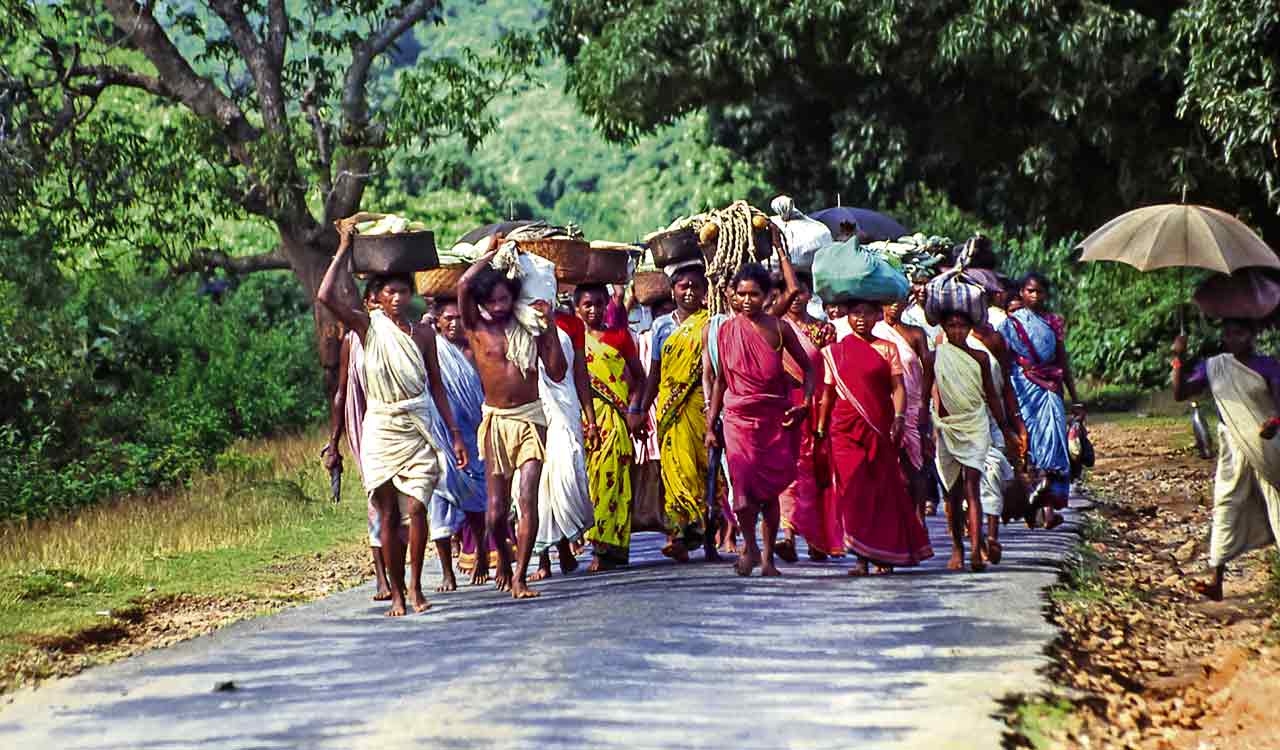
The center’s top-down tech solutions that make the program work are actually becoming barriers in tribal areas
Post Date – 12:30 AM, Wednesday – 4/5/23

by A Rajeshbabu
Hyderabad: The Mahatma Gandhi National Rural Employment Guarantee Scheme (MGNREGS) guarantees 100 days of employment per fiscal year to any adult member of a rural household who is willing to engage in unskilled manual labor related to public work. Tribes granted land rights under the Forest Rights Act of 2006 are eligible for an additional 50 days of paid employment under the program.
MGNREGS contributes directly or indirectly to the Sustainable Development Goals, namely SDG 1 (No Poverty), SDG 2 (Zero Hunger), SDG 3 (Good Health and Well-being), SDG 5 (Gender Equality) and SDG 8 (Decent World and economic growth). Scheduled Tribes are one of the most disadvantaged socioeconomic groups and MGNREGS has great potential to uplift them.
bleak scene
Despite the introduction of new technologies and initiatives, the current MGNREGS situation in tribal areas is still deteriorating. Previously, state governments had their own software to run the MGNREGS portals, but the central government brought all MGNREGS portals under the control of its National Center for Informatics. This has turned into a curse. Many tribal villages and settlements are mapped outside the NIC portal, leaving them unemployed, indicating that there are no such villages. However, previously, people were assigned to work in the same village.
Although the village is shown in the NIC portal, sometimes the tech assistant’s secure login doesn’t work. A secure login is a requirement for assigning work. After the gramma sabha is held to agree on the location and type of work, the field assistant estimates the shelf days for the job with the help of the technical assistant. This estimate is uploaded to the secure log and sent to the project lead for approval. Only after approval is obtained can work begin. Completed workloads are uploaded into secure logins for payroll purposes.
It’s also worth pointing out that earlier, in groups of 10-15 members, wages were not credited to those with inactive NPCI. But now, salaries don’t count towards the entire 40-50 member team, even if one has an inactive NPCI.
Five non-tribal areas require at least two field assistants. For tribal areas, at least one Field Assistant is required per village, where the average number of settlements is much higher and spread out over a much larger, less accessible area. Field Assistants must meet target man-days to be paid. They do their job by choosing nearby villages that have connectivity to reach their goals, which is why some villages lag behind.
low consumption
Tribes granted land rights under the 2006 Forest Tenure Act are supposedly guaranteed 150 working days, but the reality is quite different. Since the work card has not been renewed after obtaining the land rights, most farmers have not achieved 100-day work. It was also found that the grama sabhas were never held in the village which affected the estimation and allocation of jobs. If done, it is done at the block level and does not involve beneficiaries.
In 2013-14, administrative expenditures by states accounted for 10.63 percent of total MGNREGA expenditures, while in tribal areas the corresponding figure was as low as 1.88 percent. Such a low payout makes it nearly impossible for field crews to implement the program properly.
These challenges can be eliminated by taking the right measures through proper government management. For example, in 2019, Andhra Pradesh launched a volunteer system where one volunteer from each village is assigned to 50 houses to better implement the state welfare program.
corrective steps
As tribal areas are scattered, connecting volunteers with MGNREGS will benefit the people. Volunteers and principals should take on the responsibility of demanding work on behalf of the people. They should add the name of the person over 18 to the job card.
Jobs are supposed to be available during the monsoon season, and it is often seen that during the monsoon season, people in non-tribal areas work in other agricultural fields for wages. However, tribal peoples form a community and work for free on each tribe’s agricultural land. Incorporating this work into MGNREGS will be a great opportunity for the Tribe to achieve 150 days of work. Grama Sabhas should be held four times a year in each village before the work is estimated and distributed.
A related issue concerns social auditing. Social auditing empowers and entitles people, which is indispensable in tribal lands. Here special procedures are required for auditing. This again has a lot to do with the ecological structure of the tribal areas. If a social audit team takes four hours to reach a given gram panchayat, it means that there is not much time left for the audit procedure. In some cases, social audits are conducted from headquarters without any connection to the beneficiaries, thus losing the social component of the audit. Also worrying is the lack of access to official documents by social auditors.
Villages excluded from the NIC map must be included earliest. An inaccessible secure login results in zero achievements, this should be fixed. When one person does not have an active NPCI, the payment of salaries to the entire team should not stop. Feedback forms will help higher authorities know whether the work was done in true letter and spirit.
Scheduled tribes are by far the most marginalized group in India, often living in extremely remote places with minimal economic activity. In tribal areas, MGNREGS are an important security blanket against hunger and poverty, especially during crop failures. The unique ecological, social, cultural and financial circumstances of tribal areas must be considered.
MGNREGS achieves a variety of beneficial goals including promoting economic security, empowering rural women, revitalizing gram sabhas, protecting the environment, preventing forced displacement, generating valuable assets and promoting social equity. The central government is tackling enforcement issues through top-down technological solutions such as digitization, electronic registers, Aadhaar-enabled payments and geo-tagging. Addressing these issues is necessary but not sufficient because the reality is quite different, especially in tribal areas.
