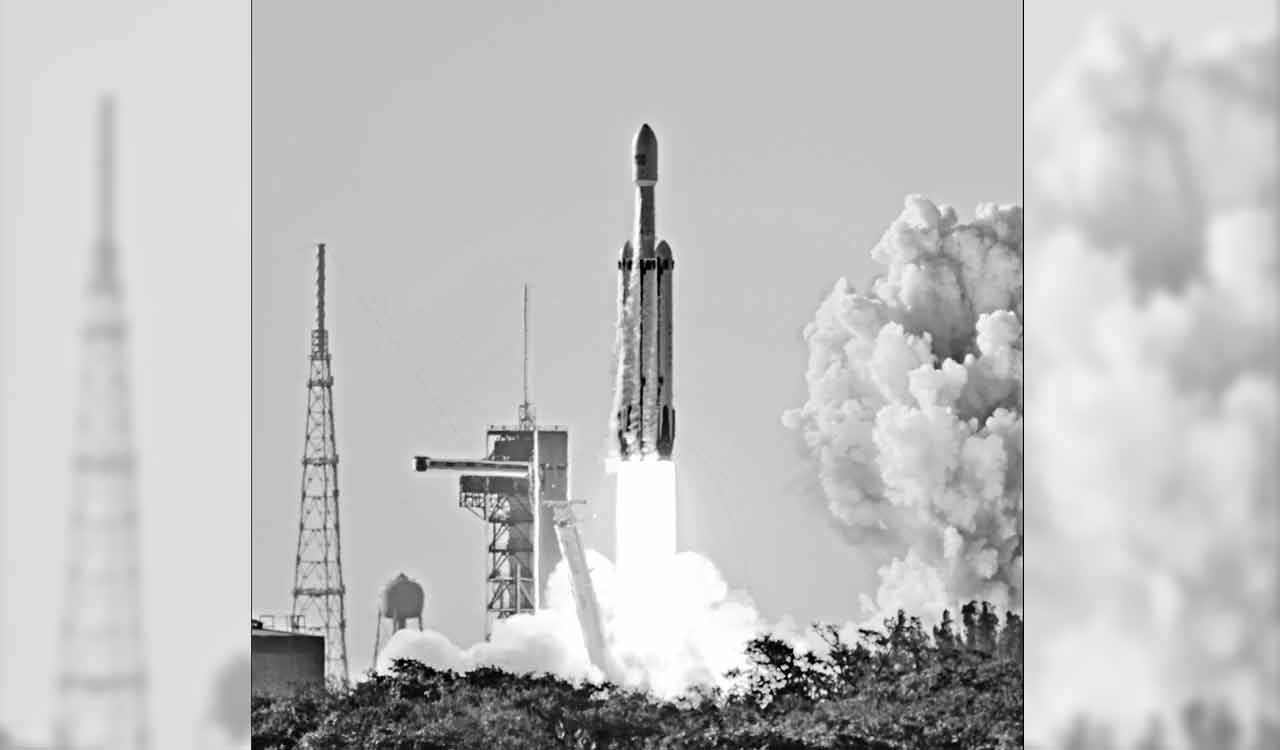
calling it a race means that the US and China are roughly equal in capabilities, but in most key areas the US is far ahead
Posted on – Friday, 4/14/23 at 12:45pm
Svetra Benyizak
Hyderabad: After many exciting launches in recent years, headlines announcing the rise of a new “space race” between the United States and China have become commonplace in news coverage. Experts pointed out that China’s rapid progress in the space field proves that China is directly competing with the United States for hegemony.
This idea of a US-China space race sounds convincing given the broader narrative of China’s rise, but how accurate is it? As a professor of space and international relations, my research seeks to quantify the power and capabilities of different nations in space. When I look at capabilities, the data paints a much more complex picture than the intense space race between the US and China. For now, at least, the reality looks more like what I would call a complex hegemony—one country, the United States, that still dominates key space capabilities, and a strong network of partners extends that lead even further.
boring game
Calling the current situation a race means that the capabilities of the United States and China in the space domain are roughly equal. But in several key areas, the United States is far ahead not only of China, but also of all other spacefaring nations combined. Start with spending: In 2021, the U.S. space budget is about $59.8 billion. China has been investing heavily in space and rocket technology over the past decade, doubling its spending in the past five years. But with an estimated $16.18 billion budget for 2021, it still spends less than a third of the U.S. budget.
The U.S. is also far ahead in terms of the number of active satellites. Currently, the total number of satellites in orbit around the Earth is 5,465. The United States operates 3,433, accounting for 63% of them. In comparison, China has 541. Likewise, the US has more active spaceports than China. With seven operating launch sites at home and abroad and at least 13 spaceports under development, the United States has more options for launching payloads into various orbits. China, by contrast, has only four operating spaceports and two more planned, all within its own territory.
Parity with Nuance
While the United States may have clear advantages over China in many areas of space, in some respects the differences between the two countries are more subtle. For example, in 2021, China attempted 55 orbital launches, four more than the US’s 51. The totals may be similar, but the rockets put very different payloads into orbit. The vast majority (84%) of Chinese launches had government or military payloads, primarily for electronic intelligence and optical imaging. Meanwhile, in the U.S., 61 percent of launches were for non-military, academic or commercial purposes, mostly for Earth observation or telecommunications.
The space station is another area where important differences lurk beneath the surface. Since the 1990s, the United States has operated the International Space Station in cooperation with 14 other countries, including Russia. The International Space Station is quite large, with 16 modules that have driven technological and scientific breakthroughs. But the ISS is now 24 years old, and participating nations plan to retire it in 2030.
The Chinese Tiangong Space Station is a new addition to the neighbourhood. Construction won’t be complete until late 2022, and will be on a much smaller scale – just three modules. China built and launched all the different parts of the station, and although other countries have been invited to join, it remains the sole operator of the station.
In a report released in August 2022, the Pentagon predicted that China would overtake the United States in space capabilities as early as 2045. However, as the United States continues to increase its funding for space, it is unlikely that the United States will stand still.
force multiplier
A major difference between China and the United States is the nature and amount of international cooperation. For decades, NASA has cultivated international and commercial partnerships in everything from developing specific space technologies to sending humans into space. The US government also signed 169 spatial data sharing agreements with 33 states and intergovernmental organizations, 129 with commercial partners, and 7 with academic institutions.
China also has allies that help in space — most notably Russia and members of the Asia-Pacific Space Cooperation Organization, including Iran, Pakistan, Thailand and Turkey. However, China has fewer collaborators and far less developed space capabilities.
The effort to return to the lunar surface well highlights the differences in allied support and synergy. Both the United States and China plan to put humans on the lunar surface and establish lunar bases in the near future. These competing lunar goals are often cited as evidence of a space race, but they vary widely in partnership and scope.
In 2019, Russia and China agreed to jointly land on the moon by 2028. Russia is contributing its Luna lander and Oryol manned orbiter, while China is improving its Chang’e robotic spacecraft. Their future international lunar research station is “open to all interested parties and international partners,” but so far no other country has committed to participating in the Chinese and Russian efforts.
In contrast, 24 countries have joined the U.S.-led Artemis Accords since 2020. The international agreement outlines the principles of mutual cooperation for future space activities, and through the Artemis program, the specific goal is to return humans to the moon by 2025, and establish a lunar base and a lunar space station soon thereafter.
more competitors
While China looks like the United States’ main competitor in space, other countries have space capabilities and ambitions that rival China’s. India spends billions of dollars in space and plans to return to the moon in the near future, possibly with Japan. South Korea, Israel, Japan, the United Arab Emirates, Turkey, Germany and the European Union are also planning separate moon missions. Japan has developed impressive space technology capabilities, including rendezvous and docking approaches to send spacecraft to asteroids and bring samples back to Earth, that rival or even surpass China.
In the past, the space race was about who could reach the stars and return home first. Today, the goal has shifted to surviving and even thriving in the harsh space environment. I believe that, despite its decisive lead, the United States is no surprise that it has partnered with other nations to get to the moon and beyond. China is doing the same thing, but on a smaller scale. The picture that emerges is not a “race” but a complex system, with the United States as the leader working closely with a broad network of partners. www.theconversation.com