

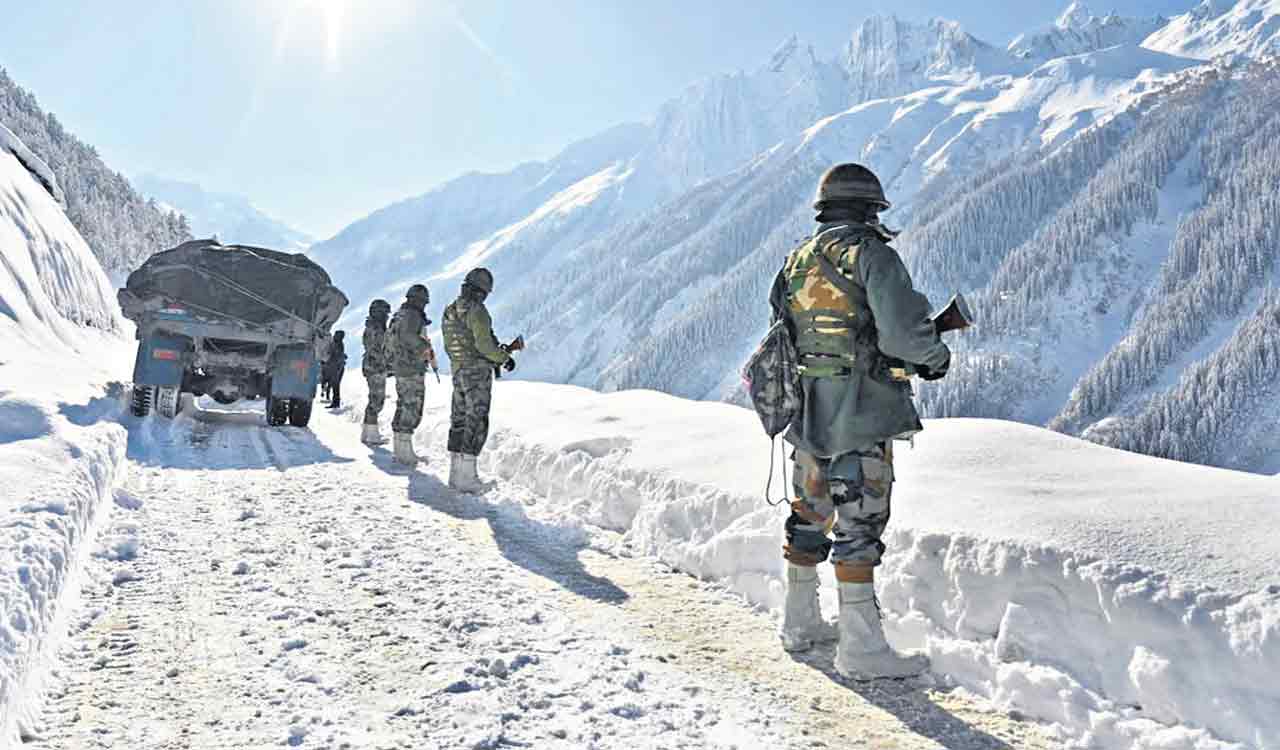
There are enough signs that Beijing is keeping the gunpowder dry on two fronts in the northeastern Himalayas.
Post Date – 12:52 AM, Mon – 12 December 22

Amitava Mukherjee
Hyderabad: China’s latest gesture in the Tawang area of the Line of Actual Control (LAC) casts the specter of menace across northeastern India. Some commentators have suggested three reasons why China is pushing for the attempt.
The first is Beijing’s interest in discrediting India after it assumed the G20 presidency and was preparing for the next summit. The second is Beijing’s implicit message to India to drop its claim to Aksai Chin in lieu of undisturbed control of Arunachal Pradesh. The third is to openly threaten India, asking New Delhi not to become any part of the South Asia and Asia-Pacific axis dominated by the United States.
History revisited?
Whatever the actual reason, the security threat in northeastern India is real. There is a certain geostrategic similarity between what happened in 1962 and what might be happening today. If you go back in history, 60 years ago, China falsely accused Jawaharlal Nehru and the Indian government of playing a proxy game on behalf of the US and Western capitalist groups.
On the other hand, certain statements and actions of the Indian government did not help the matter. The US ambassador to India, JK Galbraith, was undoubtedly found to be meddling in India’s internal affairs. Moreover, New Delhi could have distanced itself from the Dalai Lama, even though it had given him sanctuary. In the current context, Beijing is taking an almost similar route to India’s role in the Asia-Pacific region, particularly New Delhi’s participation in the Quad (an informal strategic forum comprising the US, Australia, India and Japan).
imperialist mentality
But that doesn’t give China any right to do what it did in Ladakh or what it tried to do in Arunachal Pradesh. In the western section of the LAC, the Chinese Highway connecting Xinjiang and Tibet through Aksai Chin is now almost a fait accompli. So Beijing’s cannibalization of Arunachal Pradesh is nothing more than an imperialist mentality. It is rooted in Chinese history. And don’t forget the Yuan Dynasty, a euphemism for the Mongols who ruled China from 1271 to 1368 AD with their insatiable hunger for conquest and militarism. Or the Han Dynasty conquered northern Korea, Vietnam and Mongolia, and even reached Siberia. No such parallel can be found in Indian history.
Therefore, China’s suppression of the LAC is possible despite assurances by Lt. Gen. RP Kalita of the Indian Army’s GOC-in-C Eastern Command that the situation in the LAC area is stable. China will have its sights set on two specific regions – the Chumbi Valley on the India-China-Bhutan border and the Tawang district in Arunachal Pradesh. If China can widen Tibet’s Chumbe Valley by incorporating Bhutan’s large Doklam plateau, it would be suitable for large-scale military maneuvers. This valley is very close to the Siliguri Corridor, and China successfully advanced the Chumbi Valley enough to cut off the Corridor and isolate the entire Northeast of India from the mainland of the country. China did not resort to this tactic in 1962 because its control over Tibet was weak at the time.
Beijing’s strategy
This time there are enough signs that Beijing is keeping the gunpowder dry on two fronts in the northeastern Himalayas. It has trained batches of local militias composed of Tibetan youths in the Chunbi River Valley. The People’s Liberation Army (PLA) deploys them primarily in forward areas to take advantage of their knowledge of local terrain, language, and customs. Obviously, the purpose is to win the full support of the local people in the event of an all-out war with India on the Doklam Plateau and its surrounding areas.
China always views Sino-Indian relations from the perspective of international order, while India sees it as a bilateral issue. A large part of the difference in value judgments between the two countries stems from this factor. Xi’s third term as Chinese president is sure to create tension in Sino-Indian relations, as Xi is sure to judge Narendra Modi’s New Delhi government not just from a strategic standpoint – with which it has a very close relationship. Accord and the US-led axis – but also from the perspective of his own economic preferences.
Speculation is rife that under Xi Jinping’s third term, China will deviate from the mostly free-market economic policies it has pursued in previous years, with the state sector once again dominating. At the same time, Xi Jinping will surely see a close neighbor like New Delhi as an extension of the net of US hegemony near China’s backyard, providing more and more room for free market economic projects to operate.
Admittedly, India has maintained its balance and not bowed to US pressure as far as the Ukraine war is concerned. But for Beijing, that’s not enough. It has demanded more public support from India, especially on Taiwan. As far as its worldview is concerned, Beijing’s attitude is not democratic. It is overtly imperialist in nature.Therefore, Sino-Indian relations are unlikely to ease in the short term.
The PLA’s recent incursion into the Tawang region should be viewed in this light. The oft-repeated statement by the Indian government that large parts of the LAC have no demarcated borders, which the two countries view differently, does not explain the situation. Interestingly, there is ample evidence that China had already started ramping up its military preparations north of Tawang prior to the plundering of Ladakh’s Galwan region and continued to be active in the post-Galwan period.
(The author is a senior reporter and commentator)
