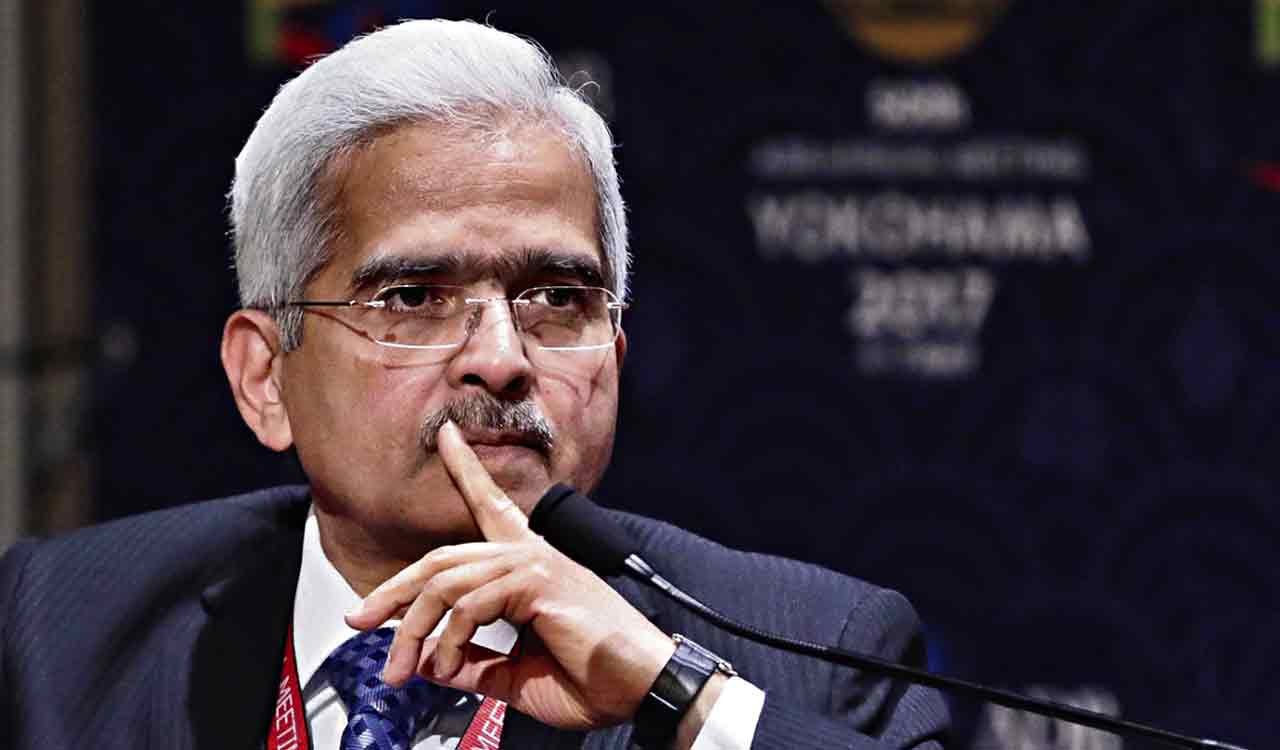
That may be one reason banks have shown no signs of stress in their loan books despite the central bank raising repo rates by 250 basis points since May last year
Posted on – Fri 06/23/23 12:45pm

By Dr. Seela Subba Rao
RBI Governor Shaktikanta Das recently addressed bank board directors, strongly opposing “smart accounting methods” to mask stress and inflated financial performance. The governor further added that the chairman of the board and the directors have a shared responsibility to ensure that corporate governance does not allow any loopholes in governance that would lead to a certain level of volatility in the bank.
He advised banks to be more cautious in pursuing growth strategies, pricing and portfolio composition. He further reiterated that bank boards and audit committees should check the propensity to show good profits through smart accounting and window dressing before approving bank financial statements.
financial health
The financial performance of the banking sector in Q4FY23 was really good. The overall after-tax profit of formal commercial banks is about 51%. Other parameters in the banking sector were also strong. Since its peak in 2020-21, the aggregate NPA (non-performing assets) ratio has halved to 4.7 per cent for public sector banks and 2 per cent for private sector banks, with fairly healthy loan provisions across banks.
A combination of factors, including the reopening of the economy after the pandemic subsided and a surge in demand for credit, has helped banks to some extent. Term commercial banks reported strong credit growth of 15.4% in FY2023, compared with 9.7% in FY2022. The growth was driven by personal loans as well as loans in services and agriculture and related activities. Margins in the banking sector improved, with net interest income up 28% in the last quarter of FY23, mainly due to slower pass-through of RBI rate hikes to bank deposits. Ample liquidity and a reduction in non-performing assets also help earnings.
Public sector banks have come a long way from a total loss of Rs 85,390 crore in 2017-18 to a profit of Rs 1,04,649 crore in 2022-23. Market leader State Bank of India announced a profit of Rs 50,232 crore for 2022-23, up 59% from the previous year. Likewise, net profit of private sector banks for the full year rose 23.3% from Rs 94,046 in FY22 to Rs 1,170,000 crore in FY23, according to data compiled by BS Research Bureau for 14 listed private banks. sector bank.
casting defamation
Despite strong growth in 4QFY23, the RBI is still smearing banks’ performance. In fact, there is some truth to Das’s assumptions and wishes. First, despite the central bank raising the repo rate by 250 basis points since May 2022, banks’ loan books show no signs of stress.
Second, since the outbreak, credit growth in vulnerable sub-sectors such as unsecured personal loans, credit card loans, and loans to small, medium and micro enterprises has been higher than other categories. Borrowers in these segments often struggle to meet their repayment obligations during periods of rising interest rates. Third, RBI inspections of these banks have uncovered instances where some banks have resorted to innovative ways of concealing the true status of stressed loans.
For example, persuading a good borrower to enter into a structured deal with a stressed borrower to conceal the stress, using internal or office accounts to adjust a borrower’s repayment obligations, renewing a loan or making new payments to a stressed borrower or related person / Additional loans. Entities close to early loan repayment dates. The central bank once encountered a situation where an evergreen method was pointed out by the inspection team and then switched to another method.
Under current regulations, commercial banks need to ensure that their balance sheets and profit and loss statements truly and fairly reflect their financial position. In addition, banks need to avoid under-provisioning, misclassification of non-performing assets, under-reporting/miscalculation of exposures/risk weights, incorrect capitalization of interest on non-performing assets, intentional inflation of assets and liabilities at the end of a financial year and subsequent write-offs immediately in the next financial year . Perhaps, there is some concern that they violated these instructions.
prescription
Needless to say, RBI should take action against banks if they use methods such as structured deals with stressed borrowers to hide bad loans, use internal accounts to adjust repayment obligations of borrowers, and issue new loans more closely to reality. necessary measures. repayment date. These practices pose a threat to the sustainability of the bank, whose true health may not be reflected in its balance sheet and income statement.
When conducting on-site inspections of the bank’s head office and some branches, the inspection team needs to carefully review the bank’s financial statements to check whether they have adopted whitewashing methods. Basically, the superficial inspection methods include asset verification and evaluation, non-performing asset provision verification, capital and income expenditure project verification and other gray areas.
From the point of view of calculating the correct profit and loss for a bank, the distinction between capital and reserve items is very important. The facade can be done by moving any capital expenditure item from the balance sheet to the income statement, showing it as a revenue expenditure. This reduces profits and vice versa. There is also a check to see if the revenue item is deferred revenue. There is also a check to see if the revenue item is deferred revenue.
Excessive growth in credit and deposits, underpriced or overpriced products, and deposit/credit portfolios that are too concentrated or insufficiently diversified can expose banks to heightened risks and vulnerabilities. Indian banks should take heed of the recent turmoil in US banking. Bank boards and audit committees should be cautious about fundamental issues such as asset-liability mismatches and excessive focus on profits and market capitalization.
If the RBI is indeed aware of such unethical practices, it would be in the interest of all stakeholders to end them by issuing stern instructions to the banks. Appropriate criminal action against banks under the provisions of the Banking Regulation Act 1949 may be considered if necessary.
India needs a comprehensive system of regulation and supervision of various banks, financial institutions and other financial services.
The Financial Regulatory Commission established in 1994, as a committee of the central board of the Reserve Bank of India, is responsible for comprehensive supervision of commercial banks and development financial institutions through its supervisory department.