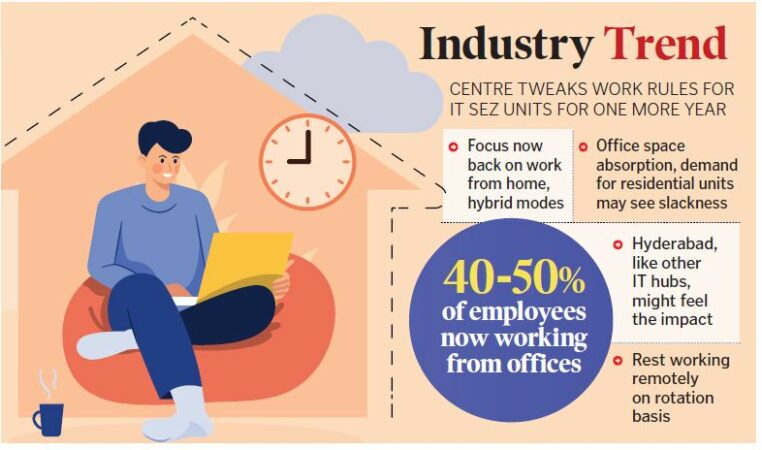
With the Indian government tweaking work rules for IT SEZ units for another year, most companies will delay their return to the office.
UPDATE – 10:32 PM, Sunday – Dec 11 22

representative image
Hyderabad: Most companies will delay returning to the office as the Indian government adjusts work rules for IT SEZ units for another year.
As a result, office take-up and corresponding demand for residential units may slow down. A full-blown rebound in the rental housing sector, which the industry hopes to materialize early next year, may also be delayed.
With hybrid work allowed for another year, companies may delay expansion plans as they go into wait-and-see mode. Like other IT hubs, Hyderabad may also feel the impact. Some deals will also be renegotiated, a real estate industry representative said.
Many people have chosen to work from home in the wake of the pandemic. About 40-50% of employees are now working in the office, while the remainder are working remotely in rotation. Many companies expect office headcount to increase from January, as earlier WFH norms end this month.
The Ministry of Commerce last week amended the Special Economic Zone Law to relax the work-from-home (WFH) rules for SEZ units. As in the previous case, WFH can be implemented without a license.
Industry body Nasscom called the change an important step in streamlining business procedures, enabling IT and business process management industries in SEZs to run flexible hybrid working models. According to the new regulations, until December 31, 2023, up to 100% of employees in special economic zone units can enjoy working from home.
Earlier this year, a new rule 43A was inserted in July to enable WFH for SEZ units. However, the industry needs greater flexibility. In a notification dated 8 December, the government said that in the wake of the disruption caused by the pandemic, hybrid working models have become the norm, especially in the IT/ITES sector.
Considering the needs of the industry and its benefits to Tier 2 and Tier 3 cities, the WFH rules have been relaxed. SEZ units can provide employees with laptops, desktops and other electronic equipment as needed.
“A very timely step. Thank you for simplifying SEZ rules,” CP Gurnani, MD and CEO of IT major Tech Mahindra, said in a tweet. He said the hybrid working model will ensure the best talent and best technology for IT and BPM industries, Indian and global clients.
“Most companies have already started looking into hybrid models. Working from home is definitely not easy for employees and companies. In fact, we should be looking for full jobs from the office, bringing back the shine of the IT industry, which helps both direct and indirect employment .Also, with the conversation around the recession, working in an office can give employees a better understanding of projects and jobs,” said Aswanth, vice president of human resources at Workfusion, of the industry trend.
Amarendra Sahu, founder and CEO of rental solutions company NestAway Technologies, said the hybrid work model is sending employees back to rentals as they have to take turns working in the office. He said rising home loan rates were also supporting the rental market.
Demand for flexible workspaces that support hybrid and distributed work is on the rise, according to Puneet Chandra, co-founder and director of managed office space provider Skootr. Businesses are increasing the proportion of flexible space and are redesigning places to accommodate hybrid work, he said.
“Companies are finding it difficult to get employees to work from the office. They are willing to let them work from anywhere. Also, some departments don’t actually require employees to be physically present at the office because if they have a connected system, they can manage work from anywhere.” . That’s what’s driving the mix of jobs,” said a real estate consultancy representative. He added that the demand for office space was not driven by SEZs but by non-SEZ units.