

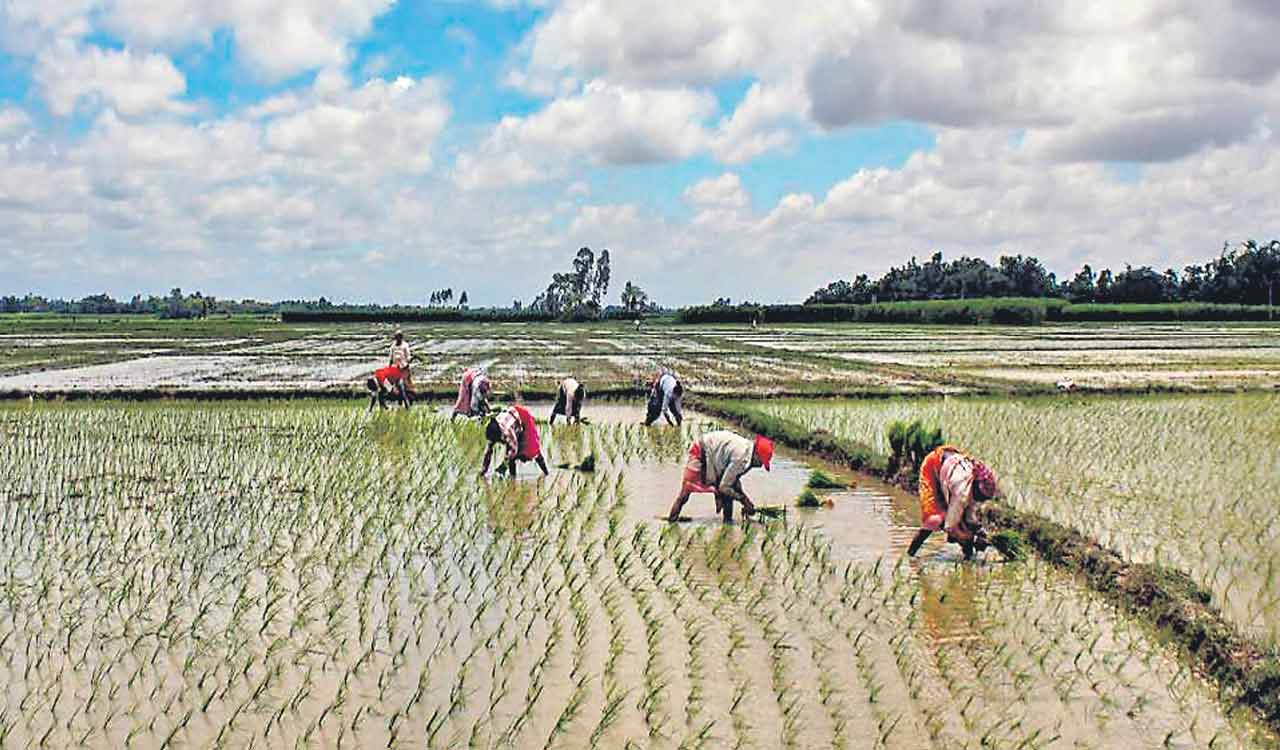
Involving the private sector in building value chains can be lucrative for both farmers and investors.
Post Date – 12:36 AM, Mon – 12 December 22

Arun Sinha
Hyderabad: The wall between the Modi government and Samyukta Kisan Morcha (SKM) is getting thicker. The government had hoped that with Modi’s address to the nation on November 19, 2021, promising to repeal three farm laws, the government would fall; it didn’t. It had hoped it would collapse when it was abolished by Parliament on November 29, 2021; it didn’t. It had hoped it would collapse with the announcement of the MSP (Minimum Support Price) committee on July 18, 2022; it didn’t.
SKM declined to join the committee, saying it had “so-called” farmer leaders who publicly supported the three farm laws. Regardless of the absence of SKM, the committee will continue its deliberations. It has held three meetings. SKM is promoting legally secured MSP. Committees meet indoors; SKM meets on the street.
no dialogue
The lack of dialogue between the government and SKM is not good for the country. Farmers are the backbone of agriculture. Agriculture is the backbone of the country’s economy. If farmers suffer, agriculture suffers; if agriculture suffers, so does the economy. Perhaps, since the peasant movement has dealt a minor setback to the BJP in recent elections, the government doesn’t care much about their voices anymore. This is a serious mistake. Farmers are the crew of the ship of agriculture. Unless they’re on board, the boat gets stuck.
The government is the management that sets the ship’s destination. It knows where the ship has to go. Even the farmers, the crew, knew where it was going. The two differ only in how they get there. The contest between the government and the Kuomintang and the Communist Party is one of convergence in goals and divergence in means.
The big near-term goal of the government and farmers is to diversify crops in the original green revolution regions – Punjab, Haryana and western Uttar Pradesh. Farmers in the region abandoned other crops (millet, beans, oilseeds) and started growing rice and wheat as the government lured them with guaranteed purchases at guaranteed prices starting in the 1960s. Rice and wheat cultivation, especially rice, drains the upper aquifer. Farmers sinking tube wells into lower aquifers to pump water only to take away metal pollutants that hinder the production of soil nutrients that have been depleted by the endless, Ghazni-like incursions of chemicals Supply exceeds demand to increase production.
The begging bowl nation is in dire need of food security, and farmers in Punjab, Haryana and western Uttar Pradesh, fueled by guaranteed income, are helping it achieve that. But one day, both see a nightmare that veils fantasy. Yields have stagnated, and with them farmers’ incomes. In the near future, water may become an elite commodity like silk, not just for irrigation but even for drinking.
In 2013-14, the central government launched a crop diversification program in the states of Punjab, Haryana and western Uttar Pradesh, with the aim of moving farmers away from rice to millet, pulses, oilseeds, vegetables and fruits, which do not erode Aquifer or soil. Crop diversification remains a central government program. But it hasn’t made any significant headway over the past eight years.
In Haryana, 20,000 hectares of rice have been replaced by cotton, accounting for only 1.5% of the total rice area. In Punjab, the state with the worst soil anemia among the three states, the program has not yet been launched. Not in UP either.
shy switch
The reason is obvious. Farmers are reluctant to switch to other crops. Their reluctance is based on some pragmatic reasons. First, rice brings them guaranteed sales and guaranteed income. Second, it brings higher income than other crops. According to official figures, in 2018-19 a farmer in Punjab earned around Rs 75,000 from paddy, but only Rs 26,000 from potatoes, Rs 15,000 from maize and 15,000 from grams per hectare. Take Rs 9,000.
Third, although the government has even set MSPs for 21 crops other than rice and wheat such as millet, pulses, oilseeds and cash crops, it has not procured them. Fourth, the government has over the years built an entire ecosystem for rice and wheat—MSP, technology, research, extension, procurement, processing—that does not exist for other crops in order to achieve its national food security goals.
The government cannot incentivize farmers to abandon rice unless they are willing to create a safe ecosystem for alternative crops to help them earn higher incomes. This is the heart of the confrontation between the government and SKM: SKM wants the government to create a safe ecosystem, starting with legally secured MSPs. A guaranteed MSP means that even private traders cannot pay farmers less than their produce. If farmers can expect guaranteed profits on other crops, they will diversify.
money first
The problem with the extremely pro-reform Modi government is that it wants to minimize public spending on agriculture and open up to the market. But you can’t build a safe ecosystem for crop diversification with less public investment. Not as much research has been done on developing high-yielding, pest- and disease-resistant, and climate-adapted varieties of beans, oilseeds, and millet than rice or wheat. You need funding to conduct research. One village may have a different soil type than another; so you need more extension workers to instruct farmers to plant other crops.
Public spending is needed to establish value chains for each alternative crop—from input supply to production, marketing, storage, and processing—and to encourage private investment. Only when farmers see that other crops are more profitable will they abandon rice. It is impossible to get more profit without value chain.
Governments must involve the private sector when building value chains. The government is erroneously trying to involve the private sector in agriculture and trade through the Agriculture Tripartite Act, threatening the survival of farmers. Instead, it must engage the private sector to create value chains that are lucrative for both farmers and markets. India cannot recast the country’s food bowl without satisfying both farmers and private investors.
(The author is an independent journalist and author of Standing Against the Minority: The Struggles of Rural India’s Poor)
